
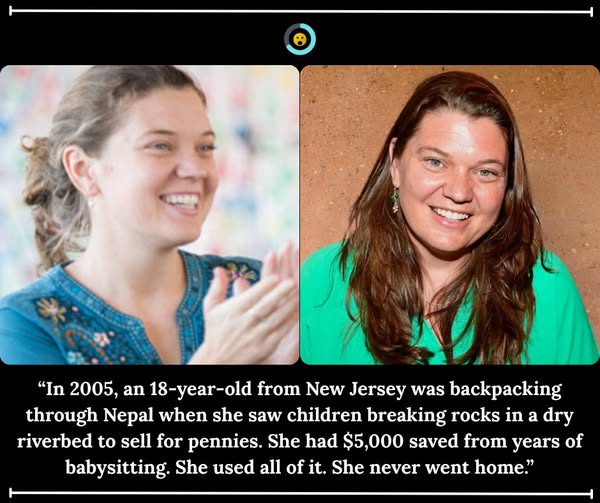
Other children came. The word spread through the Surkhet district that there was a home where children could be safe, fed, and educated. Maggie Doyne became a legal guardian, then a mother – eventually adopting several children as her own.
She also became a Nepali citizen.
She called home regularly. Her parents helped fundraise in New Jersey. Word spread in the United States. Small donations arrived. Then larger ones. She used every dollar directly – no administrative layer between the money and the children.
By 2010, the home had grown enough that she needed a school. The Kopila Valley School opened – not a temporary structure but a permanent, eco-friendly campus designed to serve the whole community. Teachers were hired. Curriculum was developed. Children who had been breaking stones in riverbeds were now studying mathematics and science.
The school grew to approximately 400 students.
In 2015, CNN named Maggie Doyne its Hero of the Year – the highest honor in the network’s annual recognition of extraordinary humanitarians. She received $1 million in prize money from Travelers and other sponsors.
She donated it all to the BlinkNow Foundation to fund the school’s expansion.
The BlinkNow Foundation now runs the Kopila Valley Children’s Home – where more than 50 children live permanently – the Kopila Valley School with 400 students, a women’s center providing skills training and microloans, and a health clinic serving the surrounding community.
Hima – the girl in the riverbed – went to school. She graduated. She went to university.
She became a teacher.
She came back to teach at Kopila Valley School – the school that was built with babysitting money, on land bought by a 19-year-old from New Jersey who watched children break stones and decided she had enough to do something about it.
Maggie Doyne still lives in Surkhet, Nepal. She is in her late 30s. The BlinkNow Foundation is still operating and expanding.
She never went back to New Jersey to finish the life she had planned.
She has said she doesn’t think about it as a sacrifice. She thinks about it as the life she found instead of the one she was supposed to live.
Share this with someone who needs to be reminded that the most important decision of a person’s life is sometimes made at a dry riverbed in Nepal with $5,000 in their pocket and no plan except to stay.