
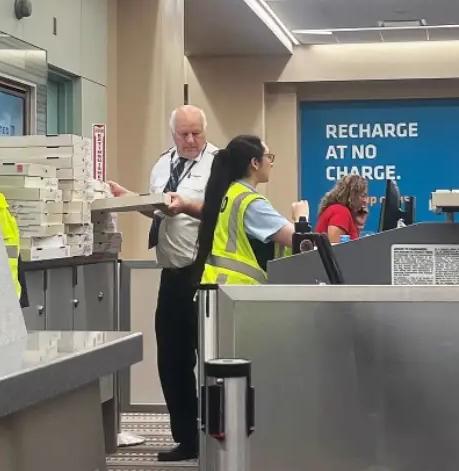
A man collapsed in an airplane bathroom. Seven hours later, 150 stranded passengers learned what leadership really looks like—and it had nothing to do with a uniform, a title, or a cockpit full of instruments.
It was Friday the 13th, September 2024.
United Airlines flight 2480 had taken off from San Francisco at 1:01 p.m., bound for Houston. A routine flight. About 150 people heading home, to meetings, to family, to the ordinary Friday night they had planned.
Then, somewhere over the American Southwest, a man collapsed in the bathroom.
Passenger Tanya Stamos noticed something odd first. All the flight attendants had quietly disappeared toward the back of the plane. Then the captain’s voice came over the loudspeaker, calm but urgent, asking if any medical professionals were on board.
Volunteers rose from their seats and disappeared into the back of the plane.
Minutes later, the captain was back on the intercom. They were making an emergency landing in Albuquerque.
At 4:15 p.m., the Boeing 737 MAX 9 touched down at Albuquerque International Sunport. An ambulance was already waiting on the tarmac. The sick passenger was rushed away. Every person on that plane said a silent prayer for a stranger whose face they had barely seen.
And then came the wall.
The medical emergency had eaten up precious time. The flight attendants had now exceeded the legal duty hours allowed by the Federal Aviation Administration. They could not fly. Until a replacement crew could be flown in from Chicago, the plane and everyone on it were stuck.
The new departure time: 10:30 p.m.
Seven extra hours in an airport. With children. With empty stomachs. With the slow, familiar sinking feeling every traveler knows when a small delay turns into a long one.
At 7:15 p.m., United finally issued meal vouchers to each passenger.
But there was a problem nobody had anticipated.
By the time the vouchers arrived, every single restaurant in the Albuquerque airport had already closed for the night. The vouchers were technically valid and completely useless. A hundred and fifty hungry people sat in a quiet terminal holding pieces of paper they could not spend anywhere.
The captain had a choice to make.
He could have stayed in the crew lounge. He could have called corporate and waited for them to figure it out. He could have shrugged and said, “I did my part—the vouchers were issued.”
He did something different.
He picked up his phone, called a local Albuquerque pizza shop, and ordered 30 pizzas.
Then he did something even more remarkable.
When the delivery arrived at the gate, he didn’t just drop the boxes off and disappear.
He set up a serving line.
He organized it, logically, by seat assignment—the only way that made sense for a group of people sitting together at a departure gate. He stood there in his captain’s uniform and personally handed a slice to every passenger who walked up.
When one box emptied, he cleared it away and replaced it with a full one. Row by row. Family by family. Stranger by stranger.
Tanya Stamos watched him work. “He stood there while everybody got pizza,” she later recalled, “and then when one box was empty, he took that box and replaced it with a full pizza.”
Only after all 150 of them had eaten did he finally make a plate for himself.
Hours later, when the replacement crew finally arrived and passengers began boarding, the captain stood at the entrance of the plane. He personally thanked each passenger as they walked past, shaking hands, making eye contact, treating them like people instead of seat numbers.
They landed in Houston in the early morning hours of Saturday.
Tanya posted a video to TikTok the next day. Her words were simple:
“Our pilot is absolutely amazing. He felt so bad for the situation that he ordered 30 pizzas from a local pizza shop and had it delivered right to our gate, then made sure all 150 passengers ate before he made himself a plate.”
The internet caught fire.
Not because the captain did something impossible. But because he did something so rare: he saw a problem, and instead of waiting for someone else to fix it, he quietly stepped forward and handled it himself.
Here is what this small moment at a quiet airport gate quietly teaches us about real leadership.
Leadership is not something that happens at 30,000 feet in a cockpit full of instruments.
Leadership is what you do when the instruments are off, the passengers are hungry, the system has failed, and everybody is watching to see whether the person in charge will hide behind policy or step forward and solve the actual problem in front of them.
This captain did not hide behind his uniform.
He did not delegate.
He did not say “that’s not my job.”
He solved the exact problem in front of him with the tools he had: a phone, a credit card, and a willingness to serve before being served.
Think about what he could have done instead.
He could have stayed comfortable. He’d flown the emergency landing perfectly. He’d followed every protocol. His technical job was done. The delay wasn’t his fault. The closed restaurants weren’t his responsibility. The replacement crew situation was outside his control.
He could have reasonably said: “I’ve done everything I’m required to do.”
But instead, he asked himself a different question: “What do these people need right now?”
The answer was simple. They needed food. They needed someone to care. They needed to see that in a system that had failed them repeatedly that day, at least one person was still thinking about them as human beings.
So he bought pizza. And then—and this is the part that matters most—he served it himself.
He didn’t send an assistant. He didn’t have someone else hand it out. He stood there, in his captain’s uniform, and personally gave a slice to every single person.
That’s not just kindness. That’s humility.
The willingness to do the unglamorous work. The willingness to be the most senior person in the room doing the most junior task. The willingness to let people see you serve them, not because you have to, but because it’s the right thing to do.
Most of us will never fly a plane.
Most of us will never stand in a terminal in our uniform holding pizza boxes.
But every single one of us will, one day, be the person in the room who can either say “that’s not my job” or quietly pick up the phone and fix what needs fixing.
When that moment comes—and it will come—remember the captain of Flight 2480.
Because real leadership isn’t about the title on your business card or the size of your office.
It’s about what you do when no one is making you do anything.
It’s about whether you wait for someone else to solve the problem, or whether you step forward and say, “I’ll handle this.”
It’s about whether you eat first, or whether you make sure everyone else is fed before you make yourself a plate.
The captain of Flight 2480 had every reason to stay comfortable that night.
He chose service instead.
And in doing so, he reminded 150 tired, frustrated, hungry people—and now millions more—that leadership isn’t complicated.
It’s just a choice. The choice to care. The choice to act. The choice to serve.
The next time you’re in a situation where something needs fixing and everyone’s looking around waiting for someone else to step up, remember:
Someone has to be the person who picks up the phone.
Someone has to be the person who organizes the line.
Someone has to be the person who serves before they eat.
That someone can be you.