
The year was 900 AD, and the air in Baghdad was heavy with the smell of woodsmoke, spice, and something far more dangerous.
Deep inside the Caliph’s palace, a group of advisors stood around a massive table, debating a problem that would define the health of the empire.
The Caliph wanted to build a great hospital—a Bimaristan—that would be the finest in the world.
But Baghdad was a sprawling, crowded metropolis of nearly a million people, and disease was a constant, invisible shadow in the narrow streets.
Where could they possibly build a place of healing where the air itself didn’t rot the patients from within?
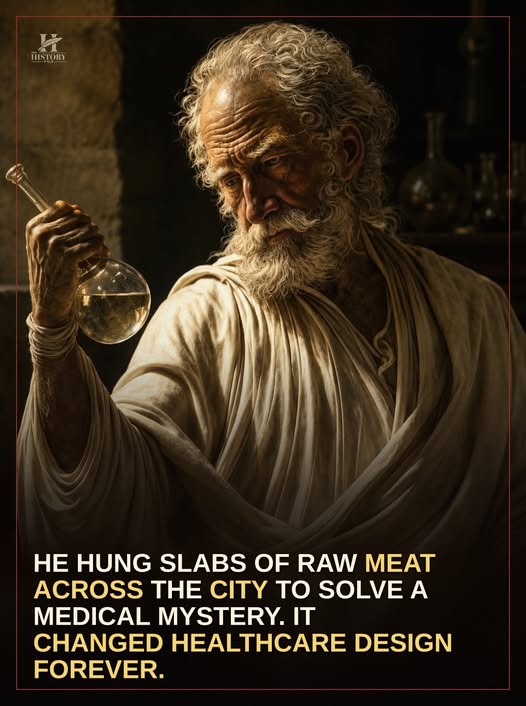
They turned to a man known as Rhazes.
He was a man of science, a polymath who had already written hundreds of books on everything from smallpox to philosophy.
Rhazes didn’t look at maps or listen to the political whims of the city’s elite.
Instead, he called for his assistants and gave them a command that sounded like the work of a madman.
He told them to go to the butchers’ stalls and buy several slabs of fresh, raw meat.
Then, he instructed them to hang these pieces of meat on tall poles in various quarters of the city.
One was placed in the bustling market, another near the stagnant canals, one near the palace, and others in the high, windy outskirts.
People stopped and stared as the bloody cuts of meat were hoisted into the air.
They whispered that the great doctor had finally lost his mind.
But Rhazes wasn’t interested in the gossip of the crowd; he was conducting a silent, deadly experiment.
He knew that disease was often carried by ’miasma’—the foul, putrid air that seemed to linger in certain parts of the city.
He believed that the air which rotted food the fastest would surely rot the human body just as quickly.
Day after day, under the blistering sun of Mesopotamia, Rhazes began his rounds.
He visited every single pole, his eyes scanning the texture of the flesh and his nose catching the first scents of decay.
In the crowded center of the city, the meat turned grey and slimy within forty-eight hours.
Near the water, the stench became unbearable by the third morning.
But in one specific spot, the meat remained remarkably red and firm.
While the other samples were crawling with flies and black with rot, this single piece of meat seemed to resist the inevitable.
Rhazes had found his answer.
He pointed to that specific patch of ground and told the Caliph: ’This is where you will build.’
He had used the most basic laws of nature to find the cleanest, most circulating air in the entire city.
It was a primitive version of what we now call environmental science.
When the hospital was finally completed, it became a sanctuary of recovery rather than a place of death.
Rhazes went on to lead the hospital, implementing revolutionary ideas like keeping detailed patient records and separating those with contagious diseases.
He understood that the environment was the first line of defense in medicine.
Long before the invention of the microscope or the discovery of bacteria, a man with a piece of meat proved that the invisible world around us is the key to our survival.
He didn’t just build a hospital; he built a blueprint for how we design our world today.
True wisdom is the ability to see the extraordinary in the ordinary.
Ibn Abi Usaybi’a, History of Physicians / National Library of Medicine
Photo: Wikimedia Commons