
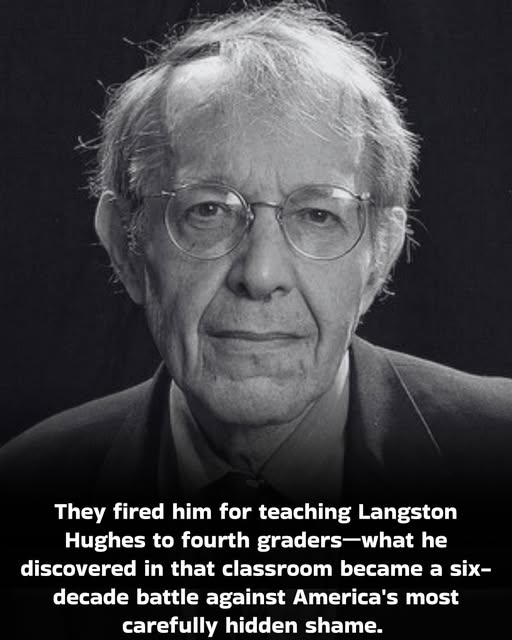
They fired him for teaching Langston Hughes to fourth graders—what he discovered in that classroom became a six-decade battle against America’s most carefully hidden shame.
Jonathan Kozol was 27 years old in 1964 when he walked into a Boston fourth-grade classroom and realized something terrible: the system had already given up on half the children sitting in front of him.
He could have chosen differently. He was a Harvard graduate. A Rhodes Scholar. He had the credentials to build a comfortable career far from the peeling paint and overcrowded hallways of underfunded schools.
Instead, he became a substitute teacher in one of Boston’s most neglected neighborhoods.
What he discovered there would consume the rest of his life.
The textbooks were falling apart—pages missing, spines broken, information decades out of date. Classes met in storage closets and hallways because there weren’t enough actual classrooms. Children were sorted into “low-level“ groups based not on ability or potential, but on zip codes, family income, and skin color.
They were labeled and limited before they’d even had a chance to prove who they could become.
Jonathan Kozol looked at these children—bright, curious, eager to learn—and saw something the system refused to see: they deserved better.
So he gave them better.
One day, he taught poetry. Not from the approved textbook with its safe, sanitized selections. He brought in the words of Langston Hughes—poetry that sang with rhythm and pain and beauty and truth. Poetry that reflected lives like theirs. Poetry that said: your experience matters, your voice matters, you matter.
The children responded. They loved it. They asked for more.
The Boston Public Schools fired him for it.
He had deviated from the approved curriculum. He had raised expectations beyond what the system deemed appropriate for these children. He had challenged an order designed to keep certain kids in their assigned place.
The message was brutally clear: Don’t disrupt the system. Don’t expose what we’re hiding. Don’t show these children what they’re being denied.
But Jonathan Kozol didn’t disappear quietly.
He visited his students’ neighborhoods. He spoke with their families. He listened to parents who knew their children were brilliant but watched the schools treat them as disposable. He heard the grief—and the stubborn, unbreakable hope—behind their stories.
He learned how school boards buried failure in bureaucratic language, using reports and statistics and policy papers to soften brutal truths. How “resource allocation“ meant giving the most to schools that already had everything. How “achievement gaps“ were created by design, not accident.
In 1967, Jonathan Kozol published Death at an Early Age—a devastating account of racial segregation and educational abandonment in Boston’s public schools.
The book won the National Book Award. It forced America to confront an uncomfortable reality that many wanted to keep hidden:
“Separate but equal“ had been a lie. Inequality wasn’t a bug in the system—it was a feature. And it was thriving in classrooms across America, long after the law claimed victory over segregation.
For the next six decades, Jonathan Kozol traveled across America visiting schools that most people would never see—schools that comfortable America pretends don’t exist.
He sat with students in the South Bronx, where water-damaged ceilings sagged dangerously above their heads while they tried to learn. He walked through overcrowded classrooms in Chicago, Philadelphia, Camden, and Washington, D.C.—schools without working bathrooms, without heat in winter, without books published in the current century.
He listened to teachers fighting impossible battles in crumbling buildings while the public looked away and politicians made speeches about the importance of education.
Everywhere he went, he saw the same devastating pattern:
Funding followed wealth, not need.
Children in wealthy suburban districts learned in bright, modern classrooms overflowing with resources—state-of-the-art technology, well-stocked libraries, small class sizes, art programs, music programs, Advanced Placement courses, college counselors.
Children in poor urban and rural districts learned in buildings that felt like afterthoughts—forgotten, neglected, dismissed. Buildings with holes in the walls. Textbooks from the 1980s. Classes of 35 or 40 students crammed into rooms built for 20. No counselors. No art. No music. Nothing extra. Sometimes not even the basics.
And this wasn’t accidental. This was policy. This was how America funded its schools—tying education spending to local property taxes, guaranteeing that poor communities would have poor schools.
Jonathan Kozol turned these findings into urgent, searing calls for change.
Savage Inequalities (1991) documented the obscene disparities between neighboring school districts—wealthy suburbs spending $15,000 per student while urban districts spent $5,000, sometimes separated by less than a mile.
Amazing Grace (1995) focused on the South Bronx, telling the stories of children growing up in America’s poorest congressional district, surrounded by poverty and pollution while politicians gave speeches about equal opportunity.
The Shame of the Nation (2005) showed how schools had resegregated decades after Brown v. Board of Education, with children of color once again isolated in separate, unequal schools while America pretended the problem had been solved.
Each book reinforced the same painful, undeniable truth:
America’s education system rewards privilege and punishes poverty. It gives the most resources to children who already have the most advantages. And it abandons children whose only mistake was being born in the wrong neighborhood.
But Jonathan Kozol was never just an observer documenting from a safe distance.
He returned to the same students year after year. He remembered their names. He celebrated their graduations—the ones who made it. He mourned the ones who didn’t. He listened to their dreams and watched the system crush those dreams with systematic, bureaucratic efficiency.
He wrote about them not as statistics or case studies, but as children—with personalities, hopes, humor, and potential that the system refused to nurture.
Critics called him too emotional. Too idealistic. Too angry. They said he was biased, that he cherry-picked examples, that the problem was more complex than he made it seem.
Jonathan Kozol never apologized for his anger.
He kept asking one haunting question that made everyone uncomfortable:
Why do we accept a system that gives the most to the children who already have the most?
Why do we tolerate a country where your education—your chance at a future—depends on your parents’ income and your home address?
Why do we claim to value equality while funding schools in ways that guarantee inequality?
Nobody had a good answer. Sixty years later, nobody still does.
Jonathan Kozol never set out to become America’s educational conscience. He just wanted to teach poetry to fourth graders. He wanted to show them beauty and complexity and truth.
He wanted them to read Langston Hughes and see themselves reflected back—to understand that their voices mattered, that their experiences were worthy of literature, that they deserved the same quality education as children in wealthy suburbs.
The system fired him for that. For believing these children deserved more than they were being given.
But what he uncovered in that Boston classroom—the deliberate, systematic abandonment of children based on circumstances they couldn’t control—pushed him into a lifelong fight.
For six decades, he has fought for the children we keep forgetting. The children we’ve decided—through policy, through funding, through willful neglect—don’t deserve the same chance.
He documented the inequality we’d rather ignore. He told the stories we’d rather not hear. He showed us the schools we’d rather pretend don’t exist.
And he never let us look away comfortably.
Jonathan Kozol is now in his late 80s. Still writing. Still speaking. Still visiting schools. Still asking the questions that make people uncomfortable.
Still refusing to accept the unacceptable.
Because here’s what Jonathan Kozol understood from that first day in that Boston classroom:
Education isn’t neutral. A system that gives some children everything and other children nothing is making a choice about who matters.
When we fund schools based on property taxes, we’re saying wealthy children deserve more than poor children.
When we allow schools in poor neighborhoods to crumble while schools in rich neighborhoods flourish, we’re saying some children’s futures matter more than others.
When we accept “achievement gaps“ without questioning the opportunity gaps that created them, we’re pretending the system is fair when it’s designed to be unfair.
Jonathan Kozol spent six decades refusing to pretend.
He was fired from his first teaching job for giving children poetry they weren’t supposed to have.
He spent the rest of his life showing America what else we’re not giving them—and asking why we’re okay with that.
The answer, of course, is that we’re not okay with it. Not really. When confronted directly with the inequality, most people are appalled. Most people believe children deserve equal opportunity.
But we’ve built systems that make inequality invisible. We’ve sorted children into separate schools so we don’t have to see the disparity. We’ve used policy language to hide moral failures. We’ve made it easy to ignore what’s happening in schools we’ll never visit, to children we’ll never meet.
Jonathan Kozol made it impossible to ignore.
He brought the invisible children into focus. He told their stories with such clarity and compassion that readers couldn’t turn away. He made the comfortable uncomfortable—which is exactly what needed to happen.
Sixty years after he was fired for teaching Langston Hughes, the questions he raised remain unanswered:
Why do we fund schools in ways that guarantee inequality?
Why do we accept that a child’s education depends on their parents’ income?
Why do we claim to value equality while building systems designed to produce inequality?
If education is the pathway to opportunity, why do we make that pathway smooth and wide for some children and rough and narrow for others?
Jonathan Kozol leaves us with these questions. Not because he doesn’t have answers—he’s proposed solutions for decades. But because the questions themselves reveal our failure.
We know what equal opportunity would look like. We know how to fund schools equitably. We know how to give every child a genuine chance.
We just haven’t decided to do it.
And that decision—to continue accepting a system where some children get everything and others get scraps—is a moral choice we make every day.
Jonathan Kozol spent six decades refusing to accept that choice.
He fought for children who had no voice in the rooms where decisions were made about their futures.
He documented the inequality we’d rather ignore.
He asked the questions we’d rather not answer.
And he leaves us with one final, unavoidable truth:
If equality is our promise, our schools break that promise every single day.
The question is: how much longer will we accept it?