
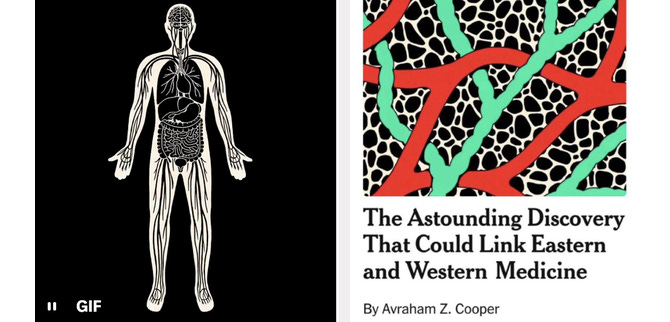
In another fascinating medical story, the NYT published a bizarre article, if you can call it that, headlined “Inside the Interstitium, the Human Body’s Hidden Pathways.” I’ll file this story under the category of medical innovation of the kind we haven’t seen in the last 25 years. In short, suddenly and unexpectedly, scientists discovered a third circulatory system in the human body that they had never noticed before.
What’s most exciting, from a nerdy alt-health perspective, is that the discovery could explain most of the difference between Western and Eastern medicine. For centuries, Western medicine has recognized two major fluid-circulation systems: blood and lymphatic. Turns out they missed one. (In response, the American Medical Association issued a statement saying they are “cautiously optimistic” that the human body does not contain any more surprises, and that they are “reasonably confident” they have now found all the important parts.)
Researchers studying tattoo ink migration in the body found that fluid‑filled “interstitial spaces” throughout the body’s connective tissue were not just isolated pockets as they’d supposed, but were in fact one continuous network. They are calling it “the interstitium.”
There are pretty significant implications. The existence of this major fluid pathway could explain how cancer cells spread after they metastasize. It could explain how inflammation in one part of the body causes inflammation in another. It could explain how acupuncture works.
The story wasn’t exactly “breaking.” The lead researchers first published their findings in 2018. It has taken eight years for a major media outlet to cover the story, which is actually pretty fast by the standards of heterodox medical discoveries. By comparison, the medical establishment spent roughly forty years confidently telling patients that stomach ulcers were caused by stress before finally admitting they were actually caused by bacteria. The researcher who proved it, Barry Marshall, had to drink a beaker of the bacteria to get anyone to pay attention.
The good news is that scientists studying the interstitium have not yet been required to drink anything.
Still, one detects a lingering whiff of resentment. The Times chose to break this potentially civilization-altering medical discovery not as a written article, but as an interactive multimedia scroll that requires approximately 17 minutes of clicking to read what could have been three pages of text. This is the journalistic equivalent of announcing the discovery of fire by interpretive dance.
Anyway, the discovery of the interstitium is potentially another major challenge to orthodox medicine’s historical certainties. Welcome to 2026’s accelerating medical revolution.
https://open.substack.com/pub/coffeeandcovid/p/revolution-and-renewal-tuesday-may