
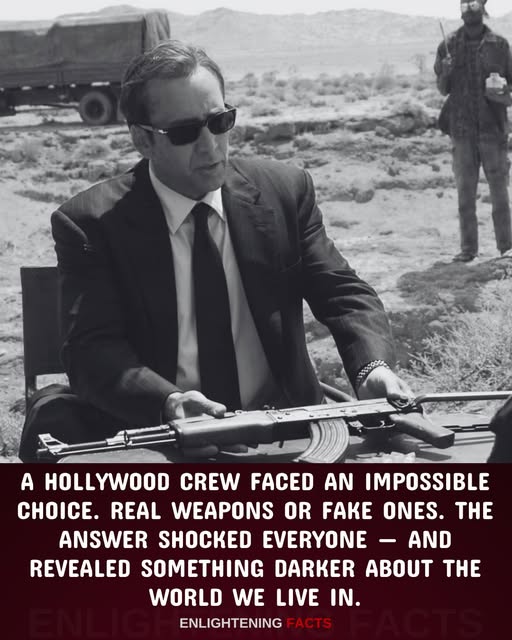
In 2004, director Andrew Niccol faced a problem most filmmakers never encounter.
He needed guns. Thousands of them.
Not for violence. Not for spectacle. But to tell the truth about a world most people never see — the shadowy business of arms dealing that fuels wars across continents.
His film, Lord of War, would follow an illegal weapons dealer moving rifles from Eastern Europe to conflict zones. To make it believable, the production needed an arsenal that looked real. Niccol expected to spend a fortune on prop weapons. Hollywood prop houses charge premium rates for realistic replicas, especially military-grade firearms.
Then someone on the crew made a phone call.
What they discovered would change everything about the production. It would also expose an uncomfortable truth about the global arms trade.
A Czech arms dealer had thousands of rifles in storage. Real ones. SA Vz. 58 assault rifles that looked nearly identical to the famous AK-47. The dealer made Niccol an offer.
Rent 3,000 real guns for less than the cost of 3,000 fake ones.
Niccol’s team ran the numbers twice. Then a third time. The math seemed impossible, yet it held. Authentic military weapons, capable of firing live ammunition, cost less to acquire than Hollywood props made of rubber and plastic.
The production said yes.
Three thousand rifles arrived on set in the Czech Republic. Not replicas. Not deactivated museum pieces. Working firearms from an active arms dealer’s inventory. The same weapons that might appear in a conflict zone were now appearing on a film set, rented by the day like camera equipment.
But the guns were just the beginning.
For one scene, Niccol needed tanks. Rows of them, lined up for sale like cars at a dealership. The production found another Czech dealer who could provide fifty real tanks.
There was one condition.
The tanks were only available until December. After filming wrapped, the dealer had another buyer waiting. According to reports, those tanks were headed to Libya. The same military vehicles used for a Hollywood scene would potentially roll into a real conflict zone months later.
Before filming the tank scene, the production team took an unusual step. They contacted NATO headquarters. They explained what they were doing and where. They shared their filming schedule.
The reason? Satellite surveillance. NATO monitors military buildups across Europe. Without warning, fifty tanks assembling in the Czech Republic might trigger alarms. Intelligence analysts might mistake a film set for a genuine military operation.
The irony wasn’t lost on anyone involved. A movie about arms dealing required diplomatic clearance because it looked too much like actual arms dealing.
Niccol later told reporters that working with real arms dealers provided unexpected authenticity. They understood the business in ways consultants couldn’t match. They knew how weapons moved across borders, how paperwork disappeared, how prices fluctuated based on conflict and demand.
One crew member reportedly joked that if the film failed, they could always sell the guns and recoup their investment. Nobody laughed very hard. The joke was too close to reality.
The film opened in September 2005. Critics gave it mixed reviews, but audiences connected with its unflinching look at the weapons trade. Amnesty International endorsed it publicly, praising how it highlighted the dangers of unregulated arms sales.
Years later, those fifty tanks would take a strange journey. After their use in Libya, many were eventually purchased by the United States, refurbished back in the Czech Republic, and sent to Ukraine to defend against invasion.
Props that weren’t props. Tanks that served in multiple wars. A film set that required military oversight.
Lord of War set out to expose the strange economics of the global arms trade. It succeeded in ways even Niccol couldn’t have predicted. The production itself became evidence of the thesis — that weapons flow more freely than water, that dealers operate in plain sight, that the infrastructure of conflict is cheaper and more accessible than most people imagine.
The film’s most famous line comes from Nicolas Cage’s character describing the AK-47: “It’s so easy, even a child can use it. And they do.”
But perhaps the real lesson came from behind the scenes. In a world where real guns cost less than fake ones, where tanks move from film sets to battlefields and back again, where arms dealers rent equipment to Hollywood studios between sales to governments — the line between fiction and reality had already blurred beyond recognition.
For those who remember when movies felt separate from the world they depicted, this production offered a different truth. Sometimes the props are real. Sometimes the dealers are actual dealers. Sometimes the most unbelievable part of a story is that it’s not fictional at all.
What does it say about our world when instruments of war are more economical than their plastic imitations? When the infrastructure of conflict operates so openly that Hollywood can rent from the same suppliers as nations? When the economics of violence are so efficient that they undercut even the business of pretending?