
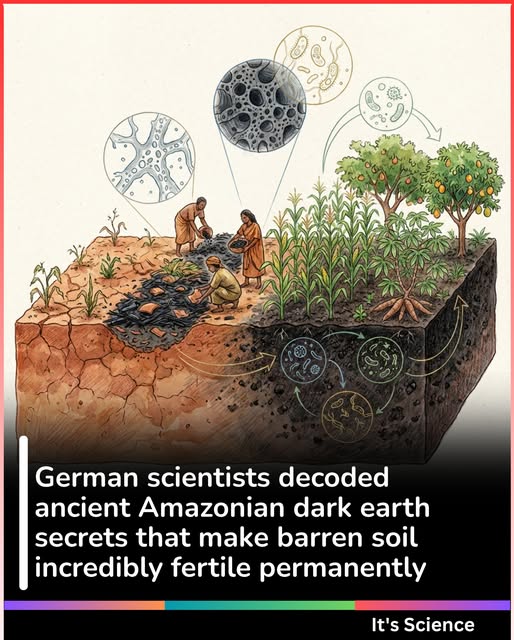
German scientists decoded ancient Amazonian dark earth secrets that make barren soil incredibly fertile permanently — cracking a 2,000-year-old agricultural mystery with implications for modern food security, carbon sequestration, and the regeneration of degraded farmland across the world’s most climate-stressed regions.
Terra Preta — Portuguese for “dark earth” — is an extraordinarily fertile black soil found in patches throughout the Amazon basin, created by pre-Columbian civilizations between 500 BCE and 1000 CE through processes that modern soil science has been attempting to fully decode since its serious investigation began in the 1990s.
Unlike surrounding tropical soils, which are notoriously nutrient-poor and rapidly depleted by cultivation, Terra Preta maintains its extraordinary fertility for centuries without any further amendment. Crops grown in it outperform modern fertilized soil in productivity comparisons, and crucially, the soil appears to regenerate its properties over time rather than depleting.
Researchers at the University of Bayreuth resolved the final pieces of the formation puzzle using advanced geochemical isotope analysis combined with ancient DNA sequencing of the microbial communities preserved within the soil. They found that Terra Preta formation required three simultaneous components: biochar from slow combustion of organic matter as a mineral skeleton, concentrated organic waste including bones, feces, and food scraps as nutrient sources, and — critically — a specific community of microorganisms including specialized fungi and bacteria that colonize the biochar structure and permanently lock nutrients against leaching. The microbial community, not just the biochar, is the key to the permanence.
Recreating Terra Preta at scale could restore agricultural productivity to the 2 billion hectares of degraded farmland worldwide. The Amazon’s ancient farmers discovered something extraordinarily valuable. We just fully understood it.
Source: University of Bayreuth, Nature Sustainability 2025