
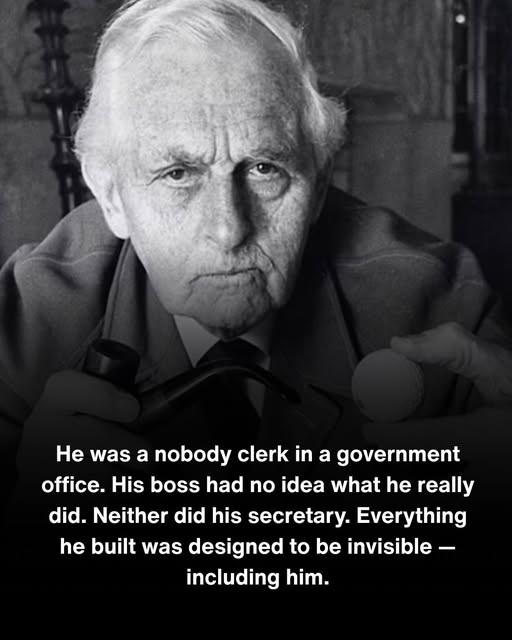
To everyone at the Ministry of Supply, Charles Fraser-Smith was just a clerk in the Clothing and Textile Department.
He shuffled papers. He placed fabric orders. He took the train from Hertfordshire each morning and sat in a cramped London office, and nobody thought twice about him.
That was precisely the point.
His real work happened elsewhere, under direction from MI6, in sessions with anonymous voices on the telephone who would call with requests that sounded like riddles.
Four hundred miniature cameras. By next week.
Three hundred Spanish Army uniforms. By month’s end.
A trunk capable of preserving a human corpse in dry ice. As soon as possible.
Fraser-Smith never asked why. He simply made it happen.
He had a gift that is very difficult to teach: he understood how people think when they’re searching for something. And he used that understanding in reverse — designing objects that looked so completely like what they were supposed to be that no one would ever think to look inside them.
A hairbrush wasn’t just a hairbrush. Unscrew the base and out came a silk map of Germany, folded to near-invisibility, and a miniature saw blade. A fountain pen hid a compass in its barrel and a map in its ink reservoir. Uniform buttons unscrewed to reveal tiny compasses with luminous dots for night navigation — but here was the genius in the detail: the thread was cut left-handed. A German guard turning it the normal way would only tighten it further. You had to know the secret to find the secret.
Behind enemy lines, in prisoner-of-war camps, in hostile territory after a plane went down — these were the tools that brought men home. Handkerchiefs printed with maps in invisible ink that could be revealed by a substance every prisoner had available to them. Bootlaces that looked ordinary but contained thin surgical saw-wire inside, capable of cutting through iron bars. Shaving brushes with film hidden in the handle. Cigarette lighters that were also cameras. Pipes lined with asbestos for carrying documents through fire. Even food compressed into toothpaste tubes — an idea, Fraser-Smith noted with quiet satisfaction, that later became a multi-million-pound commercial industry.
His proudest invention was the hollow golf ball. Packed with a compass or a coded message, the balls had to be indistinguishable from real ones — proper weight, proper bounce, passed between hands in full view of guards. They were. They worked. Countless men navigated their way home across occupied Europe following the instructions hidden in something a German officer had personally inspected and handed back.
Fraser-Smith worked with over three hundred London suppliers, none of whom knew what they were making or why. When Treasury clerks questioned his expenses, he arranged for one particularly persistent auditor to review a specific kit — after signing the Official Secrets Act. The auditor discovered the supplier had been undercharging. Nobody questioned a Fraser-Smith bill again.
His most extraordinary assignment came in 1943. British intelligence had conceived a plan of breathtaking audacity: plant false documents on a corpse, let it wash ashore in Spain, and convince Hitler that the coming Allied invasion of Europe was aimed at Greece and Sardinia rather than Sicily. Fraser-Smith received the order that made the plan possible — design a trunk six feet two inches long, capable of preserving a two-hundred-pound body in dry ice without refrigeration, using evaporating carbon dioxide to do the work of cold.
The trunk was built. The body was dressed and prepared. The documents were planted. The corpse washed ashore.
Hitler redirected entire divisions away from Sicily. The Allied landings met far less resistance than anticipated. Operation Mincemeat had worked.
Working in the same world — though rarely crossing paths directly with Fraser-Smith — was a young Naval Intelligence officer named Ian Fleming. He understood intimately how the secret gadget networks operated. He knew the ingenuity and the discipline that kept agents alive. And in 1952, when he sat down in Jamaica to write a spy novel about a fictional agent named James Bond, he created a character who supplied gadgets to field operatives.
He called the character Q.
Fraser-Smith later said he “slightly” knew Fleming. Fleming, it seems, knew his work rather better than that.
The fictional Q Branch that Fleming invented was nothing like Fraser-Smith’s actual operation — flashier, more explosive, more interested in spectacle than survival. When Fleming borrowed the hollow golf ball idea for one of his novels, Fraser-Smith complained the fictional version wouldn’t have fooled an Irish farmhand, let alone a German prison officer. But the connection was real, and it ran deep.
For thirty years after the war, Fraser-Smith said nothing. The Official Secrets Act demanded silence. He bought a dairy farm in Devon, raised his family, and kept his wartime gadgets locked away. Only when the restrictions expired did he publish his memoirs and begin showing his inventions to visitors at a small museum on the Exmoor Steam Railway, spending one week each year patiently explaining how a left-handed thread had once saved a man’s life.
He died in 1992. His obituary called him “the gadget-designing genius on whom the character Q in the James Bond novels and movies was modeled.”
That might have been the end of it. A footnote to both real history and fictional espionage.
But then something happened that Fraser-Smith, with his understanding of disguise and concealment and things that are not quite what they appear, might have appreciated more than anyone.
The real MI6 — the Secret Intelligence Service — officially adopted the title “Q” for its head of technology. The department’s working philosophy became known as “Q culture.” The title wasn’t inherited from some ancient intelligence tradition. It was borrowed directly from the James Bond films.
Which were themselves inspired by Charles Fraser-Smith.
A man who built hollow golf balls to hide compasses had become a fictional character who had become an institutional title at the world’s most famous spy agency.
And then, in June 2025, the story completed its circle in a way that nobody could have planned.
The woman serving as MI6’s real Q — Blaise Metreweli, Director-General of Technology and Innovation, who spent her career building the tools that kept British agents hidden from Chinese surveillance systems and Russian intelligence — was promoted to become C. Chief of the entire service. The first woman to hold that position in 116 years.
Q became C. Reality became fiction became reality again.
Charles Fraser-Smith never sought recognition. His name was classified, his work invisible, his contribution measured only in the men who made it home because of something hidden inside an ordinary-looking object. He would have found it fitting, perhaps, that the most famous gadget-master in the world is a fictional character — and that almost nobody has ever heard of the real man who inspired him.
But that, as he understood better than anyone, is the whole point of a good disguise.
The best hiding place is the one nobody thinks to look.