
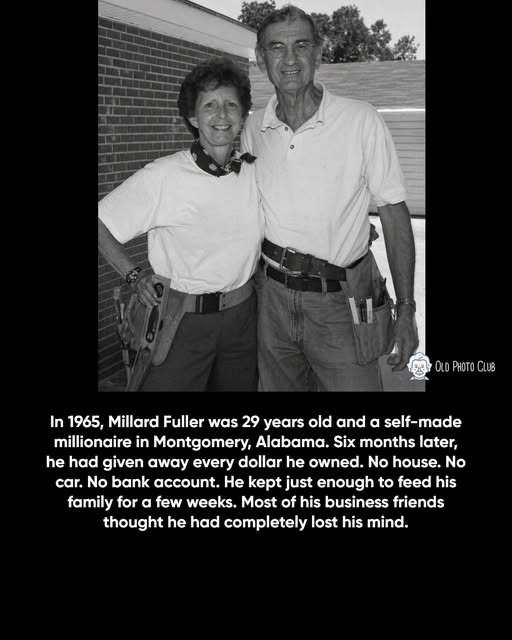
He had not lost his mind.
He had finally found his life.
Millard had grown up poor and was determined to escape poverty by any means possible. As a child, he sold pigs, chickens, and fish bait. As an adult, he and his law-school partner built a direct-mail empire from scratch. They started by selling tractor cushions to farmers. Then cookbooks. Then real estate. Almost everything they touched turned into cash.
By 29, Millard had a sprawling house. Acres of land. Horses. A cabin on the lake. He worked 14-hour days, his mind always calculating the next deal, the next expansion, the next number on the ledger.
He was building an empire.
He was also slowly destroying his marriage.
His wife Linda was suffocating in silence. She lived in a giant house with a husband who was technically present but mentally a thousand miles away. The money could not fill the silence at the dinner table.
One afternoon, Millard came home to an empty house. Linda had packed a suitcase and taken a train to New York. She left a note saying she needed time to think about whether she wanted a divorce.
The empire suddenly looked very small.
Millard cancelled every meeting and flew to New York. He found Linda in the city, and they sat down to talk honestly for the first time in years. Linda told him the truth. The wealth had become a wall between them. He was so busy securing their future that he was missing their entire present.
In that conversation, they made a decision that would change history.
They would sell the business. They would sell the house, the cabin, the horses, the land, the cars. They would give every single dollar to churches and charities for the poor. They would deliberately make themselves penniless and start their lives completely over.
In 1965, giving away the equivalent of nearly $10 million in today’s money was not seen as noble. It was seen as a nervous breakdown.
They did it anyway.
Millard, Linda, and their four children eventually moved to a small Christian farming community in Americus, Georgia, called Koinonia Farm. It was led by a farmer and biblical scholar named Clarence Jordan. It was an integrated community where Black and white families lived, ate, and worked together, which made it a target for boycotts and even gunfire in 1960s rural Georgia.
Sitting at a wooden kitchen table, Clarence and Millard sketched out a radical new idea they called partnership housing.
There would be no charity, because charity created dependency. Volunteers would build modest houses. Future homeowners would help build their own homes and the homes of their neighbors, an idea called sweat equity. The houses would be sold at exact cost. There would be 0 profit and 0 interest on the loans. Every mortgage payment would go into a revolving fund to build the next house for the next family.
It was hard, slow, and painful. The Georgia clay was brutal. Donations were scarce. But one house was finished, then another. Families moved out of dirt-floor shacks and into warm, dry homes with running water.
In 1973, the Fullers traveled to Zaire, now the Democratic Republic of the Congo, to test the model overseas. In just three years, they helped build more than 120 homes. That convinced them the idea could work anywhere on earth.
In 1976, they returned to the United States and officially incorporated their work as Habitat for Humanity.
Then in 1984, a former president named Jimmy Carter, who lived just down the road in Plains, Georgia, put on work boots and showed up at a build site in New York City with his wife Rosalynn. The cameras followed. The world finally saw what Millard and Linda had quietly built. In 1996, President Bill Clinton awarded Millard the Presidential Medal of Freedom.
Millard Fuller died in 2009 at age 74. He never became wealthy again. He never wanted to.
Today, Habitat for Humanity operates in all 50 U.S. states and in more than 70 countries. Since 1976, the organization has helped over 65 million people build or improve the place they call home.
Tens of millions of people sleep tonight under safe, sturdy roofs because one young millionaire sat in a hard moment with his wife and decided that his marriage was worth more than his money, and that his money was worth more in someone else’s home than in his own bank account.
A fortune cannot build a home if it breaks the people living inside it.
The empire is gone.
The houses still stand.