
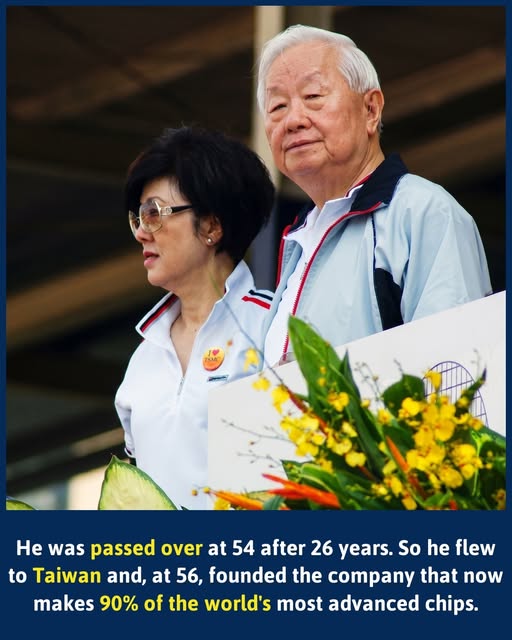
The year was 1985. A 54-year-old engineer was sitting with a quiet kind of fury — the kind that comes not from anger, but from being told, without words, that your best years were behind you. Texas Instruments had just passed him over for the top job. After 25 years. After pioneering an entire industry.
Most men would have packed up their desk and their dignity and walked away.
Morris Chang did not walk away.
He had been born in Ningbo, China in 1931, a child shaped by war and displacement. His family moved through Hong Kong before landing in the United States, where he put his head down and earned degrees from MIT and Stanford. He joined Texas Instruments in 1958, back when semiconductor chips were still a novelty, a curiosity, a gamble. He spent 26 years there, mastering every corner of the industry, becoming one of the most knowledgeable chip executives alive.
And then, quietly, the door was closed in his face.
When the Taiwanese government came to him in 1985 with an invitation to help build a domestic chip industry, Chang said yes. But he did not simply show up and get to work. He had been sitting with an idea for years, one that he was convinced nobody in the industry had been bold enough to attempt.
Every semiconductor company at the time was vertically integrated. They designed chips. They built chips. They sold chips. It was expensive, it was slow, and as chip complexity exploded, it was becoming unsustainable. Chang saw the flaw so clearly he could almost draw it on a napkin.
What if you separated design from manufacturing entirely? What if a company existed only to build other people’s chips — and never competed with them?
In 1987, at the age of 56, he founded TSMC. Taiwan Semiconductor Manufacturing Company. The world’s first dedicated chip foundry.
The skeptics came out immediately. No serious chip designer would hand over their most guarded intellectual property to an outside factory. The idea was too radical, too fragile, too strange.
They were spectacularly wrong.
TSMC’s neutrality was the whole point. Designers could innovate freely, without the cost of a factory floor. A new class of companies — fabless chip designers — emerged almost overnight. Companies like Qualcomm, NVIDIA, and AMD were built on the model Chang had invented.
Today, TSMC manufactures more than 90 percent of the world’s most advanced semiconductor chips. Apple’s processors. NVIDIA’s AI accelerators. The chips inside your phone, your car, your hospital’s MRI machine.
Morris Chang retired from TSMC in 2018 at the age of 86. He did not build his legacy in his 20s, riding a wave of venture capital energy. He built it at 56, with patience, precision, and a refusal to accept that being overlooked was the same as being finished.
Image Credit to Peellden (Wikimedia Commons) (Restored & Colorized)