
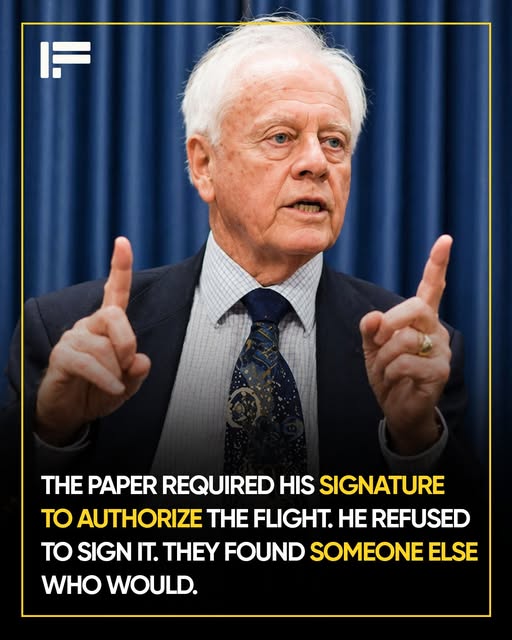
The paperwork sat on the table in front of him. All it needed was his signature to clear the Space Shuttle Challenger for launch.
He looked at the data. He looked at the pen. He looked at the men in the room who were waiting for him to be reasonable.
He told them no.
Then they walked the paperwork down the hall, found someone else to sign it, and launched the rocket anyway.
Seven people died because of what happened in that room. His name was Allan McDonald. He spent the rest of his life refusing to let anyone forget what he had tried to stop.
The last week of January, 1986, at Cape Canaveral, Florida. McDonald was the director of the solid rocket motor project for Morton Thiokol, the NASA contractor that built the booster rockets. He was not a politician. He was not a bureaucrat. He was an engineer with a degree in chemical engineering from Montana State, a wife, four children, and a career he had built for nearly thirty years on one principle. The numbers did not lie.
And the numbers were screaming.
The wind was howling off the Atlantic. Ice was hanging in heavy, sharp icicles from the launch pad. The forecast for launch morning was 18 degrees Fahrenheit. The massive rubber O-rings that sealed the rocket booster joints had never, in any test, been qualified below 53 degrees. McDonald and his fellow engineer Roger Boisjoly knew exactly what happens to synthetic rubber when it freezes. It loses elasticity. It turns hard. It stops sealing.
If those O-rings did not seal, the burning fuel inside the booster rocket would punch through the joint like a blowtorch through paper. The rocket would not be a rocket anymore. It would be a bomb strapped to a spacecraft carrying seven human beings. One of them was Christa McAuliffe, a New Hampshire schoolteacher who was about to become the first civilian in space. Her students were going to watch the launch live in their classrooms.
On the night before liftoff, McDonald and his engineering team got on an emergency teleconference. The line connected the engineers in Utah with NASA officials in Florida and Alabama. For hours, they faxed charts back and forth. They presented the data. They warned, in writing, that the cold would freeze the rings and the seals would fail. They formally recommended that NASA delay the launch until the temperature climbed above 53 degrees.
They were doing exactly what every engineer in America is paid to do.
Something had quietly shifted, though, in the bureaucracy of the American space program by the mid-1980s. During the Apollo era, contractors had been expected to prove that a vehicle was safe to fly. By the Space Shuttle era, that burden of proof had inverted. Now contractors were being asked to prove the vehicle would fail. McDonald himself put it plainly: when safety becomes an obstacle to a public schedule, the schedule always wins.
NASA officials on the call were furious. A delay would cost money. It would cost political capital. The launch had already slipped several times and President Reagan was scheduled to deliver his State of the Union address that same night.
“My God, Thiokol,” NASA manager Lawrence Mulloy snapped over the phone. “When do you want me to launch — next April?”
The pressure was crushing. The federal contract for the rocket motors was up for renewal. Thiokol’s executives were told to take off their engineering hats and put on their management hats.
The executives caved. They drafted a new recommendation, reversing their own engineering team. They handed the paperwork to McDonald to sign as the senior company official on site.
He refused.
He told them, in words he would repeat for the rest of his life, that he would not stand in front of a board of inquiry one day and try to explain why he had given permission to fly rocket boosters in an environment they had never been qualified to fly in.
His own boss stepped in and signed the authorization in his place.
McDonald was sidelined. The next morning, he stood outside in the freezing cold and watched the launch. Seventy-three seconds into the flight, in the blue sky above the ocean, he watched the worst fears of his engineering team turn into a fireball. Seven astronauts died. A schoolteacher’s students watched in real time.
In the weeks that followed, the agency tried to keep the internal debate quiet. A presidential commission convened in Washington. The panel included astronauts Neil Armstrong and Sally Ride, alongside the physicist Richard Feynman. During the early hearings, NASA managers sat at the microphone under oath and told the commissioners that they had been unaware of any serious contractor objections to the cold weather.
McDonald was sitting in the back of the room. He was not scheduled to speak. He had no protection. He was, by his own description, in “the cheap seats.”
He raised his hand anyway.
He stepped forward, uninvited, and interrupted the proceedings. He told the commission the truth. He detailed the teleconference. He explained the data. He testified that he had refused to sign the launch authorization and that Thiokol executives had been pressured into reversing their engineers.
Chairman Rogers asked him to please come down to the floor and repeat what the commission had just heard.
For his honesty, his company effectively buried him. He was stripped of his title. He was given an empty desk and almost nothing to do.
He sat there. He waited.
A signature is just ink until someone’s life depends on it.
Congress eventually intervened. Representative Edward Markey of Massachusetts threatened a joint resolution that would forbid Morton Thiokol from receiving any future NASA contract unless McDonald was reinstated. The company relented. He was promoted to vice president and put in charge of redesigning the very rocket joints that had failed.
He fixed the flaw. The redesigned joints flew safely from 1988 until the shuttle program ended in 2011. He retired in 2001. He spent the rest of his life giving lectures on engineering ethics at universities around the world.
Allan McDonald died on March 6, 2021, at the age of 83.
Today, business schools teach his actions as a case study in corporate ethics. But ethics is not an abstract concept in a textbook.
It is a man sitting at a table with a pen in his hand, surrounded by people telling him to do the easy thing.
And saying no.