
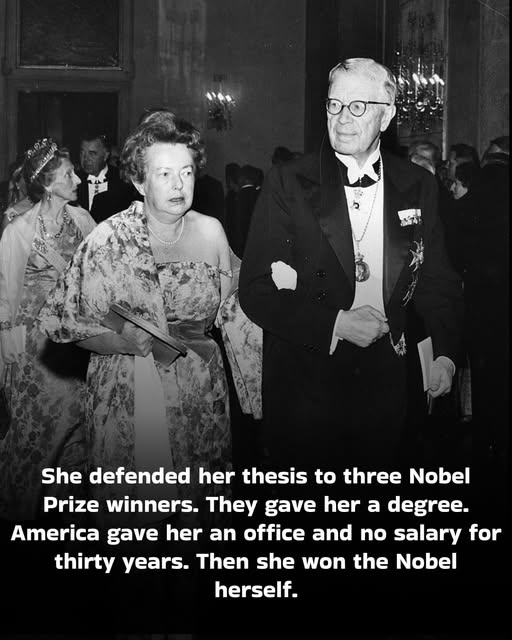
She defended her thesis to three Nobel Prize winners. They gave her a degree. America gave her an office and no salary for thirty years. Then she won the Nobel herself.
The year was 1930. The room in Göttingen, Germany, held three men who would eventually be counted among the most brilliant physicists of the twentieth century. Max Born. James Franck. Adolf Windaus. All three would win Nobel Prizes. And on this particular day, they were listening to a twenty-four-year-old woman explain her doctoral thesis on two-photon absorption.
She walked out of that room with her degree. She walked into a country that would spend the next three decades pretending not to notice what she could do.
Her name was Maria Goeppert Mayer.
She was born in 1906 in Kattowitz, Germany, the only child of a man who came from six generations of university professors. Her father told her something when she was young that shaped everything that followed. He told her not to grow up to be a housewife. He said it plainly. He said it seriously. And she took his advice the same way.
By the time she was twenty-four, she had written a doctoral thesis that a fellow physicist would later describe as a masterpiece of clarity and concreteness. The theory she proposed was so far ahead of its time that it could not be experimentally verified for thirty years—not until the invention of the laser finally made it possible to test what she had predicted in 1930. Today, a unit of measurement in physics carries her name.
Then she married an American chemist named Joseph Mayer. And she followed him to the United States.
What happened next was not dramatic. There was no single moment of rejection, no confrontation, no door slammed in her face. What happened was quieter than that. More insidious. The kind of thing that does not make headlines but shapes entire lives.
At Johns Hopkins University, where her husband took a faculty position, anti-nepotism policies prohibited universities from hiring the wives of faculty members. The rule was presented as though it were neutral, reasonable, designed to prevent favoritism. In practice, it meant that Maria Goeppert Mayer—a physicist who had just defended her doctorate in front of Nobel Prize winners—was given a small office, a minor role handling German correspondence, and access to the university facilities.
She was not given a salary.
She published landmark research there. Work that advanced the field. Work that other scientists cited and built upon. She did all of this for free, as though the value of her contributions could not be measured in money because she happened to be married to someone on the faculty.
In 1937, her husband was dismissed from Johns Hopkins and took a new position at Columbia University in New York. The pattern repeated itself with eerie precision.
She had an office. She had access to the labs. She had no salary. No title. No official position. She was a physicist without a job, producing work that mattered while being paid nothing for it.
When the United States entered World War Two, Enrico Fermi—already one of the most celebrated physicists in the world—left Columbia for war-related research. Maria Goeppert Mayer took over his classes. She taught his students. She did the work he had been doing.
She was not paid for that either.
Here is the thing you need to understand about Maria Goeppert Mayer: she kept working. That was her response to a system that had decided her brilliance was worth nothing. She kept showing up. She kept publishing. She kept thinking. She did not stop. She did not slow down. She simply continued to be excellent in an institution that refused to acknowledge it with money or position or respect.
After the war, her husband accepted a professorship at the University of Chicago. Once again, Maria followed. Once again, the university offered her a token gesture that looked like recognition but functioned like exploitation.
They gave her the title of Associate Professor of Physics. It sounded impressive. It looked legitimate on paper. But the title came with no salary. The department provided her with an office. The department did not provide her with pay.
She was forty years old. She had been one of the most productive theoretical physicists in the United States for more than a decade. And she was still working for free.
Then something shifted.
A former student named Robert Sachs offered her a part-time paid position as Senior Physicist at the newly opened Argonne National Laboratory, a research facility outside Chicago. It was not a full-time job. It was not a university professorship. But it was the first time in her entire career—after nearly two decades of professional work—that someone paid her in proportion to her ability.
In her Nobel Prize autobiography, written years later, Maria Goeppert Mayer described her arrival at Argonne with characteristic modesty. She wrote that she came with very little knowledge of nuclear physics and that it took her some time to find her way in this new field.
The modesty is typical of her. The reality is something else entirely.
Within two years of arriving at Argonne, she had identified the solution to a problem that had been baffling physicists for years. Inside every atomic nucleus, protons and neutrons are arranged in specific configurations. Some of these configurations are extraordinarily stable. Others are not. No one understood why. Physicists had observed that certain numbers of protons or neutrons—2, 8, 20, 28, 50, 82, 126—produced nuclei that were unusually resistant to radioactive decay. They called these magic numbers. But no one could explain what made them magic.
Maria Goeppert Mayer began to understand why.
The critical moment came during a conversation with Enrico Fermi, the same physicist whose classes she had once taught for no pay at Columbia. She had been working on the problem for months, turning it over in her mind, testing theories, running calculations. Fermi stepped into her office one day. They began talking about the magic numbers. As he was leaving to take a phone call, he paused at the door and asked her a single question about something called spin-orbit coupling.
He was gone less than ten minutes.
When he came back, she was already explaining the full solution. That night, she worked through the final calculations, checking every step, making sure the mathematics held. The following week, Fermi taught her result to his class.
The theory she developed is called the nuclear shell model. It proposes that protons and neutrons inside an atomic nucleus are not randomly scattered but arranged in layered shells, like the layers of an onion. Each shell has a specific capacity. When a shell is filled completely, the nucleus becomes stable. The magic numbers represent the points at which these shells are full.
The model explained everything. It explained why certain configurations are stable and others are not. It explained why some elements are rich in isotopes while others have only a few. It explained why some nuclei resist change and others decay rapidly. It reorganized the entire field of nuclear physics.
She published the nuclear shell model in 1950. A German physicist named Hans Jensen had reached the exact same conclusion independently at almost the exact same time. Rather than diminishing her work, this parallel discovery confirmed it. When two brilliant minds working separately arrive at the same answer, it is usually because the answer is true.
Thirteen years passed.
On a morning in November 1963, the telephone rang in Maria Goeppert Mayer’s home in La Jolla, California. She was fifty-seven years old. She had finally, just three years earlier, received her first fully paid professorship at the University of California, San Diego. When she answered the phone, a voice from Stockholm told her she had won the Nobel Prize in Physics.
She reportedly said she did not know anyone in Stockholm.
Her husband was already putting champagne on ice.
She became the second woman in history to win the Nobel Prize in Physics. The first had been Marie Curie, sixty years earlier. It would be another fifty-five years before a third woman won.
The San Diego newspaper, eager to celebrate the local achievement, ran the story the next day. The headline read: S.D. Mother Wins Nobel Prize.
Not physicist. Not professor. Not Nobel laureate. Mother.
Think about the timeline for a moment. She published her doctoral thesis in 1930. She did not receive a proper, full-time salary until 1960. She won the Nobel Prize in 1963.
Thirty years of working for nothing. Three years of being paid what she was worth. One prize that the rest of the world finally had to admit could not be ignored.
The injustice of it is staggering. But so is the persistence. Maria Goeppert Mayer did not wait for the system to recognize her. She did not stop working until someone decided she deserved to be paid. She simply kept going. She kept thinking. She kept solving problems that no one else could solve. She did this while being told, in every practical way possible, that her work did not matter enough to deserve compensation.
And in the end, she proved something that every person who has ever been underestimated needs to hear: excellence does not require permission. Recognition may be delayed. Payment may be withheld. Titles may be denied. But the work itself—the thinking, the discovering, the solving—cannot be stopped by people who refuse to see it.
She was told to be patient. She was patient for thirty years. And then she won the highest honor her field could give.