
For three years, he wasn’t allowed to speak to her, write to her, or even say her name.
On his twenty-first birthday, J.R.R. Tolkien sat down and wrote the letter he had been composing in his head for 1,095 days.
Then he got on a train anyway.
January 3, 1913. Oxford, England.
The night before his birthday, Tolkien poured everything into that single letter. “Dear Edith, I’ve never stopped loving you. Will you marry me?”
His guardian — a Catholic priest named Father Francis Morgan — had forbidden the relationship three years earlier. Edith Bratt was Protestant. She was three years older. And worst of all, in the priest’s eyes, she was a distraction from Tolkien’s studies. When Father Morgan discovered their romance, he gave the young orphan an ultimatum: end it, or lose everything. The priest had raised Tolkien and his brother since their mother’s death from diabetes when Tolkien was twelve. He had provided a home, paid for their education, and believed in the boy’s brilliance when no one else did.
So Tolkien obeyed.
He stopped seeing Edith. Stopped writing. Stopped everything. He told himself that on his twenty-first birthday he would be free. He would find her. He would ask her to wait.
But three years is a very long time.
They had met when Tolkien was sixteen and Edith was nineteen, both living as orphans in the same dreary Birmingham boarding house. Both were lonely. Both carried the weight of early loss — Tolkien’s mother gone too soon, Edith’s mother an unmarried governess who died when Edith was fourteen, leaving her daughter illegitimate and alone.
They found each other in that gray house with its lace curtains and climbing vines. They snuck to tea shops and dropped sugar cubes into the hats of people walking below, laughing like children. They sat by the window late into the night, talking until sunrise while Big Ben tolled the hours. Edith would appear at the window in her little white nightgown. They had a secret whistle-call. They took long bicycle rides through the countryside.
Tolkien fell completely, desperately in love.
But Father Morgan saw recklessness. When Tolkien failed his Oxford scholarship exam the first time, the priest blamed Edith. “You will not see her again,” he commanded, “until you are twenty-one.”
Tolkien could have refused. Could have defied him. But the priest had been more of a father than many real fathers. So he agreed.
He wrote Edith one final letter explaining why he had to disappear.
Then silence.
For three years.
Tolkien later admitted those years nearly broke him. He fell into “folly and slackness.” But he never stopped thinking about Edith.
As midnight approached on January 2, 1913 — the night before his twenty-first birthday — he wrote the letter he had rehearsed in his heart for 1,095 days. He posted it that night.
A week later, her reply arrived.
“I thought you’d forgotten me. I’m engaged to someone else.”
Tolkien read those words and refused to accept them.
He didn’t write back. He didn’t send another letter.
He got on a train to Cheltenham, where Edith was staying with family friends.
Edith met him at the station platform.
They spent the entire day together, walking through the countryside, talking about everything that had happened in three years of silence.
By the end of that day, Edith had made her decision.
She returned her engagement ring to her fiancé.
And accepted Tolkien’s proposal.
They were officially engaged — three years and one day after they had been forced apart.
They married on March 22, 1916, in a small Catholic church in Warwick during World War I. It was a Wednesday — the same day of the week they had been reunited in 1913. Edith had converted to Catholicism for him, a sacrifice that estranged her from what remained of her family.
Weeks later, Tolkien was sent to France to fight in the trenches. He survived, but came home sick with trench fever. While recovering in hospitals over the next two years, he began writing the mythology that would eventually become The Silmarillion and The Lord of the Rings.
But the most important story — the one that would run through everything he ever wrote — came from a single afternoon with Edith.
They were living in Yorkshire while Tolkien recovered. They took a walk in the woods. In a clearing filled with blooming hemlock, Edith began to dance.
Tolkien watched his wife — her dark hair catching the light, her eyes bright, her movements effortless and joyful — and saw something mythic.
Years later, after her death, he wrote to his son Christopher:
“In those days her hair was raven, her skin clear, her eyes brighter than you have seen them, and she could sing — and dance.”
That moment became the story of Beren and Lúthien.
A mortal man who falls in love with an immortal elf maiden. A love so powerful it defies death itself. A story where love requires sacrifice, where lovers face impossible odds, where devotion means giving up everything.
It was Tolkien and Edith’s story, disguised as myth.
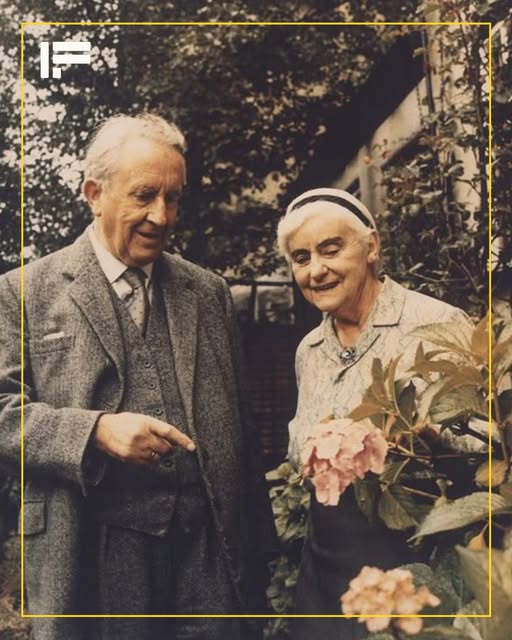
They were married for fifty-five years.
It wasn’t always easy. Edith never fully embraced academic life. She struggled with Catholicism. Tolkien buried himself in his work and his invented languages. But they chose each other, over and over.
They worried obsessively about each other’s health. They wrapped each other’s birthday presents with ridiculous care. When Tolkien retired, he moved them to Bournemouth — a resort town Edith loved — even though he found it boring.
He chose her happiness over his own comfort.
Just as he had chosen to wait three years when he could have rebelled.
Edith died on November 29, 1971, at age eighty-two.
Tolkien was devastated. In a letter to Christopher, he wrote:
“But the story has gone crooked, and I am left, and I cannot plead before the inexorable Mandos.”
In the mythology he created, Mandos was the judge of death who had reunited Beren and Lúthien.
But in real life, Tolkien had to wait.
He died twenty-two months later, on September 2, 1973.
They are buried together in a single grave in Oxford.
The headstone reads:
EDITH MARY TOLKIEN
LÚTHIEN
1889–1971
JOHN RONALD REUEL TOLKIEN
BEREN
1892–1973
The man who created Middle-earth, who invented entire languages and mythologies, who wrote one of the greatest love stories in literature — lived it first.
He waited three years in silence.
He got on a train when she was engaged to someone else.
He watched her dance in the woods and built a mythology around that single moment.
And when she died, he inscribed her name on their shared grave as the immortal elf who chose mortality for love.
Because the greatest fantasy Tolkien ever wrote was just the shadow of the real thing.