
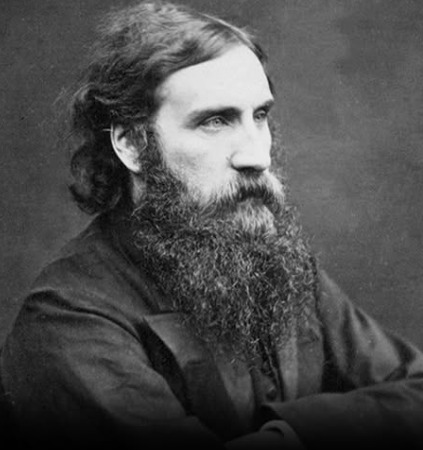
In 1853, a young minister named George MacDonald stood before his congregation in Arundel, England, and said something that would destroy his career.
He said God’s love was too big to abandon anyone. That even the most broken soul might one day find their way home. That a love truly without limits couldn’t have an exception list.
The church elders didn’t see poetry. They saw heresy.
They cut his salary. Then they voted him out entirely.
At 29, MacDonald was publicly disgraced, unemployed, and sick with tuberculosis — already coughing blood, already knowing the disease could take him at any time. He had a young family, no income, and no future in the only profession he had trained for.
So he did the only thing left. He started writing.
Not grand sermons. Not theological arguments. Fairy tales.
Strange, aching, beautiful stories about enchanted forests where shadows could kill you, where trees had souls, where a young man could wander through a dream world and come out changed on the other side. In 1858, he published a book called Phantastes, and almost nobody bought it.
He kept writing anyway. He wrote through poverty. He wrote through grief — several of his children died young. He wrote through worsening lungs and mounting debt, producing more than 50 books across his lifetime. Most of them were quietly ignored.
He died in 1905 in a small cottage in Bordighera, Italy — far from home, largely forgotten — believing, in all likelihood, that he hadn’t mattered very much.
He was wrong.
What MacDonald didn’t know was that in Ireland, a bookish, grieving boy named Clive Staples Lewis was growing up — a boy who had lost his mother, lost his faith, and was quietly becoming a skeptic who trusted logic more than wonder.
A few years after MacDonald’s death, the teenage Lewis picked up a worn copy of Phantastes at a train station bookstall.
He later said that reading it felt like his imagination had been baptized.
Not converted — not yet. But something woke up in him. The story didn’t argue for God. It didn’t preach. It simply made him feel that holiness was real — that it had a texture, a weight, a fragrance. That some truths can only be lived through story, never argued into existence.
Lewis went on to become one of the most widely read Christian writers in history. He wrote the Chronicles of Narnia — Aslan, the wardrobe, the lampost in the snow. He never stopped crediting MacDonald. “I have never concealed the fact,” Lewis wrote, “that I regarded George MacDonald as my master.”
Lewis’s closest friend was J.R.R. Tolkien — a man who believed, as MacDonald did, that fantasy wasn’t escapism. That myth could carry truth that realism couldn’t hold. Tolkien wrote The Lord of the Rings. He wrote of a hobbit who chose courage, of a ring that had to be carried into darkness, of ordinary people who turned out to be quietly extraordinary.
The lineage runs like a quiet river: MacDonald to Lewis to Tolkien — and from them outward into every fantasy novel, every epic film, every story of redemption and chosen sacrifice that has moved you since.
Every time Aslan walks toward the Stone Table. Every time Frodo says I will carry it. Every time a story makes you feel, somewhere deep and wordless, that love might actually be stronger than darkness —
That is George MacDonald’s idea. The one he was fired for preaching.
He couldn’t say it from a pulpit. So he hid it in fairy tales. He planted it in enchanted forests and talking trees and magical transformations, trusting that the stories would carry what the sermons could not.
He was right.
He scattered those seeds in obscurity. In poverty. In grief. Without recognition, without reward, without ever seeing a single one of them take root.
But here’s what his story keeps whispering, across all this time:
The work that changes everything is rarely the work that gets applauded.
It’s the quiet thing. The overlooked thing. The thing you keep doing not because anyone is watching, but because it is true, and you cannot stop.
George MacDonald kept writing because the stories were true. He never saw what grew from them.
We’re living in it.