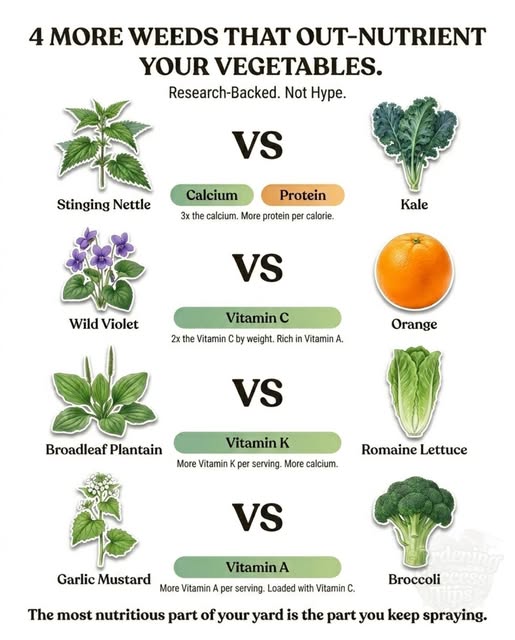
Stinging nettle — the weed that fights back when you grab it — tastes like spinach’s more assertive cousin once you blanch it for thirty seconds. The brief boil neutralizes the sting completely. It’s dense in calcium, iron, and protein. It shows up along fence lines and damp field edges in spring, when the young tops are most tender.
Wild violet — the small purple flower carpeting shady lawns in spring — has leaves mild enough for raw salads and flowers that make an edible garnish with a faintly sweet flavor. The heart-shaped leaves are rich in vitamin C.
Broadleaf plantain — the flat, oval-leaved weed that survives being stepped on, parked on, and mowed over — is rich in vitamins A, C, and K. Young leaves taste mild enough for salads. Older ones cook down like a sturdier spinach.
Garlic mustard — the woodland-edge invader with heart-shaped leaves and a sharp garlic-onion scent — was brought to the U.S. as a cooking herb and is now so aggressive that land managers encourage people to pull it. Straight into a colander.
– Harvest nettle with thick gloves and blanch immediately — 30 seconds in boiling water disarms the sting
– Pick violet leaves in early spring when they’re youngest
– Pull plantain leaves small, before the veins toughen — use raw like a mild, slightly fibrous green
– Gather garlic mustard before it flowers for the best flavor — first-year rosettes and second-year leaves both work
The grocery store version costs more and delivers less.