You pruned the suckers off your Roma and wondered why it produced less fruit. You didn’t prune your Brandywine and it became a tangled mess that rotted from the inside.
Same plant family. Opposite pruning rules. The tag on the transplant tells you which.
The two types that matter most:
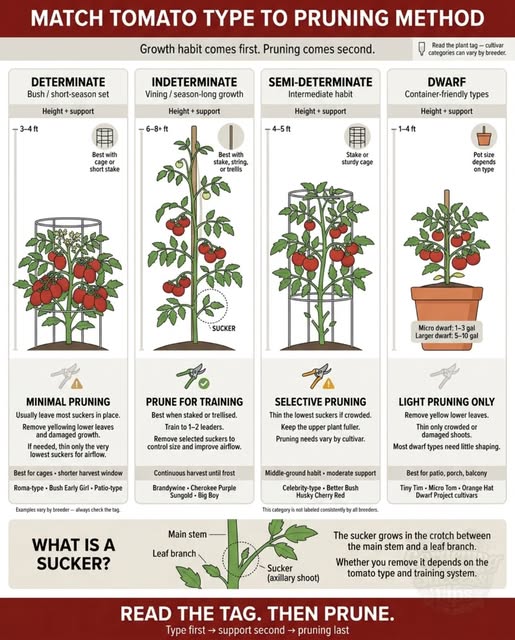
Determinate tomatoes (Roma, Celebrity, Rutgers) grow to a set height, produce most of their fruit in a concentrated window, and stop. Every sucker on a determinate becomes a fruit-bearing branch. Removing suckers removes fruit. Don’t prune them — just take off the lowest leaves where they touch the soil to reduce splash-borne fungal contact. Cage them. Let them bush out.
Indeterminate tomatoes (Brandywine, Cherokee Purple, Sungold, most cherry types) grow and produce continuously until frost. Left unpruned, each sucker becomes a full secondary stem that produces its own suckers — and the interior becomes dense, shaded, and damp. Prune the suckers. Train to one or two main stems on a tall stake or string. Pinch new suckers when they’re small. Check twice a week in warm weather — they appear fast.
The quick guide:
– Determinate (bush) — don’t remove suckers. Remove only the lowest leaves. Cage it. Harvest comes in a concentrated flush — good for canning and preserving
– Indeterminate (vining) — remove suckers regularly. Stake or string trellis. One or two leaders. Harvest is continuous small batches through the season — good for fresh eating
– Semi-determinate (Better Bush, Mountain Magic) — remove suckers below the first flower cluster, leave everything above. Short stake or sturdy cage
– Dwarf (Tiny Tim, Micro Tom) — minimal pruning. Remove lower leaves for airflow. Small stake if it leans. Container-friendly
The Roma you pruned like a Brandywine lost fruit it was never going to replace. The Brandywine you didn’t prune needed the airflow you never gave it.
Read the tag. Match the type.