
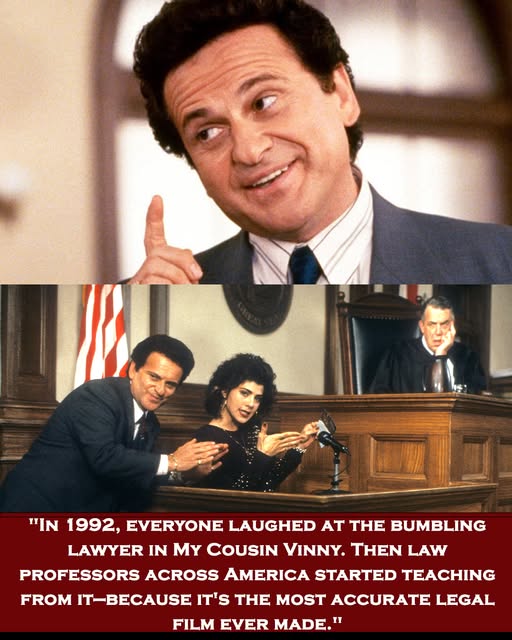
It was 1992, and audiences were howling with laughter.
On screen, Joe Pesci stumbled through an Alabama courtroom as Vinny Gambini—a Brooklyn personal injury lawyer who’d failed the bar exam six times, never tried a criminal case, and showed up wearing a maroon velvet suit that made the judge’s face turn purple.
It was a comedy. A farce. Entertainment.
Nobody expected law schools to start teaching from it.
But that’s exactly what happened.
Within a few years of My Cousin Vinny’s release, something strange started appearing in law school syllabi across America: a comedy film listed alongside Supreme Court cases and legal textbooks.
Criminal procedure professors assigned it. Evidence courses screened it. Trial advocacy instructors made it required viewing.
Because buried inside this slapstick comedy about an incompetent lawyer was something almost impossible to find in Hollywood: perfect legal procedure.
The discovery happened gradually. A defense attorney watched it on cable and paused mid-scene. “Wait—that cross-examination is actually correct.” An evidence professor noticed the impeachment technique was textbook-accurate. Trial lawyers realized the expert witness sequence was flawless.
By the late 1990s, legal scholars were writing academic papers about it. The American Bar Association was recommending it. Judge Joseph Bellacosa of the New York Court of Appeals called it “particularly rich in its use of the Constitutions, rules of evidence, civil and criminal procedure.”
A Joe Pesci comedy had become the gold standard for courtroom accuracy.
Here’s why that’s remarkable:
Most legal dramas sacrifice accuracy for drama. A Few Good Men features a climactic speech that would get you disbarred. The Verdict has procedures that make real lawyers cringe. Even prestige courtroom films choose compelling storytelling over legal reality.
My Cousin Vinny did both.
The plot seems simple: two college kids are wrongly accused of murder in rural Alabama. Vinny Gambini—their cousin who just passed the bar after six attempts and has never set foot in a courtroom—shows up to defend them.
He’s a disaster. He insults the judge. He doesn’t know basic procedure. He wears ridiculous outfits. Every scene suggests his clients are doomed.
Then the trial actually starts, and something shifts.
The prosecution presents two eyewitnesses who claim they saw the defendants’ car fleeing the murder scene at high speed. In most movies, the hero lawyer would give a passionate speech about reasonable doubt.
Vinny does what real lawyers do: he destroys their testimony using physical evidence and logic.
The first witness claims he saw the car while cooking breakfast. Seems solid—until Vinny cross-examines him about the grits. How long were they cooking? What type? Instant or regular?
Through relentless, methodical questioning, Vinny establishes that regular grits take twenty minutes to cook properly. The witness’s timeline is impossible. He couldn’t have seen what he claimed.
The courtroom erupts when Vinny asks: “Were these magic grits? Did you buy them from the same guy who sold Jack his beanstalk beans?”
It’s hilarious. It’s also perfect impeachment technique—using specific details to expose impossible testimony.
The second witness is an elderly woman who claims she saw the car clearly. Vinny doesn’t call her a liar. Instead, he establishes through gentle questioning that she needs thick glasses to see distances, wears them inconsistently, and couldn’t possibly have identified a speeding car from her window at that distance.
He uses her own testimony to destroy her credibility. No drama. No shouting. Just methodical cross-examination.
Then comes the sequence that law professors obsess over.
Vinny calls his girlfriend, Mona Lisa Vito, as an expert witness on automobiles. The prosecutor immediately objects—she’s not qualified.
The judge demands her credentials.
What follows is two minutes of textbook-perfect expert witness qualification. Mona Lisa lists her father’s career as a mechanic, her childhood working in his shop, her training, her certifications, her specific expertise in American automotive engineering from 1963 to 1972.
It’s exactly how expert witnesses establish credibility in real trials.
Then Vinny examines her about the tire marks at the crime scene. He asks open-ended questions. He lets her explain the technical details. He builds logically to the conclusion: the tire marks physically could not have come from his cousin’s car—the vehicle lacked the mechanical specifications to make those marks.
When the prosecutor tries to cross-examine her, he fails spectacularly. She knows more about cars than anyone in that courtroom, and it shows.
Legal experts point to this scene as a masterclass in expert witness examination. The qualification. The direct examination. The failed cross-examination. All of it tracks exactly how real trials work.
Even the comedy comes from accurate legal procedure. Judge Haller holds Vinny in contempt repeatedly—for inappropriate clothing, for addressing the judge incorrectly, for procedural violations. This isn’t exaggerated. Real judges enforce these standards exactly this way.
The voir dire sequence where Vinny questions potential jurors? Accurate. The discovery violations? Correct. The objections and their legal basis? Precise.
Screenwriter Dale Launer wasn’t a lawyer, but he spent months researching. He interviewed defense attorneys, studied trial transcripts, consulted legal experts. He wanted the legal framework to be bulletproof so the comedy could work.
He succeeded beyond imagination.
Marisa Tomei won an Oscar for her performance. But the film’s legacy extends far beyond entertainment.
Today, it’s cited in legal journals and continuing legal education seminars. Harvard Law School has screened it. Trial advocacy courses use clips to demonstrate proper technique. The National Institute for Trial Advocacy references it in training materials.
A 2008 survey of lawyers ranked it the seventh-best legal film ever made for accuracy—ahead of prestige dramas and documentaries.
Because My Cousin Vinny understood something most legal films miss: real trials aren’t won by dramatic speeches. They’re won by mastering procedure, understanding evidence, and methodically building a case.
Vinny Gambini looks like a buffoon in his leather jacket and attitude. But watch carefully, and you see him doing everything right: he studies the evidence, he identifies inconsistencies, he prepares his witnesses, he follows proper examination technique.
The joke isn’t that he’s incompetent. The joke is that everyone—including the audience—assumes he’s incompetent because he doesn’t look like their idea of a lawyer.
Thirty years later, law students still watch Vinny stumble through that Alabama courtroom, laughing at his mistakes—until they realize he’s been building an airtight defense the entire time using flawless legal strategy.
It’s a comedy about an underestimated lawyer who wins through actual competence.
And accidentally, it became the most legally accurate courtroom film Hollywood ever made.