
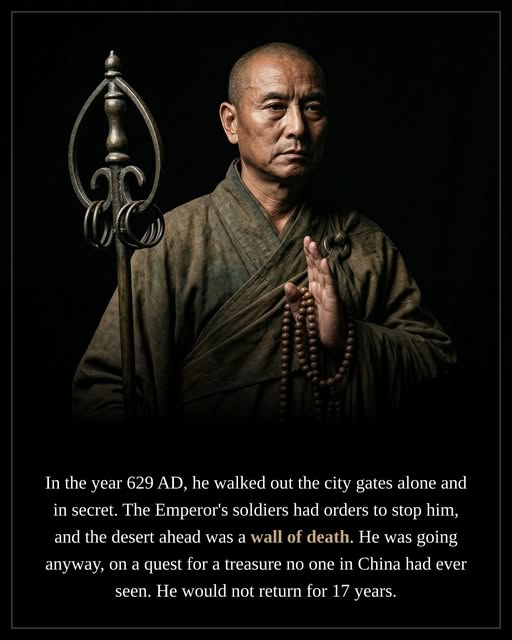
The gates of Chang’an closed behind him with a soft, final thud.
It was 629 AD.
The young monk, Xuanzang, was now an outlaw.
He had just violated a direct imperial decree. The Tang Emperor Taizong had forbidden all travel beyond the western frontiers.
The punishment for disobedience was severe.
But Xuanzang had made his choice. He walked west, alone, into the gathering dusk.
His goal was not gold or glory.
It was paper.
Specifically, the original words of the Buddha, written on palm leaves in a language he had never fully mastered.
The Buddhist scriptures available in China were a mess. They were incomplete, translated by different hands over centuries, and full of contradictions.
Monks argued over the true meaning of the teachings. Xuanzang’s soul burned with a single question: what did the Buddha actually say?
He believed the answer lay 10,000 miles away.
In India.
His journey would become one of the most epic solo treks in human history.
He faced the Gobi Desert first.
It was a sea of bleached bones and shifting dunes. The sun was a hammer.
The wind was a blade. He nearly died of thirst when he spilled his entire water skin.
For five days and four nights, he stumbled forward without a single drop.
He began to see mirages of armies and oases. He prayed to the Bodhisattva Avalokiteshvara.
A sudden cool breeze revived him, guiding him to a patch of grass with a hidden spring.
He survived.
Next were the Pamir Mountains, the roof of the world.
Paths were mere goat trails carved into cliffs of ice. He inched across rope bridges that swung wildly over thousand-foot gorges.
The cold bit through his robes. He slept in caves, surrounded by the groans of glaciers.
He passed through warring kingdoms and bandit-infested valleys.
He was captured more than once. Robbers held knives to his throat, demanding his meager possessions.
He would sit calmly and begin to lecture them on karma and compassion. Astonished, they often let him go.
After four grueling years, he finally crossed into India.
He had reached the land of the Buddha.
But his quest was only half complete.
He spent the next decade traveling across the subcontinent. He visited every sacred site.
He debated the greatest scholars in their own tongue. He mastered Sanskrit until he spoke it better than many native priests.
His ultimate destination was Nalanda University.
It was the Oxford of the ancient world.
A sprawling monastic city of 10,000 students and 2,000 teachers. Libraries stretched to the horizon.
The debates were legendary, intellectual combat where the defeated could be forced to convert.
Xuanzang did not just study there.
He conquered.
He engaged in weeks-long philosophical duels with the masters of eighteen different schools of thought. He defended his interpretations with such flawless logic and scriptural knowledge that he was declared a *mahapandita*—a great scholar.
The head of Nalanda, the venerable Silabhadra, personally tutored him.
Xuanzang’s reputation soared. Indian kings showered him with gold, elephants, and titles.
He refused them all.
He had only one treasure in mind.
Original texts.
He spent years meticulously copying them. Sutras, commentaries, treatises.
He filled crate after crate. He also collected precious relics and hundreds of statues.
In 643 AD, laden with knowledge, he knew it was time to go home.
The journey back was just as perilous.
Bandits attacked his caravan on the Indus River. The boat capsized.
Dozens of manuscripts were lost to the muddy waters. Xuanzang wept on the riverbank, but he pressed on.
He chose a different, even more treacherous route back through the southern deserts to avoid the northern passes he’d already conquered.
He was testing fate one last time.
Seventeen years after he had slipped out of Chang’an, a weathered figure approached the city walls.
It was 645 AD.
He was 43 years old.
He was leading a train of twenty-two horses, all staggering under the weight of his cargo.
The news raced through the capital.
The outlaw monk had returned.
And he had brought back 657 bundles of sacred texts.
Emperor Taizong, the same emperor who had forbidden his departure, now sent a royal escort to greet him. The city erupted in celebration.
Thousands lined the streets to see the man who had walked to the edge of the world and back.
The Emperor asked him to write an account of everything he had seen.
Xuanzang produced the ‘Records of the Western Regions of the Great Tang Dynasty.’ It was a masterpiece of geography, ethnography, and politics. For centuries, it would be the most accurate map the Chinese had of India and Central Asia.
Then, he turned to his life’s work.
Translation.
He assembled a team of the brightest scholars in the empire. He worked day and night for nineteen years.
He translated over 1,300 chapters of scripture, bringing clarity to Chinese Buddhism for generations to come.
He worked until his brush fell from his fingers.
He died in 664 AD, surrounded by the towering stacks of paper that were his true legacy.
He had defied an empire, crossed deserts of death, scaled mountains of ice, out-debated the greatest minds of his age, and carried a continent’s wisdom home on his back.
All because he needed to know the truth.
He walked so that millions could read.
Sources: The British Museum / Dunhuang Research Academy / Records of the Tang Dynasty (舊唐書)
Photo: Wikimedia Commons