
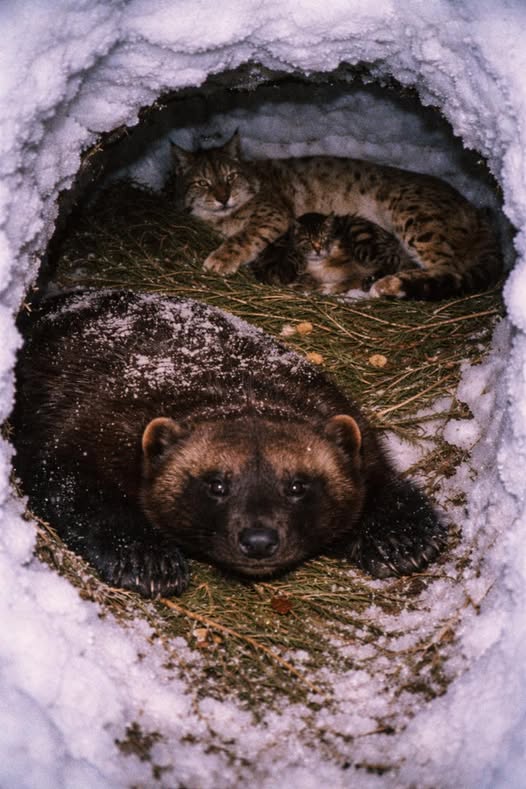
“In March 1972, during a blizzard that killed eleven people in interior Alaska, a trapper found a wolverine den that contained something impossible: a wolverine, a mother cat, and three kittens. Alive. Together. The wolverine — the most aggressive pound-for-pound predator in North America — had dug a snow cave large enough for all five of them. The cat was nursing. The wolverine was lying two feet away, facing the entrance, blocking the wind with its body.”
Walt Buchanan, fifty-seven, had been trapping in the Brooks Range of interior Alaska for thirty-one years. He had caught wolverines, skinned wolverines, and respected wolverines more than any other animal in the north. A wolverine will face down a grizzly bear over a carcass. It will travel forty miles in a day through waist-deep snow. It has jaws that can crush frozen bone. It fears nothing.
In March 1972, a blizzard dropped four feet of snow in thirty-six hours across the interior. Temperatures hit -52°F with wind chill. Eleven people died.
On March 14, two days after the blizzard ended, Walt was checking his trap line along a frozen creek north of Wiseman when he noticed a hole in a snowbank — not a natural formation, but a dug opening. The entrance was approximately eighteen inches wide, angled downward. The snow around it was packed hard. Claw marks were visible on the inner surface — large, deep, spaced wide. Wolverine.
Walt had found wolverine dens before. He approached with caution — a cornered wolverine is one of the most dangerous encounters in the north. He shone his flashlight into the entrance.
What he saw made him back away, sit down in the snow, and — as he told the story for the rest of his life — “try to figure out if the cold had finally gotten to my brain.”
The den was approximately five feet deep and three feet wide — a classic wolverine snow cave, dug with precision into a packed drift. The floor was lined with spruce boughs — wolverines sometimes drag vegetation into their dens for insulation.
Against the back wall, on a bed of spruce boughs, was a grey tabby cat. On her side. Nursing three kittens. Approximately two weeks old. All alive. All warm.
Two feet from the cat, between her and the den entrance, a wolverine lay flat on its belly. A large male, maybe thirty-five pounds. It was facing the entrance. Its body was positioned to completely block the eighteen-inch opening — no wind could reach past it. Its fur was frosted. Snow had accumulated on its back. It had been lying there, motionless, as a living door.
The wolverine looked at Walt. Walt looked at the wolverine. The wolverine did not growl. It did not charge. It looked at him with small dark eyes and then looked back at the entrance. Guarding.
Walt backed away. He returned the next day with a camera — a Kodak Instamatic that produced small, square photographs. He took four pictures from the den entrance before the wolverine’s posture shifted and he decided discretion was the better part of wildlife photography.
The photographs — grainy, flash-lit, slightly blurred — show the interior of a snow cave. In the back: a cat and kittens on spruce boughs. In the foreground: the dark bulk of a wolverine, facing the camera, eyes reflecting the flash.
Walt monitored the den for nine days. On the ninth day, the cat and kittens were gone — their tracks led south, toward a mining camp three miles away where feral cats were known to live. The wolverine was gone too — its tracks led north, into the Range.
The cat had used the wolverine’s den for shelter during the blizzard. Or the wolverine had dug the den and allowed the cat to stay. Or something else entirely had occurred that neither Walt nor anyone who heard the story could explain.
Dr. Audrey Magoun, a wolverine researcher who spent twenty years studying the species in Alaska, heard Walt’s account in 1988. She examined his photographs and confirmed the den structure was consistent with wolverine construction. She wrote in a personal note: “Wolverines are solitary, aggressive, and territorial. They do not share dens. They certainly do not share dens with potential prey. Walt’s photographs appear to show a wolverine acting as a windbreak for a nursing cat in a den it constructed. I have no behavioral explanation for this. The only framework that approaches it is the denning behavior wolverines exhibit with their own kits — in which the male sometimes guards the den entrance while the female nurses inside. If this wolverine was exhibiting paternal guarding behavior toward a non-wolverine family, then we need to significantly expand our understanding of wolverine social cognition.”
Walt died in 1994. His four photographs are in a shoebox in his nephew’s house in Fairbanks. They have never been published.
His nephew says Walt told the story the same way every time, and always ended with the same line:
“That wolverine was the meanest animal in Alaska. I’ve seen them fight wolves, fight bears, fight everything. But that night, in that hole in the snow, he wasn’t fighting anything. He was keeping a door closed so three kittens could stay warm. You tell me what that means. Because I’ve had fifty years to think about it and I still don’t know.”