
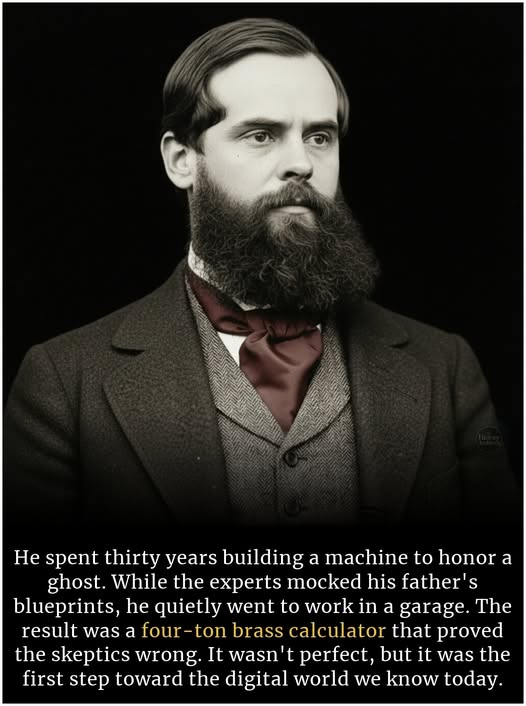
In 1910, the floor of a London workshop finally stopped shaking. After thirty years of grinding metal and late nights, the machine was done.
It stood over nearly three feet high and weighed huge amounts of brass and iron. It looked less like a calculator and more like a steam engine designed to crush rocks.
This was not a hobby project. This was a matter of family honor.
Decades earlier, in London, a genius named Charles Babbage had a vision. He designed the “Analytical Engine,” a device that would use punch cards to solve math problems.
He secured government funding, which is usually where the trouble starts. The project burned through cash, the engineers argued over specifications, and the government eventually pulled the plug in 1842.
Charles died in 1871, a bitter man. The world saw him as a failure who wasted public money on a pipe dream. His blueprints were gathering dust, dismissed as the ramblings of a mad scientist.
But his son, Henry Prevost Babbage, refused to let the story end there.
Henry wasn’t just a dutiful son; he was a skilled man who understood the value of hard work and construction. He knew the designs were sound.
In the 1880s, Henry went into retirement, but he didn’t go fishing. He went to work.
He took his father’s chaotic drawings and started building. He focused on the “Mill”—the processing unit—and a printing mechanism.
This was serious heavy industry. He had to machine thouands of custom brass gears. There were no computer-aided designs, just hand tools and patience.
For thirty years, he labored in obscurity. He funded the construction himself, investing his own time and resources when the experts said it was impossible.
Finally, in 1910, he fired it up. The gears turned. The pistons pumped. The immense machine calculated multiples of Pi and printed them out on paper coils.
It wasn’t perfect. There were mistakes in the math. It wasn’t fully programmable like the computers we have today.
But it worked.
He proved the theory was solid. He proved the mechanics were viable. He proved his father was right.
It was a vindication of a lifetime of struggle. Henry didn’t build it to get rich or famous. He built it to clear his family name and show that the investment of intellect wasn’t in vain.
Today, that brass beast sits in a museum. It reminds us that sometimes the most advanced technology starts with a wrench, a blueprint, and a son who won’t quit.
When Henry finished the machine, he didn’t try to hide its flaws. The device calculated multiples of Pi, but it made errors along the way. It was a mechanical beast, subject to friction and wear, just like any engine.
Henry candidly noted the mistakes in the printed results. He wasn’t trying to sell a perfect product; he was offering a proof of concept. Even with the errors, the fact that a pile of brass gears could perform complex algebra in 1910 was nothing short of miraculous. It remains a testament to Victorian engineering and sheer stubbornness.
Sources: Science Museum London / The Babbage Papers