
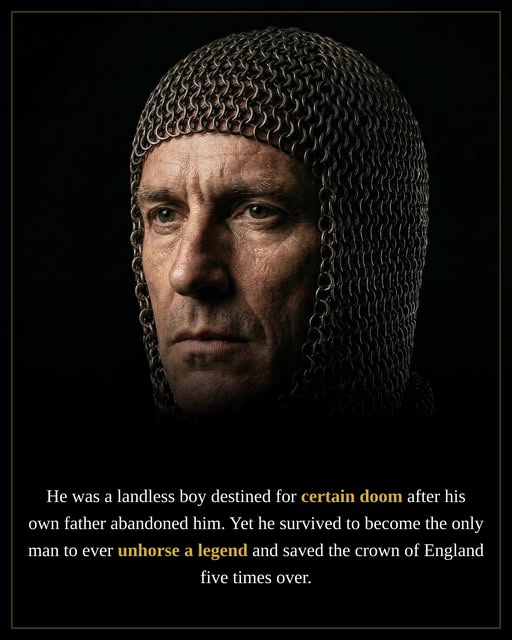
The year was 1152, and a five-year-old boy stood trembling before a massive siege engine.
His name was William Marshal, and his father had just signed his death warrant.
During the brutal civil war known as The Anarchy, William’s father had given the boy to King Stephen as a hostage to guarantee a truce.
But when the father broke that truce immediately, the King sent word that he would hang the boy or launch him from a catapult over the castle walls.
His father’s response was chilling: “I still have the hammer and the anvil with which to forge still more and better sons.”
To his father, William was a disposable pawn. To the King, he was a nuisance.
But the King looked into the eyes of the boy playing with his spears and saw something different. He saw a spark of courage that stayed the executioner’s hand.
William survived that day, but he was left with nothing—no land, no inheritance, and no future but the one he could carve with a sword.
He spent his youth in the brutal world of medieval tournaments, which were less like sports and more like chaotic, small-scale wars.
He didn’t just participate; he dominated. It is said he captured over 500 knights in his career, amassing a fortune in ransoms and a reputation that echoed across Europe.
But William Marshal was more than a mercenary. He was a man of an extinct brand of loyalty.
In 1189, during a rebellion, a young and hot-headed Prince Richard—the man who would become Richard the Lionheart—found himself face-to-face with Marshal on the battlefield.
Richard was the greatest warrior of his age, yet Marshal charged him with such ferocity that the Prince was terrified.
“By God’s legs, Marshal, do not kill me!” Richard shouted.
Marshal had the power to change history with one thrust of his spear. Instead, he chose a different path.
He pivoted his aim at the last second and drove his lance through Richard’s horse, killing the animal and pinning the Prince to the ground.
He had proven he could take the life of a future king, yet his code of honor forbade it. He simply turned his horse and rode away.
When Richard eventually took the throne, he didn’t seek revenge. He sought the service of the man who was brave enough to best him.
William Marshal would go on to serve five different English kings, often acting as the only pillar of stability in a kingdom tearing itself apart.
His greatest test came during the reign of King John, a man widely regarded as one of the worst monarchs in history.
While other barons betrayed the King and invited a French invasion, Marshal remained steadfast.
It wasn’t because he loved the tyrant John; it was because he had sworn an oath before God to protect the crown.
When King John died in 1216, the kingdom was in ruins. Half of England was occupied by the French, and the heir to the throne, Henry III, was only nine years old.
The boy king was crowned with his mother’s golden belt because the royal crown had been lost in a swamp.
At nearly 70 years old—an ancient age for a medieval warrior—William Marshal was named Protector of the Realm.
He didn’t retreat to his estates. He put on his armor one last time.
At the Battle of Lincoln in 1217, the old man led the charge himself, his white hair flowing from beneath his helmet as he smashed the French forces and secured the throne for the boy king.
He saved England when no one else could, then voluntarily gave up his power as Regent once the threat had passed.
As he felt his final days approaching in 1219, he did something that surprised the royal court.
He summoned the Knights Templar to his bedside. Years earlier, while on crusade in the Holy Land, he had secretly promised to join their order.
On his deathbed, the greatest knight of the age took the vows of poverty and service, dying not as a wealthy Earl, but as a humble brother of the Temple.
At his funeral, the Archbishop of Canterbury stood over his body and addressed the grieving crowd.
He didn’t call him a politician, a lord, or a general. He gave him the title that has followed him through the centuries.
“He was,” the Archbishop said, “the greatest knight that ever lived.”
He began his life as a boy destined for a catapult and ended it as the savior of a nation, proving that a man’s worth is not born in his blood, but forged in his honor.
Sources: ’The History of William Marshal’ (13th-century biography) / British Library Archives / University of Oxford Historical Records
Photo: Wikimedia Commons