
Some people are stellar examples. This is one of them.
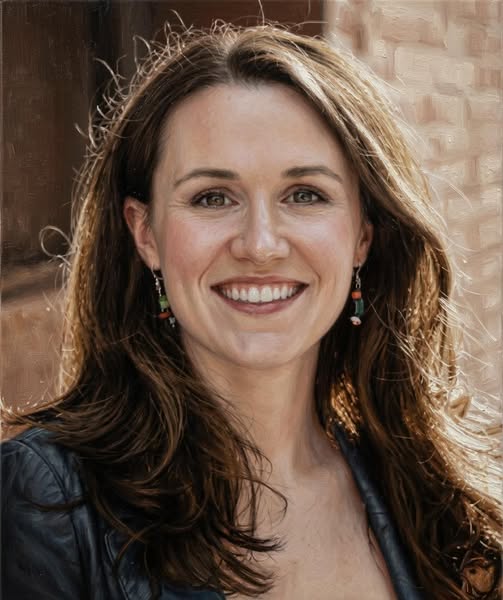
Some people are stellar examples. This is one of them.
She chose the subway token over the slice of pizza. She was starving. That choice changed everything.
Elizabeth Murray stood at her mother’s grave on a frozen December morning in 1996. She was sixteen years old. The coffin was donated pine. Someone had written her mother’s name in black marker—and spelled it wrong. There was no money for flowers. No money for anything. Just a crumpled photograph in Liz’s coat pocket: her mother at seventeen, smiling, before the world took it all away.
Liz made herself a promise that day. Her life would look nothing like this.
She was born in the Bronx in 1980 to parents who loved her desperately and could not take care of her. Both were addicts—cocaine and heroin ruled the household. Her mother Jean was legally blind, which meant a monthly welfare check. The first of every month, there was food. Music. Life. By day five, the money was gone. For the next three weeks, Liz and her sister ate mayonnaise sandwiches. When the eggs ran out, they ate ice cubes. The cold, Liz said later, felt enough like eating to quiet the hunger.
She watched her parents shoot up in the kitchen. They didn’t hide it. Once, her mother stole five dollars from Liz’s birthday card—money sent by her grandmother—and used it for drugs. When Liz confronted her, Jean collapsed in tears, begging forgiveness.
Liz forgave her. She always did.
At eleven, her mother told her she had AIDS.
Everything unraveled slowly, then all at once. Her parents separated. Liz bounced between her father’s apartment, her grandfather’s house, a group home, the streets. School became impossible—not just because of the chaos, but because the other kids mocked her unwashed clothes. It was easier to disappear.
At fifteen, her world ended. Her father moved into a homeless shelter. Three weeks before Christmas 1996, her mother died of AIDS and tuberculosis in a hospital bed.
Liz had nowhere to go.
She learned how to survive. The D train was warmest at 2 AM—she rode it in circles to stay out of the cold. She slept in apartment hallways, on friends’ couches, in parks. She ate what she could find. But somewhere deep inside, something was calculating. Connecting dots. She saw the path her mother’s choices had carved, and she refused to follow it.
She went looking for a school.
One day, she reached into her pocket and counted what she had: exactly enough for either a subway token to a school interview or a slice of pizza. She was so hungry her hands shook. She bought the token.
The man across the desk was Perry Weiner, founder of Humanities Preparatory Academy in Manhattan. He listened. He gave her a seat.
Nobody at school knew she was homeless. She hid it completely—arriving early, never missing class, doing homework in subway stations by fluorescent light. She loved learning with a hunger that matched the one in her stomach. The classroom was the only place that made sense.
She did four years of high school in two. Graduated top of her class of 158 with a 95 average.
Her teacher took her to visit Harvard. Liz walked onto the campus and felt something shift inside her. Her teacher said: “It’s a reach. But it’s not impossible.”
She found the New York Times scholarship—twelve thousand dollars a year for students who had overcome extraordinary obstacles. The application asked her to describe those obstacles. For the first time in her life, she told the whole truth.
The morning her essay was published, Liz arrived at school to find the lobby full of strangers. Teachers. Students. Neighbors who’d read her story. Someone brought food. Someone brought money. Someone offered her a couch.
From that day forward, she never slept on the street again.
She was one of six students—out of three thousand applicants—to win that scholarship.
Harvard admitted her in 1999.
But the story didn’t end there. Three years into college, her father—who had gotten sober—was dying of AIDS. Liz left Harvard to care for him. She sat with him until he died in 2006. Then she went back. She finished her degree in 2009.
She became a speaker, a counselor, an advocate for homeless teenagers. She named her mentoring organization The Arthur Project, after the upstairs neighbor who was the first person to believe in her.
Oprah gave her the first-ever Chutzpah Award for women who show impossible courage. Her memoir, Breaking Night, became a New York Times bestseller, translated into twelve languages. A Lifetime movie about her life earned three Emmy nominations.
And here’s the part people struggle to understand: she never blamed her parents. She said they were good people with a disease stronger than they were. She kept that crumpled photograph of her mother—young, smiling, full of hope—in her pocket for years.
She was homeless at fifteen.
She got into Harvard at eighteen.
She did her homework on the subway.
Her name is Liz Murray. And she chose the subway token.