
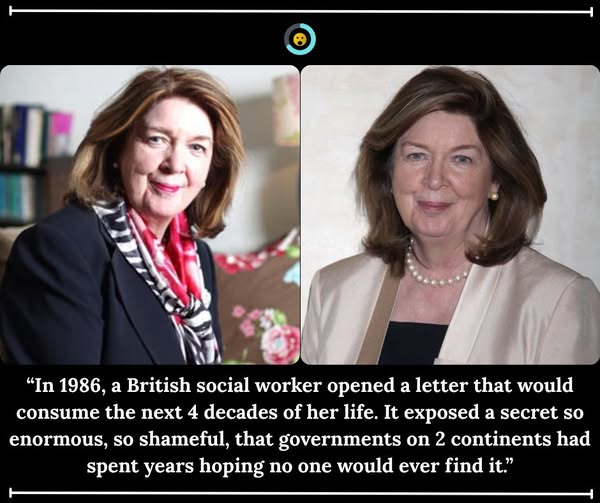
1986. Nottingham, England.
Margaret Humphreys is a social worker. She is not famous. She has no political connections, no private funding, and no reason to believe that a single letter from a stranger in Australia is about to change her life forever.
The letter is from a woman who says that at the age of 4, she was placed on a boat by the British government and shipped to a children’s home in Australia. She was told her parents were dead. She grew up an orphan on the other side of the world.
Now she is an adult. She wants to know if any of her family is still out there.
Humphreys agrees to investigate. She expects to spend a few weeks searching records and confirming what the woman already suspects — that her parents are gone.
Instead, she finds the woman’s mother. Alive. Living less than an hour from Nottingham.
The woman’s parents were never dead. They were never even told where their child had been sent.
The Secret That Had Been Hidden in Plain Sight.
Humphreys begins pulling on the thread. What unravels is one of the most shocking government programmes in British history.
For over 100 years – from the 1860s all the way to 1970 – the British government and a network of charities and religious organisations had been systematically removing children from care homes and shipping them to Australia, Canada, and other Commonwealth nations. The children were told they were orphans being given a better life.
Most of them were not orphans. They had living parents. They had siblings still in England.
They had families who had surrendered them temporarily during times of poverty or illness, fully expecting to be reunited.
Nobody told the parents where their children went. Nobody told the children their parents were alive.
More than 130,000 children were transported. The youngest were as young as 3 years old.
Here’s what makes it worse, many of the institutions receiving these children in Australia were run by religious orders who used the children as cheap labour. Boys worked farm fields from before sunrise. Girls cleaned and cooked for institutions that kept them entirely cut off from the outside world. Some were denied any education at all. Investigators would later describe what happened in those institutions as “widespread and systematic sexual abuse.”
The children were told they were the sons and daughters of whores. That they were worthless.
That nobody back in England loved them or wanted them back.
Many of them believed it for the rest of their lives.
1987. Humphreys’ Living Room, Nottingham.
After traveling to Australia and posting newspaper advertisements asking for former child migrants to come forward, Humphreys is overwhelmed by the response. At first it is a trickle.
Then it becomes thousands.
She establishes the Child Migrants Trust – initially from her own home, with her husband Mervyn as her closest support – and registers it as a charity in both Australia and Britain.
She has no government backing. No institutional support. The organisations responsible for the scheme – including powerful church bodies and charities – are not remotely pleased to see her digging.
She faces legal pressure. She faces institutional stonewalling. Files go missing. Doors are closed. She is one social worker from Nottingham going up against organisations that have decades of experience in making things disappear.
She does not stop.
The Work.
For the next 23 years, Humphreys travels constantly between Nottingham, Western Australia, and Victoria, combing through emigration records, church ledgers, government archives, and institutional files that were never designed to be found by people like her.
She reunites more than 1,000 individuals with their biological families in those first decades alone. Every reunion is its own extraordinary story. Elderly parents meet children they last saw as toddlers. Brothers and sisters discover each other after 40 or 50 years of believing the other was gone. Middle-aged adults finally learn their own real names.
Some of those parents are in their 80s and 90s by the time Humphreys reaches them. Some die before she can bring their children home.
In 1993, the Australian government awards her the Medal of the Order of Australia – one of the country’s highest civilian honours – for her services on behalf of the child migrants.
In 1994, she publishes her full account in a book called Empty Cradles. It causes a national outcry in Britain.
The Apologies.
It takes 23 years of campaigning to force a government to say sorry.
In 2009, the Australian government issues a formal national apology to all former child migrants for the suffering caused by the scheme.
In 2010, British Prime Minister Gordon Brown stands before Parliament and delivers an official apology on behalf of the United Kingdom. He acknowledges the “misguided” programme that unjustly broke up thousands of families and caused immeasurable harm to the children caught inside it.
A few years later, Humphreys is appointed CBE – Commander of the British Empire. The same empire that once shipped children across the world to serve it.
The film Oranges and Sunshine, released in 2010 and starring Emily Watson as Humphreys, brings the story to a global audience for the very first time.
What She Found When She Started Pulling That Thread.
Margaret Humphreys was not a detective. She was not a barrister or a politician or a crusading journalist. She was a social worker who opened a letter and decided that the person inside it deserved to know the truth.
She found over 130,000 reasons why that decision mattered.
The Trust she built from her living room is still operating today – still reuniting families, still supporting survivors, still running offices in England and Australia. Because the work is not finished. Some of those stolen children are still searching. Some are still waiting.
1 letter. 1 social worker. 1 decision to follow the truth wherever it led.
Share this with someone who believes that ordinary people can change the world – because Margaret Humphreys proves it, 1 family at a time.