
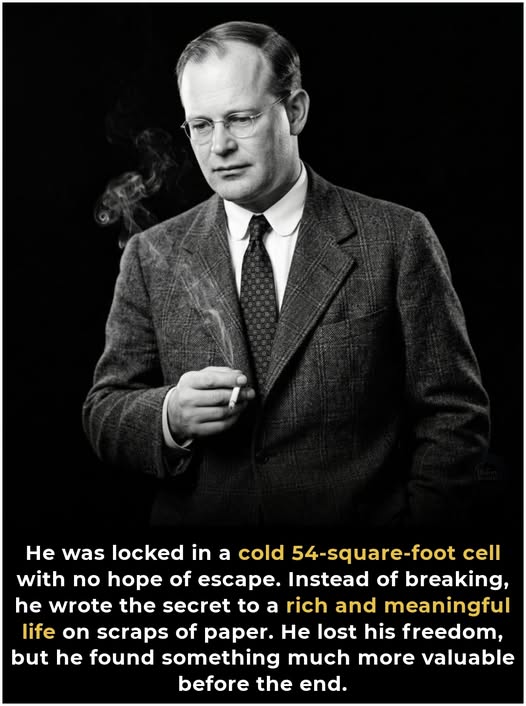
In 1943, a man sat in a cold, 54-square-foot concrete cell in Berlin, waiting for a death sentence he knew was coming.
He had everything taken from him: his books, his family, and the woman he was supposed to marry just months later.
Dietrich Bonhoeffer was no ordinary prisoner; he was a brilliant theologian who had dared to stand against the most evil regime in modern history.
He had been a leader in the underground resistance, helping Jewish families escape across the border to safety.
But by April 1943, the Gestapo finally caught up with him, throwing him into Tegel Prison.
Most men would have withered away in the darkness of such a place, consumed by bitterness or fear.
But Dietrich did something that stunned his fellow inmates and even his captors.
He began to write, filling over 300 pages of scrap paper with meditations on what it means to be human.
In the middle of his suffering, he penned a sentence that still stops people in their tracks today.
He wrote that in ordinary life, we hardly realize that we receive a great deal more than we give.
He saw the beauty in a small piece of bread. He saw the beauty in a smuggled letter. He saw the beauty in a stranger’s kindness.
While the world outside was consumed by war and hatred, Dietrich was teaching himself the art of gratitude.
He realized that even in a prison cell, life only becomes rich when we stop counting our losses and start counting our blessings.
For two years, he was moved from camp to camp, eventually ending up at the gates of Flossenbürg.
On April 9, 1945, just weeks before the war ended, he was led to the gallows at 5:00 AM.
Witnesses said he stopped to pray one last time, calm and resolute in his faith.
His last recorded words to a fellow prisoner were: “This is the end. For me the beginning of life.”
He left behind a legacy that has inspired millions to find hope when everything seems lost.
His letters were smuggled out of prison and published, proving that walls cannot silence a truly free soul.
Today, we remember him not as a victim, but as a man who found abundance in the middle of a desert.
True wealth isn’t what you have in your bank account, but what you hold in your heart.
Sources: National Archives / Dietrich Bonhoeffer: A Biography by Eberhard Bethge