Your soil is telling you what’s wrong. Most gardeners don’t know how to read it.
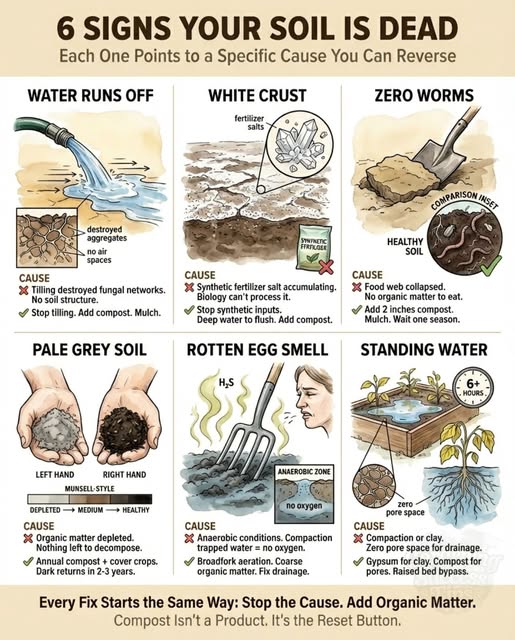
Water that sheets off instead of soaking in. A white crust after the bed dries. No worms when you flip a shovelful. Pale grey color instead of dark brown. A sour smell when you turn it. Standing water hours after rain.
Each one points to a specific cause. And almost all of them point to the same fix.
What you’re seeing and what it means:
– Water running off — the surface has crusted from compaction or lost its sponge-like structure. Fungal networks that hold soil particles together are gone. Stop tilling and mulch over a layer of compost. The structure rebuilds in one season
– White crust — salt residue from synthetic fertilizer building up faster than soil biology can process it. Switch to compost-based feeding and deep water once to flush the surface layer
– No worms in a full shovelful — the food web has nothing to eat. No organic matter, no decomposing mulch, no root activity. Add compost and mulch. Worms migrate in once there’s food
– Pale grey color — organic matter is depleted. Years of harvesting without returning material. Two inches of compost each fall and a cover crop in the off-season bring the color back within a couple of years
– Sour smell when turned — the soil went airless. Compaction or poor drainage trapped water and pushed out oxygen. A broadfork opens air channels without flipping the soil. Coarse organic matter keeps them open
– Standing water hours after rain — no pore space for drainage. Add compost to create channels, or build a raised bed on top and let the soil underneath improve over time
The pattern: five of these six are fixed the same way. Stop tilling. Add compost. Mulch. Wait a season.
The soil isn’t broken. It’s hungry. Feed it and the biology comes back on its own.