
No relationship at all to today’s oil/petrol crisis.
The year is 19 BC, and Marcus Agrippa stands atop the Palatine Hill, his eyes fixed on a marble basin that has remained dry for months.
A crowd has gathered in the searing heat of the Roman summer, their voices a low hum of skepticism and desperation.
Suddenly, a distant rumble echoes through the underground stone conduits, a sound like a coming storm beneath the earth.
Then, the first surge of crystal-clear water erupts from the fountain, cascading over the rim with a roar that drowns out the cheers of the Roman people.
The Aqua Virgo has arrived, stretching fourteen miles from the Alban Hills to the heart of the capital.
This was not just a fountain; it was a declaration of war against geography itself.
In an age before electricity, before steel, and before modern mathematics, Rome achieved the impossible: they made the mountains move.
The engineering challenge was so immense it bordered on the supernatural.
Roman surveyors had to maintain a precise downward gradient of just two feet per mile across dozens of miles of jagged terrain.
If the slope was too steep, the sheer force of the rushing water would erode the stone channels and burst the pipes.
If the slope was too shallow, the water would sit stagnant, turning into a breeding ground for disease before it ever reached the city gates.
Using nothing more than bronze instruments like the chorobates—a long wooden level—and basic geometry, they mapped routes through solid rock.
They were building rivers in the sky, monuments to a civilization that refused to be limited by the land it occupied.
Take the Aqua Marcia, completed in 144 BC, a project that redefined human labor.
Workers were forced to tunnel through six miles of solid mountain rock using only hand-forged chisels and the flickering light of oil lamps.
They worked in suffocating darkness, carving out the veins of an empire inch by grueling inch.
When a valley interrupted their path, the Romans didn’t stop; they built soaring arcades of stone that still stand today.
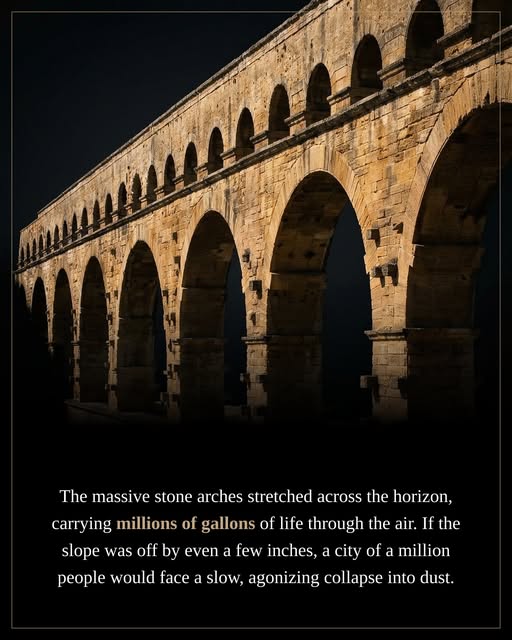
The Pont du Gard in southern France is the ultimate testament to this obsession with perfection.
Its triple-tiered arches carry water 160 feet above the river below, a structure so sturdy it survived the collapse of the very empire that built it.
By the second century AD, eleven massive aqueducts fed the insatiable thirst of Rome.
The system delivered over 300 million gallons of water every single day.
To put that in perspective, Rome provided more water per capita to its citizens than many modern European cities do today.
Every citizen, from the wealthiest senator to the lowliest laborer, had access to fresh, flowing water at public fountains.
The wealthy took it a step further, paying a ’water tax’ to have private lead pipes divert the flow directly into their villas.
But the true heart of the system was hidden from view.
While the giant arches are what we photograph today, 80 percent of the aqueduct system was buried underground.
These miles of subterranean channels were lined with opus signinum, a waterproof cement that was the secret weapon of Roman construction.
Specialized maintenance crews known as the ’aquarii’ spent their lives in the dark, scrubbing the channels of mineral deposits to ensure the flow never faltered.
They were the unsung guardians of the city’s lifeblood.
This water didn’t just provide drinking supplies; it powered the Roman lifestyle.
The Baths of Caracalla were a sprawling complex of luxury that consumed millions of gallons daily.
Inside, 1,600 bathers at a time could move between heated pools, steam rooms, and cold plunges.
It was a level of hygiene and leisure that the world would not see again for over a thousand years.
But this miracle of engineering also created a catastrophic vulnerability.
Rome had grown so large—over one million inhabitants—that it could no longer survive on its own local wells.
The city was an artificial oasis, kept alive solely by the stone arteries stretching out into the countryside.
In the sixth century AD, the nightmare finally became a reality.
Invading Goth armies, realizing they could never breach the city’s walls, turned their attention to the hills.
They smashed the aqueducts, severing the flow of water and silencing the fountains that had roared for centuries.
Without water, the Great City began to wither almost overnight.
The population collapsed from over one million to barely 30,000 people huddled near the Tiber River.
The grand baths became empty stone husks, and the marble basins turned to dust.
Rome didn’t just lose its empire; it lost its ability to sustain life.
Today, these stone giants remain as skeletal remains across the Italian landscape, a haunting reminder of what happens when the machines of progress finally stop.
They proved that a civilization is only as strong as the hidden systems that keep it breathing.
Frontinus, De aquaeductu / The Smithsonian Institution / University of Virginia School of Architecture
Photo: Wikimedia Commons