
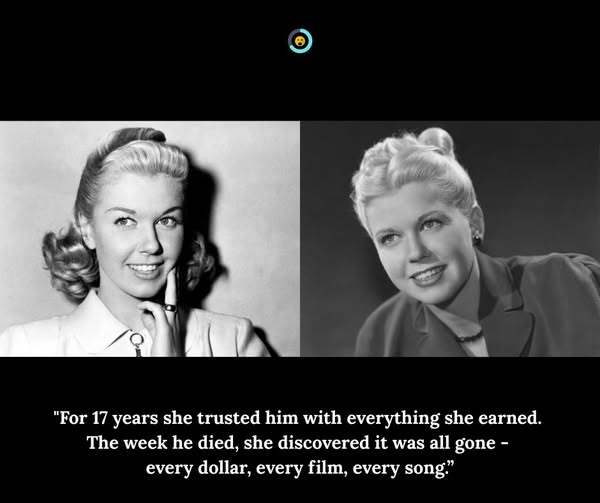
She was 46 years old, grieving, and completely alone when her son sat her down and told her the truth.
Martin Melcher – her husband of 17 years, her manager, the man who handled everything while she focused on performing – had died of a sudden heart attack in April 1968. And in the weeks that followed, as lawyers sorted through the estate, what emerged was not the security Doris Day had spent two decades building.
Melcher and his longtime business partner and attorney Jerome Rosenthal had mismanaged and embezzled roughly $20 million of her career earnings, leaving her not only penniless but saddled with substantial debts.
Twenty million dollars.
Every film. Every record. Every exhausting performance. Every season of Calamity Jane and Pillow Talk and The Man Who Knew Too Much. Gone – invested into unproductive oil wells in Texas, Oklahoma, and Kentucky, failing cattle ranches, bankrupt hotels and motels, and ventures in racehorses and other high-risk enterprises, all of which had collapsed and generated millions in losses.
Doris would later say she believed Martin had simply trusted the wrong person – that Rosenthal had deceived them both. She stated publicly that she believed Martin innocent of any deliberate wrongdoing.
That forgiveness makes the story more painful, not less.
And then came the second shock.
Day learned that Melcher had signed her name to a contract for a television sitcom called The Doris Day Show -committed her to appear on CBS, signed without her knowledge, with a significant advance already spent. She was expected on set in weeks.
She had never read a script. Never agreed to do television. Never wanted to.
But the contract was legally binding. If she refused, CBS could sue – adding even more debt to the mountain already above her.
“It was awful,” she said later. “I was really, really not very well when Marty passed away, and the thought of going into TV was overpowering.”
She showed up anyway.
Every week for five seasons, America tuned in to watch Doris Day – sunny, warm, the eternal girl next door – navigate life with optimism and grace in a cheerful sitcom about a widowed mother.
They had no idea what they were actually watching.
Behind every laugh track was a woman who had just lost $20 million to betrayal. Behind every bright set was someone working episode by episode to crawl back to solvency. Behind every warm smile was a person carrying something the audience was never meant to see.
She never let it show. She never broke character. She never complained publicly.
She just showed up.
In 1969, she filed suit against Jerome Rosenthal — accusing him of fraud, legal malpractice, and breach of fiduciary duty. The case went to trial in 1974. The 99-day trial involved 67 witnesses and 14,451 pages of transcript.
The judge ruled in her favor. The final judgment, including punitive damages, came to $26,396,511.
Rosenthal appealed repeatedly, prolonging the litigation for years. He was ultimately disbarred by the California State Bar in 1987 for moral turpitude in his handling of Day’s affairs and those of other celebrity clients.
In 1979, Day reached a settlement with Rosenthal’s insurers for $6 million, to be paid over 23 annual installments. Not the full amount. But justice, slow and incomplete, had arrived.
By then, The Doris Day Show had been off the air for years. She was financially stable again. She had rebuilt, paycheck by paycheck, what had been taken from her.
And then she did something Hollywood genuinely could not understand.
She walked away.
No farewell tour. No final album. No comeback press campaign. She moved to Carmel, California – a quiet coastal town – and co-founded the Doris Day Animal Foundation in 1978, spending her remaining decades rescuing animals and living entirely on her own terms.
When reporters asked why she’d left at the height of her renewed fame, she gave them a line that contained everything she’d learned about the world in those seventeen years,
“I like being the girl next door. I just wish I’d known what the neighborhood was really like.”
Doris Day died on May 13, 2019, at age 97.
Her obituaries celebrated Que Sera, Sera and Calamity Jane and the warmth that had made her one of the most beloved entertainers in American history.
But her real story is quieter and harder and more extraordinary than any of the films.
It’s the story of a woman who discovered at 46 that everything she had built had been taken – and chose, in the face of that, not bitterness but work. Not collapse but showing up. Not revenge but a lawsuit pursued with patient, exhausting dignity across an entire decade.
And when it was finally over, when she finally had the freedom to choose absolutely anything, she chose animals and silence and peace over every spotlight that still wanted her back.
Whatever will be, will be.
But Doris Day proved something the song never quite said: you get to have a say in what it becomes.
She lost everything.
She built it back.
And then she chose something better.