
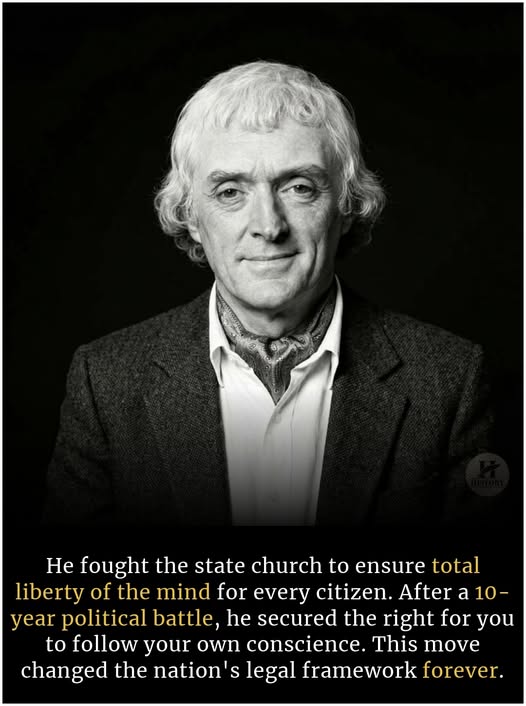
In 1776, a man sat in the heat of a Virginia summer with a quill in his hand and a radical thought in his mind. At the time, if you didn’t belong to the official state church, you were often treated like a second-class citizen or a criminal.
Thomas Jefferson saw this as a direct violation of the natural rights he held so dear. He believed that the mind was created free and that no government should ever have the power to force a person to support a religion they didn’t believe in.
He drafted the Bill for Establishing Religious Freedom, but the local establishment wasn’t ready to let go of their power. They fought him for years because they believed the state needed a state-sponsored religion to remain moral.
But Jefferson stood his ground even as the criticism mounted. He was often called an atheist or a skeptic by his enemies, but his focus remained on the legal protection of every individual soul.
He watched the dissenters struggle. He watched the preachers get jailed. He watched the citizens get taxed to support churches they never stepped foot inside.
He saw their struggle. He saw their frustration. He saw their potential for true liberty if the chains of state-mandated faith were finally broken.
It took ten long years of political maneuvering and debate, but in 1786, his vision finally became the law of the land in Virginia. This statute became the very blueprint for the First Amendment of the United States Constitution just a few years later.
Jefferson considered this one of his greatest achievements, even more than being the President. He wanted to be remembered as the man who gave Americans the right to follow their own conscience without fear of the government.
Today, we live in a nation where people of all faiths, or no faith at all, can walk the streets with the same legal rights. That reality exists because one man decided that the government had no business in the pews of a church.
This wall of separation remains the cornerstone of American liberty and a testament to the courage of our founders.
He protected our right to believe.
When Thomas Jefferson was nearing the end of his life, he left very specific instructions for his tombstone. He didn’t want his career as the third President of the United States mentioned at all.
Instead, he chose three things he felt truly defined his service to humanity. He requested to be remembered as the author of the Declaration of Independence, the father of the University of Virginia, and the author of the Statute of Virginia for Religious Freedom.
To Jefferson, the power of the presidency was temporary, but the liberation of the human mind from state control was an eternal gift to the American people.
He died on July 4, 1826, exactly fifty years after the signing of the Declaration. His legacy remains etched in the stone at Monticello, serving as a reminder that our greatest strength is our freedom of thought.
Sources: National Archives / Virginia Museum of History and Culture