
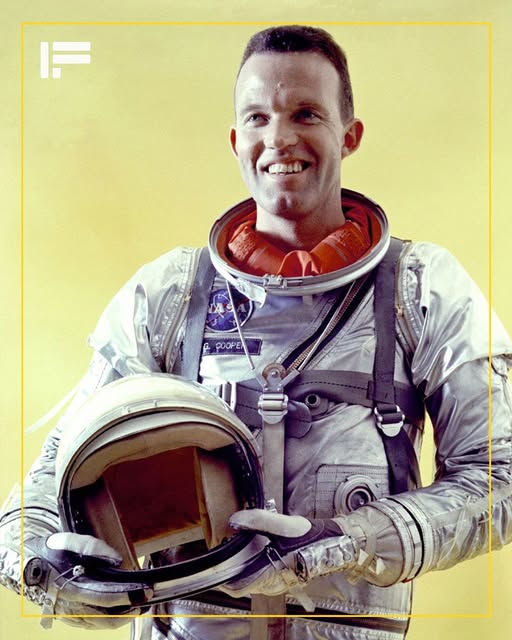
On May 16, 1963, Gordon Cooper was alone in Faith 7, orbiting Earth at 17,500 miles per hour in a capsule so small he could barely turn around.
He had been in space for more than thirty-four hours.
Then the alarms began.
First a faulty sensor falsely indicated the spacecraft was tumbling out of control. Cooper calmly switched it off. Then came the real emergency: a short circuit knocked out the entire automatic attitude-control system—the system that kept the capsule properly oriented for reentry. Without it, the spacecraft could not be aligned for the precise angle needed to survive the plunge back into the atmosphere.
Too shallow, and it would skip off the air like a stone across water, back into orbit. Too steep, and it would burn up like a meteor. The window was narrow. Every computer that was supposed to make that calculation was dead.
On the ground, Mission Control watched the telemetry go dark. They could see the problem. They could not fix it.
Cooper did not panic.
He uncapped a grease pencil and drew reference lines directly on the inside of his window to track the horizon against the stars. He had spent months memorizing star patterns as part of backup navigation training. Now he used them. He aligned the capsule manually by eye, matching the horizon marks to known constellations.
He timed the reentry burn with his wristwatch.
When the moment arrived—calculated in his head, confirmed by the stars—he fired the retrorockets. The capsule shuddered. The sky turned to plasma. For several minutes, radio blackout swallowed him whole. No voice from Earth could reach him. No data came back.
Then the parachutes deployed.
Faith 7 splashed down in the Pacific, four miles from the recovery ship USS Kearsarge—the most accurate splashdown of the entire Mercury program.
A man with a grease pencil, a wristwatch, and starlight had outperformed every automated system NASA had built.
We often speak of technology as the hero of spaceflight. And it frequently is.
But Gordon Cooper’s flight is a reminder that behind every machine, there must still be a human being who can look out the window, think clearly under crushing pressure, and decide what to do when everything else fails.
The final backup was never the software.
It was him.