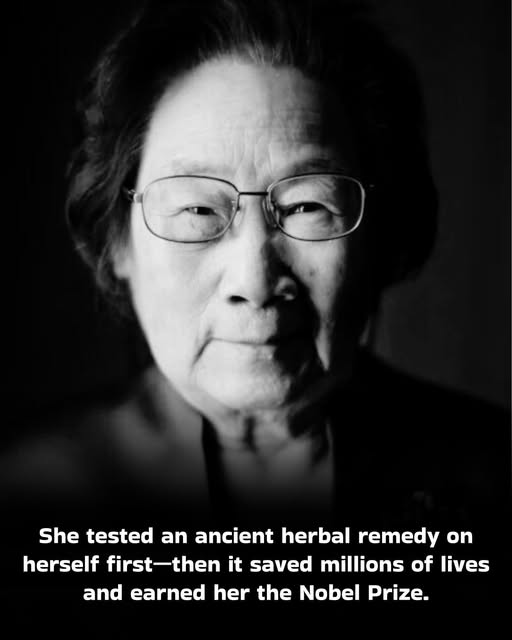
She tested an ancient herbal remedy on herself first—then it saved millions of lives and earned her the Nobel Prize.
China, 1930s. A girl named Tu Youyou grows up during turbulent times—war, occupation, social upheaval. As a teenager, she contracts tuberculosis and has to suspend her studies. Lying in bed recovering, watching life continue without her, she makes a decision about her future.
If she survives this, she will dedicate her life to healing. She will make sure others don’t have to suffer as she has.
Tu Youyou keeps that promise.
She studies pharmacology, eventually becoming a researcher at the China Academy of Traditional Chinese Medicine in Beijing. She’s methodical, detail-oriented, and deeply curious about both ancient remedies and modern science.
Then comes 1967.
The Vietnam War is raging. Chinese soldiers serving there are dying—not just from combat, but from malaria. The mosquito-borne disease is killing troops faster than bullets. It’s decimating military operations across Southeast Asia.
And the parasite is getting smarter. It’s developing resistance to chloroquine and other modern antimalarial drugs that once worked reliably. Soldiers are dying, and medicine is failing them.
The Chinese government launches Project 523—a secret military research program to find new malaria treatments. They turn to an unconventional approach: mining ancient Chinese medical texts for forgotten remedies.
Tu Youyou, then 39 years old, is appointed to lead the project.
Her team begins the painstaking work of reviewing over 2,000 traditional Chinese medicine recipes from ancient manuscripts. They’re looking for anything that mentions treating fever, chills, or symptoms that might indicate malaria.
One herb keeps appearing in texts spanning nearly two millennia: qinghao, sweet wormwood (Artemisia annua). Ancient healers had used it to treat intermittent fevers.
Tu Youyou begins experimenting with extraction methods. She tries boiling the herb, the traditional preparation method for many Chinese medicines.
It doesn’t work. The extracts show no antimalarial activity.
She tries again. And again. Dozens of attempts using different solvents, temperatures, and techniques. Nothing works consistently. The active compound remains elusive.
Then she finds something crucial in an ancient text.
Ge Hong’s “A Handbook of Prescriptions for Emergencies” (4th century CE) mentions preparing qinghao by soaking it in cold water and wringing out the juice. Not boiling. Cold extraction.
Tu Youyou realizes the problem: heat was destroying the active compound.
She adjusts her method, using low-temperature ether extraction instead of boiling. This time, it works. The extract shows powerful antimalarial activity in laboratory tests, killing the malaria parasite efficiently.
But laboratory success means nothing if the treatment isn’t safe for humans.
Tu Youyou needs to test it on people. But she refuses to risk patients’ lives before knowing the treatment is safe. Clinical trials require evidence of safety first.
So she does what any dedicated scientist facing ethical constraints would do.
She tests it on herself.
Tu Youyou takes the experimental artemisinin extract, monitoring herself for adverse reactions. When she experiences no serious side effects, her research team volunteers to try it as well.
Only after confirming through self-experimentation that the compound wouldn’t cause immediate harm do they proceed to formal clinical trials.
The results are extraordinary.
Artemisinin doesn’t just slow malaria down or suppress symptoms. It destroys the malaria parasite in ways scientists had never observed before. It works against drug-resistant strains. It acts quickly. And it’s remarkably effective even in severe cases.
Over the following decades, artemisinin-based combination therapies (ACTs) become the gold standard for treating malaria worldwide. The World Health Organization recommends them as first-line treatment.
The impact is staggering. In regions of Africa and Southeast Asia where children once died routinely from malaria, mortality rates plummet. Millions of lives—particularly children under five—are saved.
Tu Youyou’s discovery doesn’t just treat a disease. It transforms global public health.
In 2015, at age 84, Tu Youyou receives the Nobel Prize in Physiology or Medicine. She becomes the first Chinese woman ever to win a Nobel Prize in science, and the first citizen of mainland China to win a Nobel in any scientific category.
The Nobel Committee’s citation is clear: “for her discoveries concerning a novel therapy against Malaria.”
When Tu Youyou gives her Nobel lecture, she’s characteristically modest. She emphasizes the collaborative nature of the research, the contribution of her team, and the wisdom embedded in traditional Chinese medicine that made the discovery possible.
But make no mistake: her brilliance, persistence, and courage were essential.
She bridged ancient wisdom and modern science. She persisted through countless failures. She risked her own health to ensure patient safety. And she turned a 1,600-year-old herbal remedy into a 21st-century lifesaving drug.
Today, artemisinin-based treatments have saved an estimated millions of lives. The exact number is difficult to calculate, but studies estimate ACTs have prevented hundreds of millions of malaria cases and millions of deaths since their widespread adoption.
Think about that scale. One woman’s discovery, rooted in ancient texts and validated through modern science, has fundamentally altered the trajectory of one of humanity’s oldest and deadliest diseases.
Malaria has killed more humans throughout history than perhaps any other disease. It shaped the rise and fall of civilizations, influenced military campaigns, and devastated populations for millennia.
And a Chinese pharmacologist, mining forgotten medical manuscripts and combining ancient preparation methods with modern extraction techniques, found a way to fight back.
Tu Youyou’s story is about more than scientific achievement. It’s about respecting traditional knowledge while subjecting it to rigorous modern testing. It’s about persistence in the face of repeated failure. It’s about ethical courage—testing experimental treatments on yourself before asking others to take the risk.
And it’s about remembering what it feels like to be sick and helpless, then dedicating your entire life to making sure others don’t have to endure the same fate.
The girl who nearly died from tuberculosis grew up to save millions from malaria.
All because she kept a promise she made to herself in a hospital bed decades earlier.