
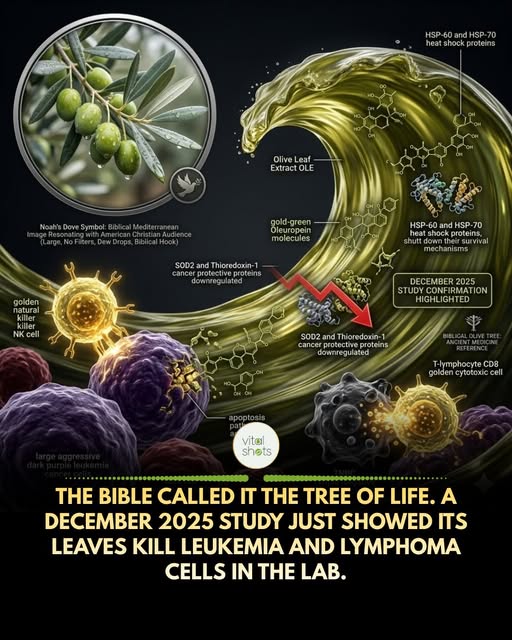
Noah’s dove came back carrying an olive branch. Ancient Greeks crowned their champions with olive wreaths. The Bible mentions the olive tree more than any other plant — over 100 times across the Old and New Testaments. And in December 2025, researchers published a study showing that olive leaf extract kills human leukemia and lymphoma cells in controlled laboratory conditions. The tree humanity has considered sacred for 6,000 years keeps giving science reasons to agree.
The olive tree (Olea europaea) has been a symbol of peace, victory, and divine blessing across virtually every Mediterranean and Middle Eastern civilization. But the leaves — the part almost no one eats — contain one of the most pharmacologically active polyphenols in the plant kingdom: oleuropein.
The December 2025 Discovery
A study published in Frontiers in Oncology (December 2025) investigated the anti-tumor effects of Olive Leaf Extract (OLE) against human acute leukemia and lymphoma cells in vitro. The results were striking: OLE significantly reduced cancer cell viability, induced apoptosis (programmed death), and downregulated four cancer-protective proteins simultaneously — HSP-60, HSP-70, SOD2, and Thioredoxin-1.
These heat shock proteins (HSP-60, HSP-70) are abundantly expressed in cancer cells and act as survival shields — they suppress apoptosis, promote angiogenesis, support metastasis, and help cancer cells escape immune detection. By downregulating them, OLE removes the armor cancer cells hide behind.
What oleuropein does that nobody expected
Earlier studies established that oleuropein induces apoptosis in breast cancer cells — including triple-negative breast cancer (TNBC), the most aggressive and treatment-resistant subtype, with virtually no effective targeted therapies available. A 2025 study confirmed oleuropein’s dual action: not only does it kill TNBC cells, it inhibits cell motility — meaning it interferes with the cancer’s ability to migrate and metastasize to other organs. This anti-metastatic effect was observed at low concentrations, making it particularly significant for functional food-based prevention strategies.
The full tumor spectrum documented
Comprehensive reviews confirm oleuropein and hydroxytyrosol (another olive polyphenol) have documented anti-tumor activity against: breast cancer, pancreatic cancer, colorectal cancer, skin cancer, melanoma, glioblastoma (brain tumor), neuroblastoma, prostate cancer, and now acute leukemias and lymphomas. Across all these cancer types, the same selective mechanism was observed: oleuropein kills cancer cells while sparing healthy cells — the holy grail of oncological pharmacology that synthetic chemotherapy still struggles to achieve.
What makes the olive leaf different from olive oil
Olive oil contains minimal oleuropein — it’s mostly converted to other compounds during pressing. The highest concentration of oleuropein is in the leaves — the part discarded in olive oil production. The Mediterranean populations who lived longest and had the lowest cancer rates weren’t just eating olive oil. They were also drinking olive leaf tea — a practice documented in Greek, Italian, and North African traditional medicine for over 3,000 years.
VITALSHOTS PROTOCOL:
Olive leaf extract standardized to 20-25% oleuropein: 500-1,000mg daily with food. For cardiovascular and antiviral effects, lower doses (250-500mg) are documented effective. For anti-inflammatory and immune support: olive leaf tea (3-4 dried leaves per cup, steep 10 minutes) — the original form used across Mediterranean civilizations for millennia. Look for extracts from Olea europaea leaves specifically — not fruit, not oil — with certified oleuropein percentage on the label.
Sources:
PMID: 41515132 | OLE Anti-Tumor Hematologic Leukemia Lymphoma In Vitro December 2025
PMC: 12787448 | Olive Leaf Extract Cancer HSP SOD2 Thioredoxin Downregulation Full Study
PMC: 9409738 | Oleuropein Anti-Cancer Comprehensive Review — Apoptosis, Anti-Proliferative, Anti-Angiogenic
FFHDJ (March 2025) | Oleuropein Apoptosis Triple-Negative Breast Cancer TNBC Cell Motility Inhibition