
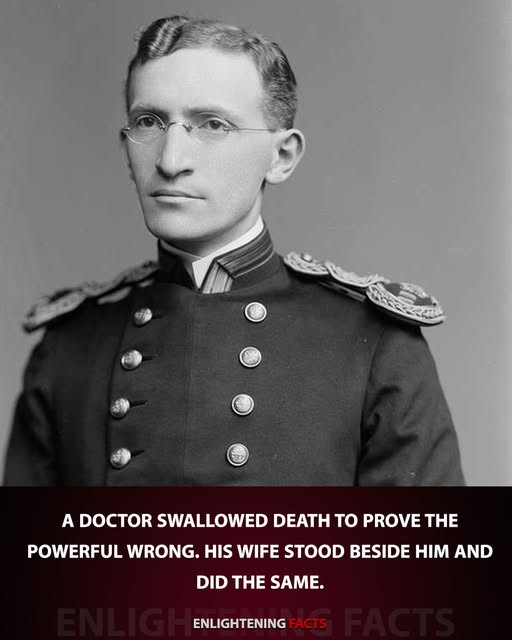
In the spring of 1916, a doctor held a capsule in his hand. Inside was something unthinkable.
His wife stood beside him, holding one too.
They were about to swallow the disease killing thousands across America. On purpose.
For thirty years, a plague had swept through the American South. Records show pellagra killed over 100,000 Americans by 1914. The symptoms were horrifying. Skin turned to leather. Minds collapsed. Bodies wasted away.
Medical authorities declared pellagra an infectious disease that spread through contact. Towns quarantined neighborhoods. Families hid sick relatives in shame.
Dr. Joseph Goldberger had discovered something different.
He knew pellagra wasn’t caused by germs. But no one believed him.
To save millions, he’d have to do something unimaginable.
Goldberger arrived in the South in 1914, sent by the Surgeon General to solve the mystery. He walked into asylum wards expecting to find evidence of infection.
Instead, he found something every other doctor had missed.
The patients were dying. The nurses and doctors were perfectly fine.
In tuberculosis wards, staff caught tuberculosis. In typhoid hospitals, workers got typhoid. Germs didn’t care about your job title.
But here, medical workers moved untouched through rooms of dying patients. They bathed them. Changed their bedding. Spent twelve-hour shifts surrounded by supposed infection.
Not one got sick.
Goldberger watched what they ate. Staff meals included fresh meat, milk, vegetables, eggs. Patient meals were what Southerners called “The Three M’s”—fatback, cornmeal, molasses.
The same food every day. Month after month.
It wasn’t contagion killing these people. It was their diet.
Goldberger supplied “a diet such as that enjoyed by well-to-do people” to two Mississippi orphanages and an asylum. He added fresh meat, milk, and vegetables.
Within weeks, every pellagra case disappeared.
He published his findings triumphantly. The response shocked him.
Southern politicians, doctors, and newspapers erupted in fury. A Jewish immigrant from New York was telling the South their traditional diet was killing them. That workers weren’t paid enough to buy proper food. That pellagra wasn’t medical—it was economic.
They called him a fraud. A liar. An agitator.
Medical journals demanded he produce the infectious germ or retract his claims. Politicians refused federal food assistance, insisting the South would solve its own problems.
Curing children wasn’t enough proof.
Goldberger realized he had to create the disease from nothing.
In 1915, Goldberger approached Mississippi’s governor with an offer: pardons for twelve healthy inmates if they’d volunteer for a dietary experiment.
The prisoners agreed. They didn’t know what was coming.
For six months, Goldberger fed them only standard Southern working-class food. Grits, cornmeal, biscuits, syrup, white rice, coffee.
No meat. No milk. No fresh vegetables.
The transformation was horrifying.
Week by week, the men weakened. After six months, six of the eleven patients contracted pellagra. Their skin cracked and bled. The red rash appeared. Their minds grew foggy, then paranoid.
One prisoner begged to be released, saying he’d “been through a thousand hells” and would rather stay locked up forever than continue.
Goldberger had manufactured pellagra using only food.
He’d proven it wasn’t caused by germs.
The critics didn’t surrender. They insisted the prisoners must have had a hidden infection that the diet “triggered.” Still a germ, they claimed.
Goldberger had one final card to play.
In spring 1916, Goldberger hosted eight gatherings with seventeen total guests. He called them research parties, though others would later name them differently.
He gathered his most trusted colleagues. Doctors willing to risk everything.
And his wife, Mary.
They collected blood, urine, feces, mucus, throat secretions, and skin scabs from patients dying of pellagra.
They injected the blood directly into their veins.
They swabbed secretions deep into their noses and throats.
Finally, they mixed everything into flour paste. Rolled it into capsules.
And swallowed them.
Mary wrote years later that she had insisted on being included. When her husband wouldn’t let her swallow the capsules, she demanded to be injected with blood from a woman dying of pellagra instead.
One nurse assisting fled the room crying.
Then they waited.
Days crawled into weeks. Every headache was analyzed. Every skin irritation examined with terror.
If the critics were right, they would all die slowly. Painfully. Skin peeling off. Minds unraveling.
Mary would die because she’d trusted her husband.
The silence in their home was suffocating.
Nothing happened.
Six months after the experiments ended, in late 1916, none of the participants showed any signs of pellagra.
Not a single rash. Not one fever.
They’d consumed death itself and walked away healthy.
Because afterward, they’d eaten fresh meat, milk, and vegetables.
The experiments proved it beyond doubt. Pellagra wasn’t infectious.
You could swallow disease and survive—as long as you had proper nutrition.
Goldberger published everything. The orphanage recoveries. The prison experiments. The undeniable proof.
He expected policy changes. Food assistance programs. Better wages so workers could buy nutritious food.
Instead, the South buried the truth deeper.
Admitting pellagra came from malnutrition meant admitting sharecroppers weren’t paid living wages. It meant acknowledging the Southern economy exploited workers. It meant accepting federal intervention.
Politicians feared investors would flee if the South was labeled a poverty zone.
So thousands continued dying.
Goldberger spent the rest of his life searching for the specific missing nutrient. He lobbied. He published. He fought.
In 1929, exhausted, he died of kidney cancer at age 54.
He never saw pellagra’s cure widely distributed.
It wasn’t until 1942, when World War II forced the U.S. government to mandate flour fortification with niacin to keep soldiers healthy, that pellagra finally disappeared from America.
The missing nutrient was niacin—vitamin B3.
Goldberger had been nominated four times for the Nobel Prize. But he died before seeing his work validated.
He saved millions of lives. He just never got to see them live.
Think about what Joseph Goldberger did.
He didn’t just risk his career. He risked his life. He asked his wife to risk hers.
They consumed human waste from dying patients to prove a truth powerful people refused to accept.
Because admitting pellagra came from poverty meant admitting the economic system was broken. Meant acknowledging workers weren’t paid enough to eat. Meant facing an uncomfortable reality.
So they called him a liar. Buried his research. Let thousands keep dying rather than change the system.
Goldberger’s story isn’t just about scientific courage.
It’s about what happens when economic interests outweigh human lives.
The South knew the answer by 1916. They chose profit over people anyway.
Pellagra killed for another 25 years. Not because we didn’t know the cure. But because using it would require admitting why the disease existed in the first place.
For those who’ve watched truth get buried under politics, or seen problems ignored because solutions cost too much—which battles in your own life have felt the same way?