
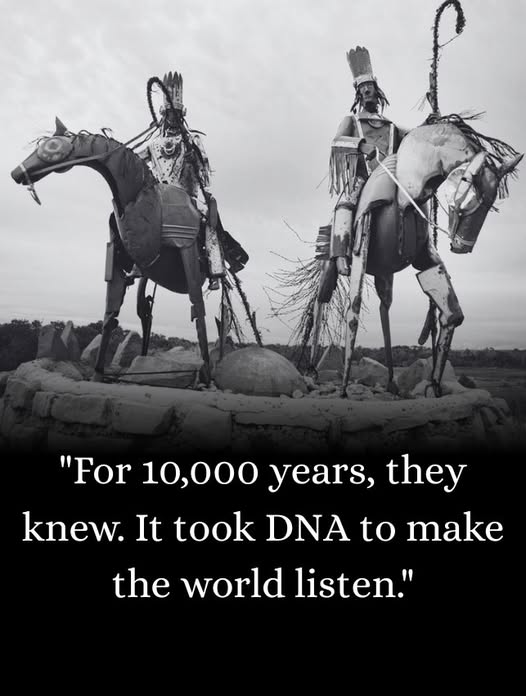
For 10,000 years, they knew. It took DNA to make the world listen.
The Blackfoot people have always known their connection to the northern Plains runs deeper than memory. Their oral traditions speak of “time immemorial”—of ancestors who hunted bison across glacial valleys, who witnessed ice retreating from mountains, who survived the Great Flood when ancient waters receded.
But for nearly two centuries, Western anthropologists told a different story.
Based on linguistic similarities to Great Lakes tribes, scholars theorized the Blackfoot had migrated westward sometime in the last thousand years. Never mind that Blackfoot oral history contained no memory of such a journey. Never mind the archaeological evidence suggesting far older presence.
The theory became textbook fact. And it threatened something crucial: land and water rights that depend on proving ancestral connection to territory.
So the Blackfoot Confederacy did something remarkable. They partnered with geneticists to let science test what their ancestors had always known.
In April 2024, the results were published in Science Advances. And they didn’t just challenge the migration theory—they shattered it entirely.
DNA analysis revealed that modern Blackfoot people belong to a previously unknown genetic lineage that diverged from all other studied Indigenous groups approximately 18,000 years ago, during the last Ice Age.
Let that sink in. While most Native American populations studied share a common ancestral lineage, the Blackfoot split off into genetic isolation nearly 18 millennia ago—and remained in their homeland ever since.
The study was led by Blackfoot community members—Dorothy First Rider, Anna Wolf, and others—working alongside archaeologist Maria Zedeño and geneticist Ripan Malhi. They analyzed DNA from six living Blackfoot individuals and seven ancestral remains dating back 100-200 years.
The findings confirmed genetic continuity: today’s Blackfoot are directly descended from those who lived on this land at European contact, who descended from those who lived there through thousands of years before.
Even more striking: Blackfoot oral traditions contain memories that align with this deep Ice Age ancestry. Dreams and stories passed down describe standing in caves watching glaciers melt. Accounts of crossing ice to reach better lands. Knowledge of extinct megafauna like giant beavers and camels that disappeared 10,000 years ago.
“The Blackfoot can dream of the Ice Age,” explained Andy Blackwater. “Through dreams, people are able to recollect the deep past by bonding to ancestral spirits from long ago.”
This isn’t mysticism. It’s the transmission of ancestral knowledge across timescales Western science once deemed impossible.
Gheri Hall, archaeologist with the Blackfeet Tribal Historic Preservation Office, put it perfectly: “This really confirms what we already knew. Now we can use the new science to fight the old science.”
Because here’s the critical point: This wasn’t science finally admitting Indigenous people were right. This was Indigenous communities using scientific tools on their own terms to generate evidence for legal battles over land, water, and sovereignty.
The Blackfoot Confederacy has fought for decades to protect their ancestral territories from governments and energy companies. In 2023, they won a major victory when Solenex LLC relinquished drilling rights in the sacred Badger-Two Medicine area.
Studies like this provide additional legal evidence for treaty rights—but they also expose something uncomfortable: How often has Indigenous knowledge been dismissed as “myth” until Western methods confirmed it?
The question isn’t whether science should lead conversations about the past.
The question is: When will we start listening to the people who never forgot?
Fun Fact: Blackfoot oral traditions describe landscapes from the Ice Age with remarkable accuracy—glacial floods, retreating ice sheets, and extinct megafauna—thousands of years before archaeologists mapped these same events. Knowledge preserved through storytelling proved as reliable as sediment cores and carbon dating.