
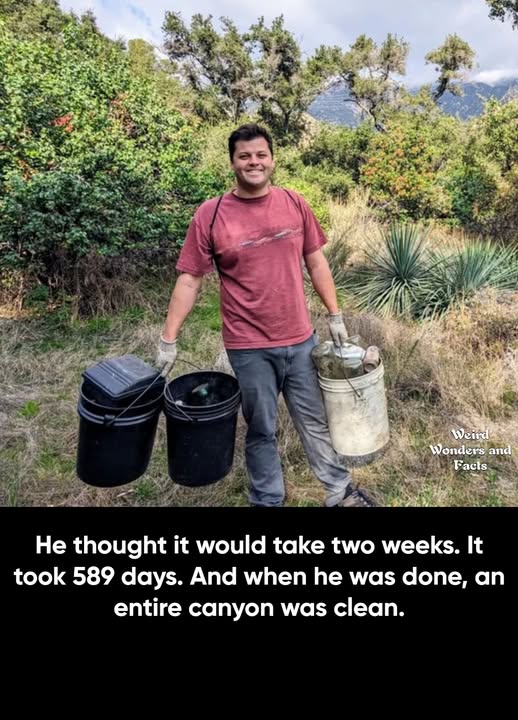
He thought it would take two weeks. It took 589 days. And when he was done, an entire canyon was clean.
In May 2019, a twenty-year-old climate activist named Edgar McGregor walked into Eaton Canyon, one of the most popular hiking spots in Los Angeles County, carrying two things: a five-gallon bucket and a pair of gloves.
What he saw stopped him cold. Trash was everywhere. Beer cans. Plastic bottles. Old phones. Lighters. Disposable masks. Car tires. At one point, he would even find a ten-foot-tall patio heater abandoned in the wilderness. Eaton Canyon sat within the Angeles National Forest, drew over 600,000 visitors a year, and had become a dumping ground that no one was taking responsibility for.
Edgar figured he could clean it up in ten to twenty days. Maybe a few sunny weekends. Grab what he could, fill some bags, and move on.
He could not have been more wrong.
The trash just kept appearing. Every trail, every waterfall, every storm drain, every streambed had layers of waste that had been accumulating for years. Edgar quickly realized that a few weekend trips were not going to fix this. If he wanted the canyon clean, he would have to come back every single day.
So that is exactly what he did.
For 589 consecutive days, Edgar McGregor hiked into Eaton Canyon with his buckets and gloves. He went when it was 117 degrees. He went in thunderstorms. He went through snow. He went when wildfire ash was falling from the sky and the hills around him were burning. He went during the pandemic, when the trails were closed to most visitors but the trash remained. He went after work, sometimes for an hour, sometimes for four. He never took a day off.
Over nearly two years, he estimates he picked up between 12,000 and 15,000 pounds of trash. On his biggest single day, he filled an entire dumpster by himself — roughly half a ton of waste pulled out of a place that was supposed to be a nature preserve.
Edgar, who has been open about being autistic, found a rhythm in the work that suited him. He was methodical. He would pick a specific location each day — a particular stretch of trail, a waterfall basin, a storm drain — and search it thoroughly until it was spotless. Then he would move on to the next section. He tracked which areas stayed clean and which ones attracted repeat dumping. He carried two buckets — one for trash, one for recyclables. The recyclables he turned in for cash and donated every cent: some to planting native western sycamore trees in the park, some to climate charities, some to political candidates who pledged to act on environmental policy. Over time, he donated more than four hundred dollars from aluminum cans and plastic bottles that other people had thrown on the ground.
Part of what motivated him was the 2028 Summer Olympics. Los Angeles had won the bid to host the games, and Edgar could not stand the thought of world-class athletes visiting his city’s trails and seeing trash everywhere. He called it a potential “global embarrassment.“ He wanted the canyon to be something Los Angeles could be proud of.
As his streak grew longer, Edgar documented everything on social media with the hashtag #EarthCleanUp. He posted photos of the most extreme conditions he cleaned in. He shared before-and-after shots of sections of trail. He never made it about outrage toward litterers — he had learned early on that anger was counterproductive. “There’s always going to be litterbugs,“ he said. “There’s nothing we can do to stop people from throwing stuff onto the ground.“ Instead, he focused on the joy he found in the work. The animals that started returning. The trails that looked the way they were supposed to. The strangers who saw him out there and grabbed their own buckets.
On March 5, 2021, something remarkable happened. Edgar walked aimlessly around the southern half of the park for four hours, checking every location he could find. He only filled two buckets. The next day, the same thing happened in the northern half. He had checked the entire main trail, all the waterfalls, all the storm drains. There was nothing left to pick up.
For the first time in 589 days, Eaton Canyon was completely free of municipal waste.
Edgar posted a video to Twitter, barely able to contain his excitement. “I AM DONE!!! I DID IT!!!“ he wrote. The post exploded. Over a hundred thousand people liked it. Thousands commented. Fellow climate activist Greta Thunberg responded: “Well done and congratulations!!“ California’s first Latino U.S. Senator, Alex Padilla, called him a “hometown hero.“ People from Australia, Norway, India, and dozens of other countries sent photos of themselves cleaning up their own local parks, inspired by a twenty-year-old in Los Angeles who had simply refused to stop.
But Edgar did not stop either.
He returned to Eaton Canyon two to three times a week for maintenance and set his sights on other parks that needed the same attention. As of 2022, he had passed 1,000 consecutive days of cleanup. He enrolled at San Jose State University to study meteorology and climatology, determined to turn his passion for the planet into a career.
“Climate action is a group project,“ Edgar wrote. “There will be no hero that will emerge from the fog to save us from ourselves. To preserve this planet, we’ll need a billion climate activists.“
He is not wrong. But the truth Edgar McGregor proved is equally important: you do not need a billion people to start. You need one person, one bucket, and the willingness to show up tomorrow, and the day after that, and the day after that, for as long as it takes.
One young man. One canyon. 589 days. Fifteen thousand pounds of trash. And a simple lesson the whole world needed to hear: the mess is never too big if you just keep showing up.