
My fifteen-year-old daughter came home last Tuesday with a black eye.
Not from a fight.
Not from sports.
From stepping between her best friend and a boy who thought he owned her.
It happened at the school dance.
Emma had been trying to break up with him for weeks.
He wouldn’t let her.
He texted constantly.
Showed up uninvited.
Threatened to spread rumors.
Threatened to hurt himself.
At the dance, when Emma told him it was over, he shoved her.
My daughter stepped in.
He swung.
And that’s how she came home bruised.
I was ready to call the police.
Ready to march to his house.
But my daughter grabbed my arm.
“Mom. Wait. That’s not the important part.”
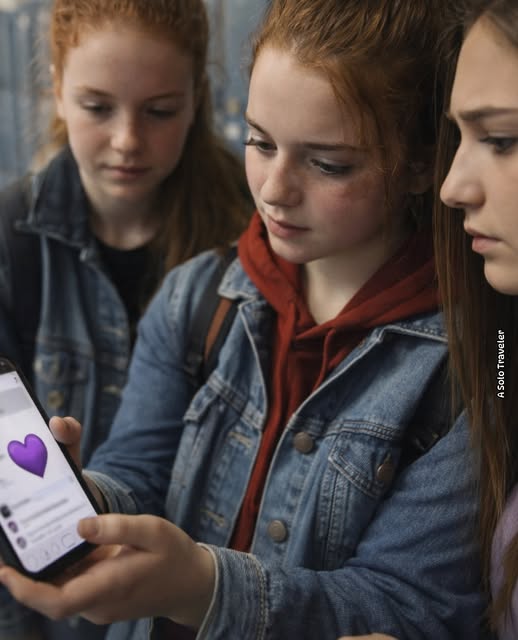
She opened her phone.
There was a group chat called: Exit Plan.
Forty-three girls.
Same high school.
Same purpose.
How to leave safely when you’re dating someone who scares you.
I scrolled.
“My boyfriend checks my phone. How do I delete messages without him knowing?”
“He follows me home. I can’t break up with him alone.”
“My parents love him. They won’t believe me.”
These weren’t dramatic teenagers.
They were fifteen and sixteen-year-old girls sharing survival strategies like field operatives.
They had protocols.
If you needed help, you dropped a purple heart emoji.
Within minutes, girls showed up.
They walked you home.
Sat next to you in class.
Created a physical buffer in hallways.
They tracked locations.
Saved screenshots.
Had code words.
They built a safety network because they didn’t trust adults to protect them.
“Why didn’t you tell a teacher?” I asked.
“A counselor? A parent?”
She looked at me gently.
“Mom… adults always say the same things. ’Just break up.’ ’Ignore him.’ ’He’s immature.’”
Then she said something that stopped me cold:
“They know where we live. They know our schedules. They have our pictures. We can’t just walk away.”
Emma’s parents listened after the black eye.
The boy was suspended.
Emma is staying with her aunt in another district until things calm down.
But here’s what I can’t stop thinking about:
Forty-three girls.
One school.
All convinced that depending on adults would fail them.
How many of them tried telling someone first?
How many were dismissed as “dramatic”?
“Overreacting”?
“Too sensitive”?
My daughter’s bruise faded in a week.
But I can’t unsee that group chat.
I can’t unknow that our daughters are quietly building emergency systems because they believe ours don’t work.
I am not writing this to glorify teenage resilience.
They should not have to be this strategic.
They should not have to think like crisis managers at fifteen.
If a young person tells you someone makes them uncomfortable—
Believe them.
Immediately.
Don’t minimize it.
Don’t rationalize it.
Don’t wait for proof.
Because by the time there’s a black eye…
They’ve already been handling it alone for far too long.
If this moved you, share it.
Someone out there needs an adult who listens the first time.
(Tom: The members of an uptone, ethical, productive group do not tolerate, justify or make excuses for unethical behaviour. They recognise and call it for what it is. And handle it. Those who minimise, justify or defend unethical behaviour are somehow in agreement with it and have their own scene to handle.
And you thought I was talking about kids at school?)