
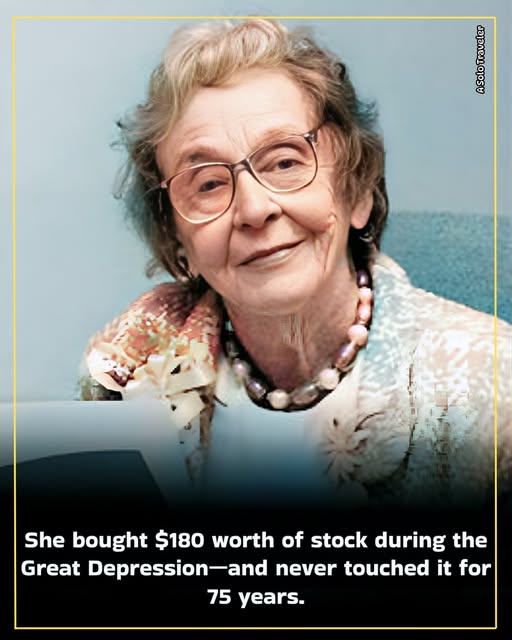
She bought $180 worth of stock during the Great Depression—and never touched it for 75 years.
In 1935, Grace Groner made a decision that looked insignificant at the time. She was working as a secretary at Abbott Laboratories, earning a modest income in a world still reeling from economic collapse. Women were rarely encouraged to build wealth. Financial independence seemed like a luxury reserved for men with means.
That year, Grace bought three shares of Abbott Laboratories stock for sixty dollars each. One hundred eighty dollars total.
Then she did something radical for the era. She held them.
Grace never chased trends. She never sold during panics. She never tried to time the market. She simply reinvested every dividend the company paid and trusted time to do what individual effort could not.
While markets crashed in the years that followed, she held. While World War II erupted and the economy shifted to wartime production, she held. While the Cold War raised fears and recessions came and went, she held. While other investors panicked and sold, she stayed still.
Her life remained simple in a way that seemed almost stubborn to those around her. She lived in a small one-bedroom cottage that had been willed to her. She bought her clothes at rummage sales. After her car was stolen, she never bought another one—she just walked everywhere instead, even into old age with a walker in hand.
She carried the mindset of someone who had lived through scarcity and never forgot it. The Great Depression had taught her that security came from living below your means, not above them.
Her wealth grew quietly in the background while her lifestyle never changed. Nobody suspected. Not her neighbors. Not her colleagues at Abbott where she worked for 43 years before retiring in 1974. Not even most of her friends.
The stock split. The shares multiplied. The dividends compounded. Year after year, decade after decade, that initial $180 investment transformed into something extraordinary—but Grace lived as though it didn’t exist.
She volunteered at the First Presbyterian Church. She donated anonymously to those in need. She attended Lake Forest College football games and stayed connected to the school that had educated her decades earlier. She traveled after retirement, experiencing the world while still maintaining her frugal habits.
In 2008, at age 99, Grace quietly established a foundation. She never told anyone what it would contain.
When Grace died on January 19, 2010, at age one hundred, her attorney opened her will. That’s when everyone discovered the truth.
Her original one hundred eighty dollars—three shares of Abbott Laboratories purchased 75 years earlier—had grown into more than seven million dollars.
The people who knew her were stunned. “Oh, my God,“ exclaimed the president of Lake Forest College when he learned the amount.
Grace, the woman who walked everywhere and bought secondhand clothes, who lived in a tiny cottage and volunteered her time quietly, had been a multimillionaire the entire time. She just chose to live as though she wasn’t.
And she didn’t spend that fortune on herself in the end.
She left nearly all of it to the Grace Elizabeth Groner Foundation—created to fund service-learning opportunities, internships, international study, and community service projects for Lake Forest College students. The same college that had educated her in 1931, paid for by a kind family who took her in after she was orphaned at age 12.
Grace had never forgotten that gift of education. Now she was paying it forward, making it possible for students who needed opportunity the way she once had.
The foundation her estate created would generate hundreds of thousands of dollars annually in dividend income—money that would change countless lives for generations. Students who otherwise couldn’t afford to study abroad or take unpaid internships would now have that chance because of three shares of stock a secretary bought during the Depression.
Her cottage—the small one-bedroom home where she’d lived so simply—was renovated by the foundation and is now home to two female Lake Forest College seniors each year, living there as Grace’s guests.
Grace Groner proved something that challenges every assumption we make about building wealth.
She proved that you don’t need a high income to become wealthy. She proved that you don’t need to be born with privilege or connections. She proved that you don’t need perfect timing or insider knowledge or lucky breaks.
Sometimes wealth comes from something much simpler: patience, discipline, and the belief that your future is worth investing in, even when the first step looks small.
Three shares of stock. One hundred eighty dollars. Seventy-five years of not selling.
That’s all it took.
But it wasn’t really about the stock, was it? It was about understanding something most people never grasp: that compounding requires time more than money. That the most powerful investment strategy isn’t activity—it’s stillness. That true wealth comes not from what you earn but from what you keep and let grow.
Grace worked as a secretary her entire career. She never became an executive. She never got rich from her salary. She never inherited a fortune or won the lottery or built a business empire.
She just bought three shares of a good company and never sold them.
While everyone else was chasing the next hot stock, the next quick profit, the next get-rich scheme, Grace was doing nothing. And in investing, sometimes doing nothing is the most powerful thing you can do.
Her story forces us to confront uncomfortable truths. How many people earn far more than Grace did but will die with far less? How many chase returns instead of letting returns come to them? How many mistake activity for progress?
Grace Groner sat still for 75 years while the world spun around her. She lived modestly while wealth accumulated quietly in the background. She died having touched more lives than most millionaires ever will—not because of what she spent, but because of what she saved and gave away.
Her foundation estimates it provides opportunities to students generating $300,000 annually in benefits. All from $180 invested in 1935 by a secretary who understood something profound about time, patience, and the power of never quitting.
The next time someone tells you it’s impossible to build wealth without advantages, remember Grace Groner. Remember the woman who bought three shares during the Depression and held them until she was 100.
Remember that sometimes the most radical thing you can do is make a small decision and trust it long enough to prove everyone wrong.