
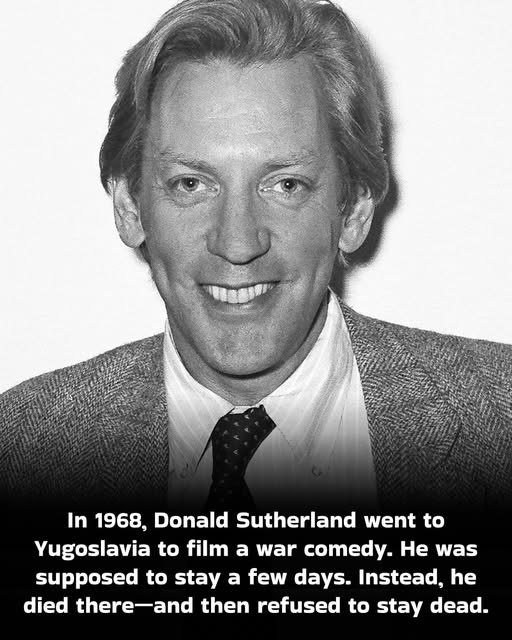
In 1968, Donald Sutherland went to Yugoslavia to film a war comedy. He was supposed to stay a few days. Instead, he died there—and then refused to stay dead.
The telegram arrived at Shirley Douglas’s home with the kind of news that stops time.
Her husband Donald was in a coma in Yugoslavia. The hospital didn’t have the antibiotics he needed. She should come immediately. He might not survive until she arrived.
Just weeks earlier, Donald Sutherland had flown to Yugoslavia for what was supposed to be a short filming stint on Kelly’s Heroes, a World War II comedy starring Clint Eastwood. It was 1968. Donald was 33 years old, riding high after breaking through in The Dirty Dozen the year before. Yugoslavia had been chosen as the filming location because it was one of the few countries whose army still operated actual World War II equipment—authentic Sherman tanks, vintage weapons, the works.
Donald was playing a character called Oddball, a laid-back, flower-child tank commander who spoke in hippie philosophy while commanding a Sherman. It was supposed to be fun. A quick job. Then back home.
Instead, somewhere along the Danube River, Donald Sutherland picked up something invisible and deadly.
Pneumococcus bacteria.
Within days, the bacteria had done what bacteria does best when left unchecked—it invaded, multiplied, spread. Spinal meningitis took hold. The infection attacked the protective membranes surrounding his brain and spinal cord. There was no gradual warning, no time to prepare.
One moment Donald was preparing for scenes with Eastwood and Telly Savalas. The next, he was being rushed to a hospital in Novi Sad, slipping away from consciousness.
The hospital did everything it could. But this was 1968 Yugoslavia. The antibiotics Donald desperately needed simply weren’t available. His condition deteriorated rapidly.
And then Donald Sutherland fell into a coma.
For six weeks, he existed somewhere between life and death.
His body lay in a hospital bed in Novi Sad while infection squeezed his brain.
Nurses performed seven spinal taps trying to fight the meningitis. During the first attempt, the needle slipped from the nurse’s hand and shattered on the marble hospital floor. People would enter his white hospital room, look at him, and start crying. Nancy O’Connor, the wife of costar Carroll O’Connor, turned and ran from the room, weeping.
But Donald could hear everything.
Years later, he would recall every word spoken in that room. Every conversation. Every sound. When you’re in a coma, he later explained, you can hear. You remember. Talk to them. Sing to them. They’re listening.
And somewhere in that in-between space, Donald Sutherland died.
Not metaphorically. Not almost. He clinically died. For a few seconds, his heart stopped. Brain activity ceased.
What happened next, Donald would describe over and over in the decades that followed—always with the same details, the same wonder in his voice, the same sense that he’d glimpsed something fundamental about existence.
“I saw the blue tunnel,” he said. “And I started going down it. I saw the white light.”
This was years before the term “near-death experience” became common language, before Raymond Moody coined the phrase in 1975, before thousands of people would report similar experiences. Donald Sutherland saw the blue tunnel in 1968 and had no cultural framework to explain what was happening.
He just knew he was dying.
And the journey felt… peaceful.
“Such a tempting journey,” he later told Smithsonian Magazine. “So serene. No barking Cerberus to wake me. Everything was going to be all right.”
Standing behind his own right shoulder, Donald watched his comatose body slide peacefully down that blue tunnel toward the matte white light glowing at what appeared to be the bottom. The seduction of it was overwhelming. Just let go. Stop fighting. Everything will be fine.
He almost gave in.
“I didn’t want to go,” he admitted, “but it was incredibly tempting. You just go, ‘Aw, shit man, why not?'”
Why not indeed? Donald Sutherland had been fighting for his life since he was old enough to remember. When he was barely two years old, polio struck him.
Most children who contracted polio in the 1930s either died or were left permanently paralyzed. Donald survived. Then came rheumatic fever severe enough that he missed an entire year of school, confined to bed while the disease attacked his heart. Then hepatitis. Then pneumonia. Then scarlet fever.
By the time Donald Sutherland was a teenager, he’d already survived more near-death experiences than most people face in a lifetime.
Maybe that’s why, in 1968, when death reached for him one more time, some primal part of him recognized the pattern.
“And then,” Donald recalled, “just as I was seconds away from succumbing to the seductions of that matte white light glowing purely at what appeared to be the bottom of it, some primal force fiercely grabbed my feet and compelled them to dig my heels in.”
He dug his heels in.
He refused.
“The downward journey slowed and stopped,” he said. “I’d been on my way to being dead when some memory of the desperate rigor I’d applied to survive all my childhood illnesses pulled me back. Forced me to live.”
Donald Sutherland came back.
Back in Yugoslavia, MGM Studios faced a problem. They’d built a six-week hiatus into Donald’s contract for Kelly’s Heroes—a stroke of luck that now became a lifeline. Director Brian G. Hutton made a decision that would define him as much as any film he ever directed: he refused to recast Donald’s role.
The studio could have moved on. Could have hired another actor. Could have reshot Donald’s scenes with someone healthy and available.
Instead, they waited.
MGM flew Donald from Yugoslavia to Charing Cross Hospital in England. Better facilities. Better antibiotics. Better chance.
But six weeks isn’t enough time to recover from bacterial meningitis that nearly killed you.
When the six-week hiatus ended, MGM made another decision. They pulled Donald out of the hospital, brought him back to Yugoslavia, and stood him up in front of the camera.
“I’d recovered,” Donald later said. “Sort of.”
Sort of.
“I could walk and talk,” he explained, “but my brains were truly fried.”
The infected layers of his meninges—those protective membranes around the brain and spinal cord—had squeezed his brain so tightly that nothing functioned the way it used to. The Donald Sutherland who came back was neurologically different from the one who’d left.
He was afraid to sleep. He wept without warning or reason. He was terrified of heights. Terrified of water. The man who’d grown up on the coast of Nova Scotia, who loved the ocean, was now paralyzed with fear at the sight of it.
But he went back to work.
They stood him up in front of the camera in Yugoslavia—in the very country that had nearly killed him—and Donald Sutherland finished what he’d started.
He played Oddball, the philosophical tank commander with the laid-back attitude and the hippie sensibilities. The character became iconic. More than fifty years later, military veterans still quote Oddball’s lines. The performance captured something ineffable—a zen-like acceptance of chaos, a refusal to be rattled by circumstances, a deep calm in the face of madness.
Maybe you can only play that kind of calm convincingly after you’ve stared down death and won.
Kelly’s Heroes was released in 1970. It became a beloved classic, one of those rare war comedies that actually works. And Donald Sutherland’s Oddball became the kind of character that actors dream of creating—weird, memorable, quotable, beloved.
But Donald was just getting started.
That same year, he starred as Hawkeye Pierce in Robert Altman’s MASH*, the anti-war satire that would define a generation’s relationship with the Vietnam War. Then came Klute in 1971, where his subtle, controlled performance opposite Jane Fonda earned critical acclaim. Then Nicolas Roeg’s Don’t Look Now in 1973—and it’s worth noting that Donald, who was now terrified of water, agreed to film the entire movie in Venice, a city built on water, specifically to confront his fear.
He worked with Federico Fellini on Fellini’s Casanova. With Bernardo Bertolucci on 1900. He starred in Invasion of the Body Snatchers, Animal House, Ordinary People, Eye of the Needle.
In the 1990s, he gave one of cinema’s most memorable supporting performances in Oliver Stone’s JFK as the mysterious Mr. X, delivering a monologue about the military-industrial complex that became legendary.
In 2012, at age 77, Donald Sutherland became President Snow in The Hunger Games franchise and introduced himself to an entirely new generation. His quietly sadistic portrayal of Snow was so effective that young viewers would approach him on the street with a mix of fear and awe.
Through it all—through six decades and nearly 200 film and television credits—Donald Sutherland never won a competitive Academy Award. Not once. Not even a nomination.
But in 2017, at age 82, the Academy gave him an Honorary Oscar for lifetime achievement.
In his acceptance speech, Donald was characteristically self-deprecating. He quoted Jack Benny: “I don’t deserve this, but I have arthritis, and I don’t deserve that either.”
The room erupted in laughter and applause for one of the most respected actors in cinema history—a man who’d brought intensity, intelligence, and an unmistakable presence to every role he played.
On June 20, 2024, Donald Sutherland died under hospice care at the University of Miami hospital. He was 88 years old. The cause was chronic obstructive pulmonary disease—those lungs that had been plagued since childhood finally gave out.
His son Kiefer, himself a respected actor, announced his father’s death with words that perfectly captured Donald’s approach to life:
“With a heavy heart, I tell you that my father, Donald Sutherland, has passed away. I personally think one of the most important actors in the history of film. Never daunted by a role, good, bad or ugly. He loved what he did and did what he loved, and one can never ask for more than that. A life well lived.”
A life well lived.
Tributes poured in from around the world. Canadian Prime Minister Justin Trudeau called him “one of the greats.” President Joe Biden wrote that Donald “inspired and entertained the world for decades.” Jane Fonda, Helen Mirren, Jennifer Lawrence, and dozens of others shared their memories of working with a man who brought such depth and humanity to every performance.
But perhaps the truest measure of Donald Sutherland’s life happened fifty-six years earlier, in a hospital in Yugoslavia, when death came for him and he made a choice.
He saw the blue tunnel. He saw the white light. He felt the seductive peace of letting go.
And he dug his heels in.
He chose to fight. Chose to come back. Chose to live—even though his brain would never work quite the same way again, even though he’d be terrified of things that never scared him before, even though recovery would be long and hard and incomplete.
Donald Sutherland came back to life, went back to the country that nearly killed him, and created something beautiful that would outlive him by generations.
Then he did it again. And again. And again.
For six more decades.
Because here’s what they don’t tell you about surviving death: it changes you. It fries your brain. It makes familiar things strange and terrifying. It leaves scars you can’t see and damage you can’t always explain.
But if you’re stubborn enough—if you’ve survived polio and rheumatic fever and hepatitis and pneumonia and scarlet fever and bacterial meningitis—if you’ve already spent half your childhood fighting for every breath, then maybe when death comes for you in Yugoslavia in 1968, you already know how this works.
You’ve been here before.
You know how to dig your heels in.
You know how to refuse.
Donald Sutherland didn’t just act in movies about war, survival, conspiracy, and power. He lived those themes. He embodied them. Every time he stood in front of a camera, there was a depth to his eyes, an intensity to his presence, that came from somewhere real.
It came from a man who’d looked death in the face multiple times and always—always—chose to stay.
The boy who couldn’t breathe properly became one of the most respected actors in cinema history.
The man who died in Yugoslavia in 1968 came back and worked for fifty-six more years.
The father who “loved what he did and did what he loved” showed us all what it means to refuse to quit, even when quitting would be easier, more peaceful, more tempting.
In 2015, while promoting a film, Donald was asked about his close call with death. By then it had been forty-seven years since Yugoslavia. He was 80 years old.
“I died for a few seconds,” he said simply, as if describing what he’d had for breakfast. “Saw the blue tunnel. Dug my feet in.”
Matter-of-fact. No drama. Just: here’s what happened, here’s what I did.
That was Donald Sutherland.
Death reached for him, and he said no.
Then he went back to work.