
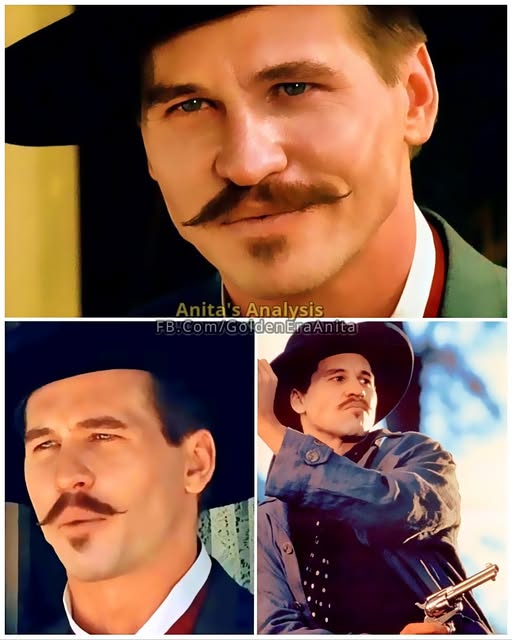
In 1993, during the filming of “Tombstone”, Val Kilmer was fighting a high fever while delivering lines that would define his career. Playing Doc Holliday, a dying Southern gambler with a deadly aim and sharper wit, Kilmer transformed what could have been a supporting character into the film’s most magnetic force. Under layers of pale makeup and labored breath, he delivered each line with a precision that blended elegance and fatalism. The phrase “I’m your huckleberry,” coolly spoken before a gunfight, became a signature moment that still echoes through pop culture.
Kilmer had immersed himself in research before the cameras rolled. He read deeply about John Henry “Doc” Holliday, a former dentist from Georgia who had tuberculosis and lived most of his final years gambling and gunfighting. Kilmer brought the illness to life without exaggeration. He adjusted his breathing pattern to sound like Holliday was constantly on the edge of collapse. He held ice cubes in his hand between takes to simulate clammy fingers. He even requested his character’s dialogue be trimmed into slower, drawn-out Southern rhythms. Director George P. Cosmatos later admitted that Kilmer came prepared with a full vision of Holliday that the crew had not anticipated.
The script for “Tombstone” (1993) gave Holliday a number of sharp quips, but it was Kilmer’s delivery that gave them staying power. When he tells Johnny Ringo, “You’re no daisy at all,” it is not mockery but something closer to pity. He plays Doc like a man already halfway to the grave, smiling at the chaos around him. While Kurt Russell commanded as Wyatt Earp, Kilmer floated through scenes with eerie grace, like death itself wearing a silk vest.
Off screen, Kilmer kept to himself. He did not break character often, preferring to stay in Holliday’s world even during breaks. Michael Biehn, who played Ringo, later said Kilmer’s focus unnerved him at times because it felt like he truly believed in the character’s fatal edge. That commitment didn’t go unnoticed. Russell, who also helped shape much of the film behind the scenes, later said Kilmer’s portrayal gave “Tombstone” its emotional backbone. His performance grounded the violence in something personal, something painful.
One scene stands above the rest. Near the end of the film, Doc lays dying in a Colorado sanitarium. Earp visits him for the final time. Doc looks down at his feet and softly says, “I’ll be damned. This is funny.” Kilmer’s delivery turns that line into a quiet acceptance of death. There are no tears, no declarations. It is a man meeting his fate with dignity and a bitter smile. The scene is haunting because of its restraint. Kilmer didn’t ask for sympathy. He earned it through silence and control.<
Even thirty years later, Kilmer’s work in “Tombstone” is regularly cited as one of the greatest performances in a Western. Fans continue to quote his lines at screenings. Memes and T-shirts carry his phrases. But more than anything, what remains is the image of Doc Holliday sweating through his linen suit, coughing into a handkerchief, and stepping into one last duel with the line that no one can forget.
Kilmer’s Doc wasn’t about guns or bravado. He was about loyalty, decay, charm, and pain stitched into one unforgettable presence. That kind of role doesn’t happen often. That kind of performance, even less.
His whisper of “I’m your huckleberry” still sends a chill through every saloon door memory and late-night rewatch. Every time the line plays, Kilmer lives again in smoke and silver.