
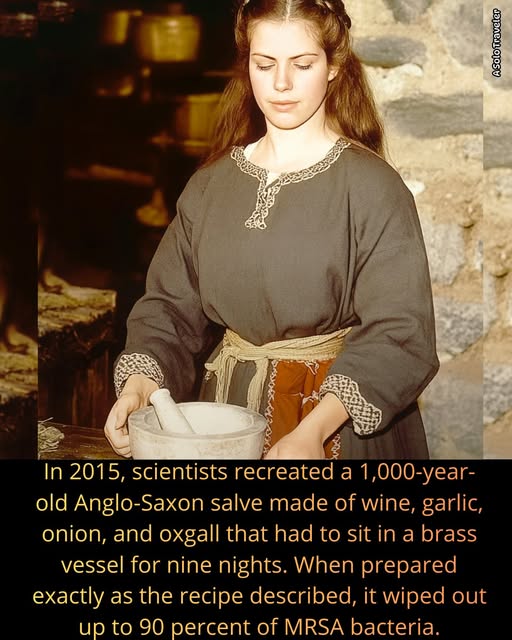
In 2015, a group of scientists decided to put an unlikely medieval remedy to the test.
They turned to a 10th-century Anglo-Saxon medical manuscript known as **Bald’s Leechbook**, which described a treatment for eye infections that sounded almost too simple to take seriously. The recipe called for garlic, onion, wine, and oxgall, mixed together in a **brass vessel** and left to sit for **nine nights**. The instructions were precise—so the researchers followed them exactly, down to the type of container used.
Expectations were low. Medieval medicine is often written off as superstition or guesswork. But when the aged mixture was finally tested in the lab, the results stunned everyone.
The salve was applied to **MRSA**, one of the most dangerous antibiotic-resistant bacteria in the modern world. Instead of barely working, the ancient formula wiped out **up to 90 percent** of the bacterial cells—outperforming many contemporary treatments. Even more surprising, none of the ingredients worked nearly as well on their own. The power came from the **exact combination**, prepared exactly as the text described.
The discovery forced scientists to rethink long-held assumptions about early medicine. It suggested that some medieval healers, through observation and experience, had uncovered complex antimicrobial strategies long before modern microbiology existed.
Since then, Bald’s Leechbook has become a symbol of something bigger: the idea that valuable medical knowledge may still be hiding in ancient texts, overlooked simply because of their age.
Sometimes progress doesn’t come from inventing something new, it comes from listening carefully to the past.