
Sweden, 1941. A mother sits beside her daughter’s bed. The girl is burning with fever, slipping in and out of delirium. “Tell me a story,” she whispers.
“About what?” the mother asks.
“Tell me about Pippi Longstocking.”
Astrid Lindgren had absolutely no idea what that meant. Her daughter Karin had just invented a name out of thin air. But Astrid started talking anyway—making it up as she went.
She described a girl with bright red pigtails and mismatched stockings. A girl so strong she could lift a horse. A girl who lived alone in a house called Villa Villekulla with a monkey and a horse, with no parents to tell her what to do. A girl who ate candy for breakfast, slept with her feet on the pillow, and told adults “no” whenever she felt like it.
Karin loved her. Astrid kept inventing more Pippi stories every time her daughter asked.
A few years later, Astrid slipped on ice and injured her ankle. Bedridden and bored, she decided to write down all the Pippi stories as a birthday present for Karin. Then she thought: maybe I should try to publish this.
Publishers rejected it immediately.
The character was too wild. Too disrespectful. Too inappropriate. This was 1944 Sweden, where children’s books were about obedient boys and girls learning moral lessons. Pippi Longstocking was pure chaos—a child living without adult supervision, lying when it suited her, defying teachers, physically throwing policemen out of windows, refusing to go to school or follow any rules.
Critics would later call the book dangerous, warning it would teach children to misbehave.
But in 1945, one publisher—Rabén & Sjögren—took a chance. They published Pippi Longstocking.
Children went absolutely wild for it.
Finally, here was a character who represented everything they weren’t allowed to be. Loud. Messy. Free. Independent. Pippi had adventures on her own terms, made her own decisions, and treated adults as equals rather than authorities to be feared.
Some adults were horrified. But other adults—and millions of children—saw something revolutionary: a story that treated children as intelligent, capable people deserving of respect and autonomy.
Astrid kept writing. She created Karlsson-on-the-Roof, Emil of Lönneberga, Ronya the Robber’s Daughter. All of her characters questioned authority, trusted their own judgment, and had rich emotional lives. Astrid never wrote down to children. She didn’t simplify their feelings or pretend life was always happy. Her books dealt with loneliness, fear, injustice, even death—but always with respect for children’s ability to understand complex emotions.
Her books began reshaping how Swedish culture understood childhood itself.
By the 1970s, Astrid Lindgren wasn’t just Sweden’s most beloved children’s author—she was a cultural icon with real political power.
In 1976, she wrote a satirical fairy tale called “Pomperipossa in Monismania” published in Sweden’s largest newspaper. It mocked the country’s absurd tax system using humor—describing a children’s author being taxed at over 100% of her income.
The piece exploded into national conversation. It sparked fierce debate about tax policy. The Social Democratic government, which had ruled Sweden for over 40 years, lost the election shortly after—partly because of the tax debate Astrid’s satire had triggered.
She’d proven her voice could move mountains.
And she decided to use that power for something that mattered even more than taxes.
In the late 1970s, Astrid turned her full attention to a brutal reality that everyone in Sweden simply accepted as normal: hitting children was legal.
Parents spanked. Teachers used rulers and canes on students. It was called “discipline,” not abuse. It was how things had always been done.
Astrid Lindgren believed it was violence against the most defenseless people in society. And she believed it had to stop.
She began speaking everywhere—newspapers, television, public speeches, interviews. She wrote articles. She appeared on national programs. She used every ounce of her fame to argue one simple point: hitting children teaches them that violence is acceptable. Physical punishment doesn’t create better behavior—it creates fear, shame, and the lesson that might makes right.
Sweden listened to her.
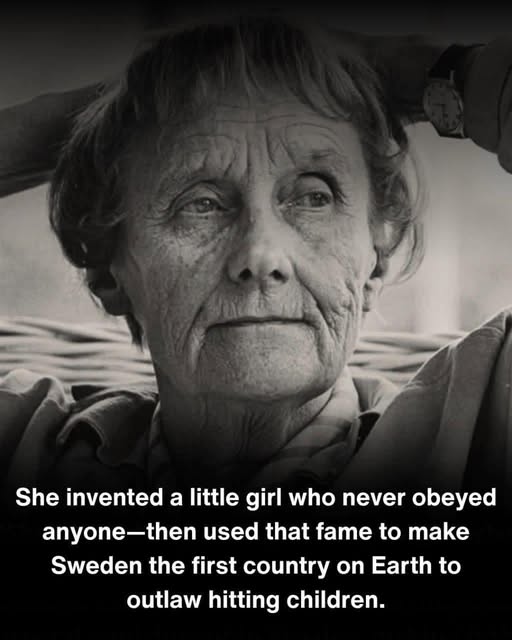
In 1979, Sweden became the first country in the entire world to legally ban corporal punishment of children.
Parents could no longer legally hit their children. Teachers couldn’t use physical punishment in schools. The law didn’t criminalize parents, but it established an absolute principle: children have the right to protection from violence, even from their own parents.
It was revolutionary. No country had ever done this before.
And Astrid Lindgren’s advocacy was absolutely crucial to making it happen.
She didn’t stop there. She campaigned for animal rights, environmental protection, and humane treatment of farm animals. She used her platform to push Sweden toward becoming a more compassionate society—for children, for animals, for anyone vulnerable.
Astrid continued writing into her eighties. She published over 100 books translated into more than 100 languages. Pippi Longstocking became a global icon—a symbol of childhood independence and joy recognized on every continent.
When Astrid Lindgren died in 2002 at age 94, Sweden mourned her like a beloved national grandmother. The Swedish royal family attended her funeral. Thousands lined the streets. The ceremony was broadcast live across the nation.
But her real legacy was what she changed.
Sweden’s 1979 ban on corporal punishment influenced the entire world. Today, more than 60 countries have followed Sweden’s lead and outlawed hitting children. That number grows every year.
And countless millions of children grew up reading about Pippi, Emil, Ronya, and Karlsson—characters who showed them that being a child didn’t mean being powerless, voiceless, or less important than adults.
Think about what Astrid Lindgren actually accomplished.
She created Pippi Longstocking in 1941 to entertain her sick daughter. That girl with red pigtails and superhuman strength became one of the most recognized characters in children’s literature worldwide.
But Astrid’s real achievement was understanding that if you’re going to write stories where children have dignity, you have to fight to build a world where they actually do.
She wrote books that respected children. Then she helped create laws that protected them.
Sweden became the first country to write that respect into law.
Because one author believed children deserved better—and refused to stay quiet until the world agreed.
Astrid Lindgren proved that respecting children wasn’t just good storytelling. It was good policy. It was justice. It was necessary.
And it started with a feverish little girl asking her mother to tell her about a character with a funny name.
That’s how revolutions begin.