
(Tom: The following are wise words yet despite their wisdom, these three distinguished gentlemen did not adequately pursue the source of man’s pain to arrive at the ultimate resolution, the discovery of and technique to erase the reactive mind, the hidden source of what ails man. To discover this for yourself, get a copy of Dianetics and read it. Discover the truth for yourself.)
From a Collective Evolution post on Facebook:
There is a strange moment that happens as you grow older.
One day, you realize your life isn’t changing because you’re making better decisions.
It’s changing because you’re repeating the same unconscious ones.
The same arguments.
The same fears.
The same habits.
The same invisible story about who you are.
You promise yourself that next year will be different.
It rarely is.
Here’s the unsettling part.
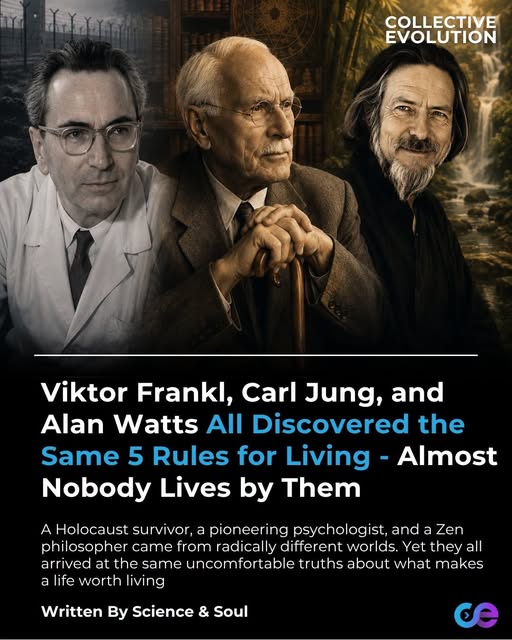
Nearly a century ago, three of the most influential thinkers of the modern era—Viktor Frankl, Carl Jung, and Alan Watts—approached this mystery from completely different directions.
One survived Nazi concentration camps.
One spent his life exploring the unconscious mind.
One translated Eastern philosophy for the Western world.
Different cultures.
Different professions.
Different beliefs.
Yet they kept arriving at remarkably similar conclusions.
Not about success.
Not about happiness.
But about the hidden psychological traps that quietly steal an entire lifetime.
Most people don’t ignore these lessons because they’re difficult.
They ignore them because accepting them would require becoming someone entirely different.
Here are the five principles they all seemed to discover.
Rule 1: Stop Searching for Happiness. Search for Meaning.
Modern culture has convinced us that happiness is the goal.
Frankl believed the opposite.
People can survive astonishing suffering if they know why they’re suffering.
Without meaning, even comfort begins to feel unbearable.
Jung observed that many psychological disorders weren’t simply illnesses—they were crises of meaning.
Watts argued that chasing happiness is like trying to smooth water with your hand.
The harder you chase it, the further it slips away.
This explains a strange paradox of modern life.
Never before have people had so much convenience.
Never before have so many reported feeling empty.
Perhaps the problem isn’t that life has become harder.
Perhaps we’ve mistaken pleasure for purpose.
Meaning often arrives disguised as responsibility.
Rule 2: Everything You Refuse to Face Eventually Controls You
Most people think avoidance protects them.
Psychology says the opposite.
Jung famously argued that what remains unconscious doesn’t disappear—it shapes your life from behind the curtain.
Frankl saw people imprisoned physically while remaining inwardly free.
Others lived in freedom while becoming prisoners of fear.
Watts repeatedly warned that resisting reality creates suffering beyond the original pain.
The emotion you suppress.
The conversation you postpone.
The grief you never process.
The insecurity you hide beneath achievement.
None of it vanishes.
It simply changes form.
Anxiety.
Burnout.
Perfectionism.
Control.
The monster isn’t under the bed.
It’s inside the room you’ve refused to enter.
Rule 3: Your Identity Is More Flexible Than You Think
One of the most dangerous sentences in the English language is:
“This is just who I am.”
It sounds like self-acceptance.
Often, it’s surrender.
Jung believed the self isn’t fixed.
It’s continually unfolding through a lifelong process of integration.
Frankl insisted that even in the most horrific conditions, people retained one freedom:
The freedom to choose their response.
Watts challenged the idea that the isolated ego is who we truly are.
Your identity isn’t a prison.
It’s a story.
And stories can be rewritten.
The future isn’t created by discovering yourself.
It’s created by becoming someone your past couldn’t predict.
Rule 4: Life Begins to Change When You Stop Trying to Control Everything
Control feels safe.
It also becomes exhausting.
We attempt to control outcomes.
Other people.
Time.
Money.
Reputation.
Our own thoughts.
The result?
Constant tension.
Watts argued that trying to control life is like trying to hold your breath forever.
Eventually, reality wins.
Frankl distinguished between what belongs to fate and what belongs to personal choice.
Jung believed psychological maturity comes not from mastering the world, but from relating differently to uncertainty.
Ironically, resilience grows precisely where certainty ends.
You cannot control life.
But you can become the kind of person who no longer requires certainty before acting.
Rule 5: The Greatest Prison Is the One You Can’t See
The most dangerous prison rarely has walls.
It has assumptions.
That your worth depends on achievement.
That everyone is judging you.
That success guarantees fulfillment.
That comfort equals security.
These beliefs quietly shape careers, relationships, and entire identities.
Jung called for making the unconscious conscious.
Frankl encouraged people to answer life rather than demand answers from it.
Watts reminded us that many of our perceived problems exist because we’ve mistaken our thoughts for reality itself.
Most people spend decades trying to escape external circumstances.
Few realize they’re carrying the prison with them.
Freedom doesn’t begin when your environment changes.
It begins when your perception does.
The Uncomfortable Truth
People often ask what the secret to a meaningful life is.
Perhaps that’s the wrong question.
The better question is:
What illusion are you still protecting?
Frankl didn’t promise a painless life.
Jung didn’t promise a simple one.
Watts certainly didn’t promise certainty.
Instead, they pointed toward something both harder and more liberating.
Life is not something you conquer.
It is something you participate in.
The tragedy isn’t that life is short.
The tragedy is that many people never truly live it because they’re too busy defending the version of themselves they created years ago.
Every day you delay confronting that truth, the unconscious writes another page of your future.
The question is no longer whether your life will change.
It will.
The only question is whether you’ll choose the change—or wait until life chooses it for you.