
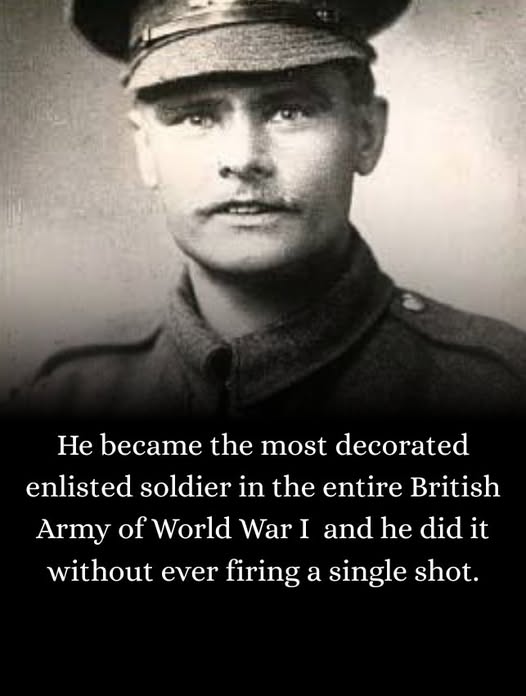
For two days and two nights, one small man crawled back and forth across a killing field, unarmed, carrying wounded men out on his back.
His name was William Harold Coltman. He stood just five feet four inches tall. He never carried a weapon. And by the end of the First World War, no enlisted man in the entire British Army had been decorated more times for bravery than he had.
He was an unlikely soldier. Born in 1891 near Burton-upon-Trent in the English Midlands, Coltman was a market gardener and a Sunday School teacher, a devout and gentle member of a Christian group called the Plymouth Brethren. When war came, he volunteered in January 1915 and joined the North Staffordshire Regiment. At first, like every other soldier, he was handed a rifle.
Then came the night that changed him. Trapped in a shell-hole under enemy fire, he lay in the dark listening to the cries of wounded men he couldn’t reach. Something in him settled. He resolved that he would never again shoulder a rifle. He would not take a life. Instead, he would spend the rest of the war saving them, as a stretcher-bearer — the men who ran toward the fallen while everyone else took cover.
What followed reads almost like a legend, except every bit of it is documented.
In February 1917, an officer was shot through the thigh and left stranded in no-man’s-land, in full view of the German lines. Coltman went out and dragged him back to safety under fire. That earned him the Military Medal.
That June, near Lens, he earned a bar to it — effectively a second Military Medal. When a mortar round set an ammunition dump ablaze, he helped bring the danger under control. When another shell tore into the battalion headquarters, he rushed in to treat the wounded. And when a dozen men were buried alive by a collapsing tunnel, he organized the rescue and tended the survivors he helped dig out.
In July 1917 came the Distinguished Conduct Medal, one of the army’s highest honors, for days of hauling wounded men out of the front line under shellfire — and for crawling into no-man’s-land in the dark, again and again, to find those still breathing.
By late September 1918, near the St. Quentin Canal at Bellenglise, the great German defensive wall known as the Hindenburg Line was finally cracking. In the thick of that ferocious fighting, Coltman worked without rest or sleep, ignoring shells and machine guns, refusing to stop until he was certain not one wounded man had been left behind. That earned him a bar to his DCM — a second one.
And then came Mannequin Hill.
Here is what most people miss: the most decorated enlisted soldier of the entire war never once tried to kill anyone. Every medal on his chest was earned rescuing the wounded, not defeating the enemy. We tend to imagine that the bravest man on a battlefield is the fiercest fighter. Coltman quietly proved otherwise. He walked into the deadliest places on the Western Front carrying nothing but bandages and a stretcher, and his faith was never in conflict with his courage — it was the engine of it. His refusal to take a life did not make him timid. It made him unstoppable.
On October 3 and 4, 1918, scarcely a month before the war ended, British troops were pushed back at Mannequin Hill and forced to leave their wounded behind on the field. Coltman couldn’t accept that. He went forward alone into a storm of enfilade fire, found the abandoned men, dressed their wounds, and carried them out on his back — one, then another, then another. For a full 48 hours he tended the wounded without stopping. For that, King George V pinned the Victoria Cross, Britain’s highest award for valor, to his chest at Buckingham Palace in May 1919. France added its Croix de Guerre.
He wanted none of the glory. When his hometown planned a hero’s welcome, he slipped off the train early and made his own quiet way home to avoid the crowds. Then he went back to work tending the town’s parks, planting and pruning, as though he’d never done anything remarkable at all. When the next world war came, he served again, commanding the local Army Cadet Force as a captain — still, always, drawn to protecting the young.
He retired from the parks department in 1963 and died in 1974, at the age of 82. His medals now rest in a regimental museum, where a replica trench has been named in his honor. His own church never formally recognized his decorations at all — to them, such honors came from human conflict and the hand of man, not from God. Coltman, a humble man to the end, almost certainly didn’t mind.
True courage is measured not by the lives a person takes, but by the ones they refuse to leave behind.