
Sometimes courage is not lifting a trophy.
Sometimes courage is standing in front of impossible odds and refusing to quit.
That is exactly what Eloy Room did.
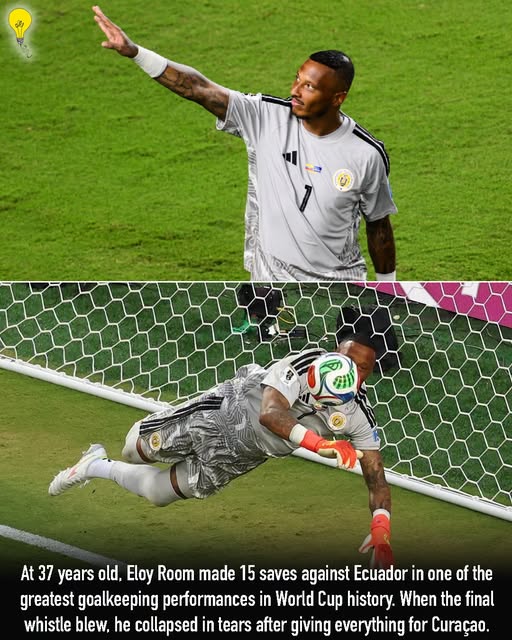
At 37 years old, the Curaçao goalkeeper delivered one of the most extraordinary performances ever seen on football’s biggest stage. Facing a relentless Ecuador attack at the 2026 FIFA World Cup, Room spent nearly the entire match under pressure as wave after wave of chances came crashing toward his goal.
Most goalkeepers would have cracked.
Room did the opposite.
Save after save, he kept his team alive.
Shots from close range.
Powerful strikes.
Dangerous headers.
Every time Ecuador thought they had found a way through, there was Eloy Room standing in the way.
By the end of the match, he had made an astonishing 15 saves, one of the greatest goalkeeping displays World Cup fans have ever witnessed.
Yet the statistics only tell part of the story.
Because behind every save was a veteran goalkeeper carrying the hopes of an entire nation.
A player who had spent years working for moments like this.
A man who refused to surrender no matter how difficult the challenge became.
As the final whistle blew, the scoreboard showed a hard-earned draw.
For Curaçao, it felt like a victory.
For Ecuador, it felt like a missed opportunity.
And for Eloy Room, the emotions became impossible to contain.
The goalkeeper collapsed to the ground in tears.
Not because he had won a trophy.
Not because he had broken a record.
But because he had given absolutely everything he had.
Football can be cruel.
It can break hearts.
It can expose every mistake.
But every so often, it also produces moments that remind us why we love the game.
Moments where determination matters more than talent.
Where resilience matters more than fame.
Where one person refuses to stop fighting, even when the odds seem overwhelming.
Eloy Room may never score the winning goal.
He may never be the most famous player at the World Cup.
But on that day, with 15 saves and tears in his eyes, he showed the world something just as important.
That sometimes greatness is not about winning.
Sometimes greatness is simply refusing to give up.