
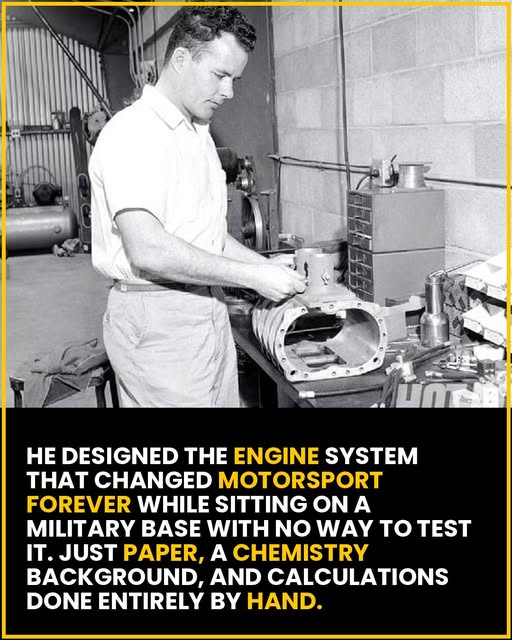
He designed the engine system that changed motorsport forever while sitting on a military base with no way to test it. Just paper, a chemistry background, and calculations done entirely by hand.
Stu Hilborn was born in Calgary in 1917 and grew up in Southern California, a speed-obsessed kid who found his way to the dry lake beds of the Mojave Desert in the late 1930s where hot rodders pushed their cars as fast as they could go. He bought a used Model A with no engine, found a Ford flathead, and started building something fast.
He met Eddie Miller, a former Indianapolis driver who taught him the fundamentals — including how to grind custom camshafts with nothing but a bench grinder and a steady hand. No computers. No CNC machines. Skill and patience.
The car was fast. Hilborn wanted faster.
He found a streamliner and bought it on December 7, 1941. Then heard the news from Pearl Harbor. He stored the car, joined the Army Air Forces, and served as an aerial gunner. And while stationed on a military base with no test equipment and no machine shop, he began designing something no one had yet managed to make work on a racing engine.
A mechanical fuel injection system. On paper. Entirely by hand.
He used his chemistry background to calculate nozzle sizes, fuel pressure, and mixture ratios — everything a dyno and fuel flow measuring equipment would normally tell you — worked out in equations in his spare time between duties.
After discharge, he went back to the streamliner. He ran carburetors first while he refined the injection system. His peers were skeptical. Most told him the concept would never work for a race car. He tested anyway — careful, methodical, fixing what failed and trying again.
In 1948, Howie Wilson drove the Hilborn streamliner through 150 miles per hour at the dry lakes. The first hot rod ever to break that barrier. The superiority over carburetors was undeniable. The streamliner made the cover of Hot Rod Magazine.
Word spread fast.
Hilborn designed an injection system for the Offenhauser engine — the dominant powerplant in midget racing. A dyno test by the Offy makers showed injection boosted power by ten percent. The results in competition were immediate. Starting in 1949, Hilborn-equipped cars began winning at Indianapolis Motor Speedway. Within a few years, Hilborn injectors were standard at Indy.
Then drag racing. Then land speed records. Then circle track. Then every form of motorsport that cared about winning.
Over four decades, Hilborn fuel injection powered cars in virtually every major racing discipline. From naturally aspirated gas engines to supercharged fuel dragsters. From dry lake beds to the Brickyard.
The iconic “stacks” — flared tubes rising directly out of each cylinder — became one of the most recognizable sights in American motorsport. You knew a Hilborn car when you saw one.
Many companies eventually entered the fuel injection market. But Stu Hilborn was first. He designed it in the military. Built it in a garage. Proved it on a salt flat. And made carburetors obsolete for anyone serious about speed.
Stu Hilborn died on December 16, 2013, at age 96. He was inducted into the SEMA Hall of Fame and the Hot Rod Magazine Speed Parts Hall of Fame. His systems are still manufactured and raced today.
He started with a Model A that had no engine and a mentor who ground camshafts on a bench grinder.
He ended as the man who changed how engines breathe.