
Most people know the songs. Very few know the man who made them. And almost nobody knows just how close the world came to never hearing any of them at all.
His name is Nile Rodgers.
He was born on September 19, 1952, in New York City — into a world that was difficult from the very beginning. His mother was just 14 years old when he was born. His stepfather and mother were heroin users, though by all accounts loving in their own chaotic way. His biological father, a travelling percussionist, was rarely present. Nile grew up moving between New York and Los Angeles, between relatives and neighbourhoods, learning how to observe the world around him long before he fully understood it.
Then, somewhere along the way, he picked up a guitar.
Music became everything. As a teenager, he was already playing professionally. He performed with the Sesame Street band on PBS. He joined the legendary house band at the Apollo Theatre in Harlem, where he backed Aretha Franklin and Parliament-Funkadelic. These were not small stages — they were masterclasses in rhythm, timing, and how to make an audience feel something.
In 1970, Nile met a young bassist named Bernard Edwards. They connected immediately over a shared obsession with precision, groove, and the idea that music could be both intelligent and irresistible. They played together for years, building something new. By 1977, they had finally shaped it into a band. They called it Chic. Their first single, Dance, Dance, Dance, became a hit. Then came Everybody Dance. People were starting to pay attention.
Which brings us to that New Year’s Eve.
Studio 54 in New York was the most famous nightclub on the planet. Celebrities, artists, and icons danced there every night under glittering lights. Singer Grace Jones had invited Nile and Bernard to come watch her perform. They dressed in their finest clothes and walked through the freezing New York night to the back door of the club. They told the doorman they were personal friends of Grace Jones.
The doorman slammed the door in their faces.
Grace had forgotten to put their names on the list. They knocked again. The doorman told them, in the rudest possible way, to go away. And that was that.
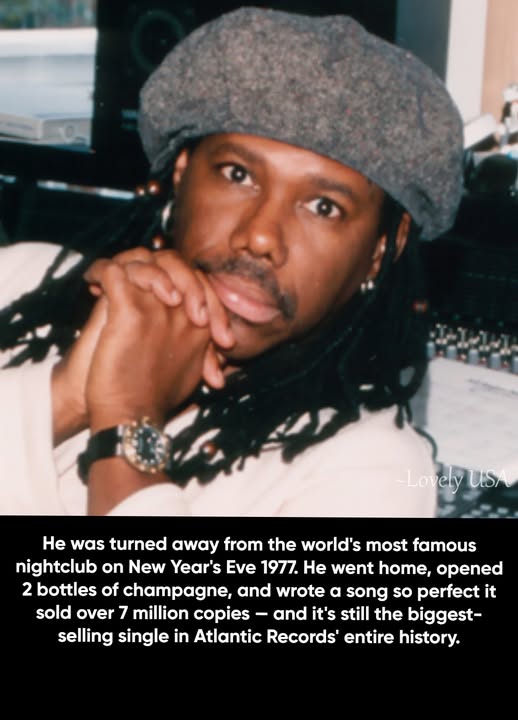
Nile and Bernard walked back to Nile’s nearby apartment — cold, embarrassed, and furious. They opened two bottles of Dom Pérignon champagne, which Nile has always jokingly called “rock and roll mouthwash.” They started drinking. And then, because they were musicians and musicians cannot stop being musicians even when they are angry, they started playing.
Out of their frustration came a groove. A furious, irresistible, brilliant groove.
The chorus they sang first was, in Nile’s own words, not exactly suitable for radio. It was a direct message aimed at the doorman. But as the song grew, they realised they needed to clean it up. “Freak off” didn’t work. Then, finally, they landed on it.
“Freak out.”
Le Freak was born.
Released in September 1978, the song became an absolute phenomenon. It hit number 1 on the Billboard Hot 100. It sold more than 7 million copies. It became the biggest-selling single in the entire history of Atlantic Records — a title it still holds to this day. The very club that had slammed a door in their faces was now playing their song all night long, every night.
But Nile Rodgers was nowhere near finished.
In 1979, Chic released Good Times. Its bass line was so perfectly constructed, so hypnotically groovy, that a group of young musicians in the Bronx building something brand new heard it and knew immediately what they needed to do. The Sugarhill Gang built Rapper’s Delight on top of it. That song became one of the first hip-hop records to achieve mainstream success. The DNA of an entirely new genre of music ran directly through Nile Rodgers’ guitar playing.
Then the disco backlash came. Clubs burned disco records. Radio stations turned against the sound. Chic, one of the most musically sophisticated bands of the era, was swept aside along with everything else labelled disco. It could have ended Nile Rodgers’ career.
Instead, it launched a second one.
In 1983, David Bowie approached him. They worked together at the Power Station studio in New York. Bowie told Nile simply, “I want you to make hits.” Nile did exactly that. The Let’s Dance album went on to sell 11 million copies and became Bowie’s biggest commercial success. Let’s Dance was the only Bowie single to hit number 1 in both the United States and the United Kingdom.
The following year, a young Madonna came to him. Together they made Like a Virgin — the album that launched her into global superstardom. He produced Diana Ross. He worked with Duran Duran, Mick Jagger, Sister Sledge, and the B-52s. He kept going, year after year, with barely a pause.
Then, in 2013, he did something remarkable.
He returned to the very top of the charts — by producing Daft Punk’s Get Lucky, from their album Random Access Memories. That same year, he announced publicly that he had beaten cancer. He was 60 years old, standing at the peak of the music world again, healthier and more creative than ever.
Here is the number that still does not feel quite real. Nile Rodgers has written, produced, or performed on records that have sold more than 750 million albums and 100 million singles worldwide. There are very, very few musicians in the entire history of recorded music who can say anything close to that.
But here is what makes the story truly remarkable.
Through all of it, Nile Rodgers has never demanded to be seen. He does not swagger. He does not dominate. His guitar style, which he calls “chucking,” is built on tiny, precise, almost invisible movements. You can barely see his right hand when he plays. But the sound that comes out of it has shaped disco, funk, rock, hip-hop, and pop music across five decades — in a way that almost no single human being ever has.
He lost Bernard Edwards to pneumonia in 1996, while the two were on tour together in Japan. It was one of the worst moments of his life. He still tours under the name Nile Rodgers and Chic. He still picks up his beloved Fender Stratocaster, nicknamed “The Hitmaker,” and plays like a man who cannot quite believe how lucky he is to still be doing what he loves.
Here is the lesson buried inside his extraordinary story.
You do not have to be the loudest person in the room to leave the biggest mark on the world. Nile Rodgers took a cold, humiliating New Year’s Eve, a slammed door, two bottles of champagne, and an old guitar — and turned all of it into pure joy that has now been heard by hundreds of millions of people across five decades.
He never tried to be the star. He tried to make everyone around him sound like stars. And in doing so, he became one of the most important musicians who ever lived.
So the next time you hear that bright, chopped, chiming guitar riff somewhere in the background — and you feel your body start to move before your brain even notices — remember.
That is probably Nile Rodgers. Quietly doing what he has always done.
Making the whole world dance. One perfect note at a time.