
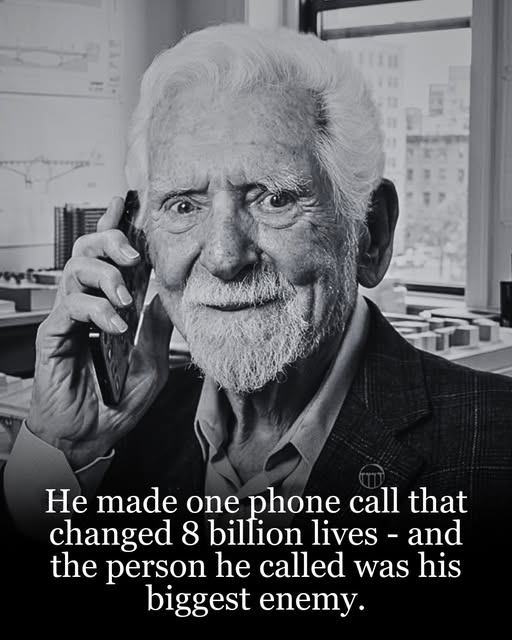
It was a Tuesday morning in New York City. The year was 1973.
A man stepped out of the New York Hilton onto Sixth Avenue, looked around at the taxis and pedestrians rushing past, and held something to his ear that no one on that street — or anywhere on Earth — had ever seen before.
It was enormous. Gray. Rectangular. Nearly ten inches tall, with a thick antenna jutting from the top like a miniature radio tower. It weighed two and a half pounds — about as heavy as a large bag of sugar. Your arm would ache after holding it for more than a few minutes.
It was a telephone.
And it had no wires.
The man’s name was Martin Cooper. He was a division director at Motorola — not a young dreamer, but a seasoned engineer who had spent years fighting for an idea that most of the world’s most powerful companies had already dismissed as unnecessary.
Before making any statement to the press, before giving any formal demonstration, before posing for a single photograph — Cooper had one call to make first.
He flipped open his phone book, found the number he had memorized for exactly this moment, and dialed.
The phone rang.
A man named Joel Engel answered.
Engel was Cooper’s counterpart at AT&T’s Bell Labs — the most celebrated research institution in the world, the place that had invented the transistor, the laser, and had been building toward the same technology Cooper now held in his hand. For years, AT&T and Motorola had been locked in a race to develop a truly personal, portable, wireless telephone. AT&T believed the future was car phones — large devices bolted into vehicles. Motorola believed differently.
And Cooper, standing on a Manhattan sidewalk in the spring of 1973, had just proved it.
“Joel,” he said, “I’m calling you from a cellphone. A real cellphone. A personal, handheld, portable cellphone.”
Silence.
Cooper couldn’t see Engel’s face. But silence, in a competition as fierce as this one, said everything.
“There was silence on the other end of the line,” Cooper recalled years later with a grin. “And he said something very nice and polite. To this day, he doesn’t remember that phone call.”
The device Cooper was holding had been built in just 90 days.
Not months of careful deliberation. Not years of gradual refinement. Ninety days — a frantic, sleep-deprived sprint fueled by competitive desperation, because Motorola had learned that AT&T was about to petition the government for exclusive rights to the mobile phone spectrum. If they moved first, the game would be over.
So Cooper assembled his team, set the clock, and told them to build something the world had never seen.
What they produced was, by any objective measure, absurd.
It stood nearly ten inches tall. It weighed 2.5 pounds. Inside its chunky gray shell, engineers had packed 30 individual circuit boards, wired together by hand, working alongside batteries and antenna components in an impossibly tight space. The phone took ten full hours to charge. Once it was charged, you had roughly 20 to 30 minutes of actual talk time before it died.
They called it the DynaTAC — short for Dynamic Total Area Coverage.
Everyone else called it something simpler: The Brick.
“The battery life was only 20 minutes,” Cooper joked in later interviews. “But that was not a problem, because you couldn’t hold that heavy thing up for more than 20 minutes anyway.”
The demonstration on Sixth Avenue was witnessed by reporters who had gathered specifically to watch — but many of them weren’t entirely sure what they were looking at. The idea of a telephone with no cord, no wall socket, no physical connection to anything — it didn’t quite fit inside the imagination of 1973.
One passerby, so distracted by the sight of a man speaking into a handheld device while walking, stepped off the curb and nearly got hit by a taxi.
That moment, in miniature, captured everything. The world wasn’t ready for what Cooper was holding. And yet, in a very real sense, the world had already changed. The call had been made. The proof existed. The only question now was how long it would take for everyone else to catch up.
The answer turned out to be: about a decade.
It wasn’t until 1983 — ten years after that sidewalk demonstration — that the first commercial handheld mobile phone became available to the public.
The Motorola DynaTAC 8000X cost $3,995 — roughly $12,000 in today’s money.
It weighed 28 ounces, offered around 30 minutes of talk time, and took ten hours to recharge overnight.
By every practical measure, it made almost no sense.
People lined up for months to buy one anyway.
The waiting lists stretched around the block. Executives carried them like scepters. Wall Street traders barked orders into them on trading floors. The phone became a cultural icon almost immediately — most famously immortalized in the 1987 film Wall Street, where Gordon Gekko paced a beach at dawn, the antenna of his DynaTAC silhouetted against the sunrise, speaking in the shorthand of a man who couldn’t afford to be unreachable.
Owning one didn’t just mean you had a phone.
It meant you had arrived.
Looking back now, the temptation is to laugh at the absurdity of it all. A phone heavier than most modern laptops. A battery that expired before most morning meetings ended. A price tag that exceeded many people’s monthly salary.
But Martin Cooper and his team at Motorola weren’t building a finished product.
They were building a proof.
A proof that people didn’t need to be tethered to a desk to make a phone call. A proof that communication could be personal — not just tied to buildings and offices and homes, but carried in a person’s hand wherever they went. A proof that the phone could become, over time, as intimate and essential as a wallet or a set of keys.
“We used to tell people,” Cooper recalled, “that someday when you’re born, you would be assigned a phone number. And if you didn’t answer the phone, you would die.”
He was joking, of course.
Mostly.
Today, there are more mobile phones on Earth than there are people — over 8 billion active devices connecting human beings across every language, continent, and time zone.
The smartphone in your pocket weighs a few ounces. It fits in your hand. It contains more computing power than the systems that guided astronauts to the moon. It lasts all day on a single charge, connects to the internet at speeds that would have seemed fictional in 1973, and does things that Martin Cooper, standing on that Manhattan sidewalk, never could have imagined.
But here is what he did imagine:
That communication should be free. That a person shouldn’t have to be somewhere specific to be reachable. That the telephone — the most important communication tool in human history — belonged in a person’s hand, not mounted on a wall.
He imagined it. He fought for it. He built it in 90 days.
And then, because he was human and the moment deserved it, he picked it up and called the one person who most needed to hear it.
Your phone is probably within arm’s reach right now. Maybe it’s in your pocket. Maybe it’s sitting on the table next to you. Maybe you’re reading these words on its screen.
That is not an accident.
That is the world Martin Cooper invented on a Tuesday morning in 1973 — when a man walked out of a hotel, held a gray brick to his ear, and dialed in the future.
One call.
One brick.
One rival who picked up the phone.
And the entire world changed.