
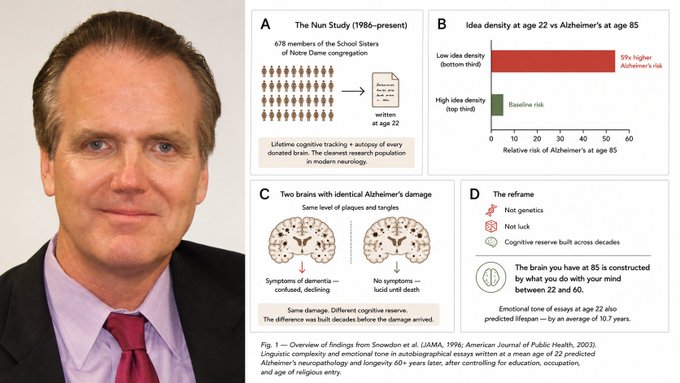
A University of Kentucky epidemiologist convinced 678 Catholic nuns to donate their brains and their entire life records to science, and the autopsies he performed quietly rewrote everything modern medicine thought it knew about Alzheimer’s disease.
The findings have been published in JAMA and the New England Journal of Medicine.
Almost nobody outside the field of neurology has heard of them.
His name was David Snowdon.
He was a young epidemiologist at the University of Minnesota in 1986 when he had what most of his colleagues considered a crazy idea. He wanted to study Alzheimer’s disease the way it had never been studied before. Not through brain scans of confused 80-year-olds in a hospital. Not through self-reported family histories. He wanted to find a group of people whose entire lives were on paper, from their twenties to their deathbeds, and then look inside their brains after they died and see what the autopsies actually showed.
He chose 678 Catholic sisters from the School Sisters of Notre Dame congregation.
The choice was not random. Nuns lived almost identical lifestyles. Same diet. Same housing. Same daily schedule. Same medical care. No smoking. No drinking. No pregnancies confounding the hormonal data. They were, statistically speaking, the cleanest research population on Earth. And they had something no other study population had ever offered.
Their entire lives were already documented. Every nun in the order had written a one-to-two-page autobiography in her early twenties, before taking her final vows. The essays had been sitting in convent archives for 60 years, untouched, waiting to be discovered.
Then Snowdon did the part most researchers would never have agreed to. He asked the nuns, in person, one at a time, if they would donate their brains to science after they died.
They said yes. All of them.
The study ran for over 25 years. Annual cognitive tests. Annual physical exams. Detailed medical records. And at the moment of death, every single brain was carefully removed and analyzed under a microscope.
The findings broke modern neuroscience.
The first thing the autopsies showed was that many of the nuns had brains riddled with the classic plaques and tangles of full-blown Alzheimer’s disease. Severe damage. The kind of damage that, in any other patient, would have produced complete dementia.
But while they were alive, these particular nuns had shown no symptoms at all. They had stayed sharp until the day they died. They had taught classes. They had run errands. They had recognized everyone. Their brains were destroyed. Their minds were intact.
Something was protecting them that nobody had ever measured before.
Snowdon called it cognitive reserve. The brain, he argued, can absorb extraordinary amounts of damage without showing symptoms, as long as it has been built thick enough beforehand. The nuns who stayed sharp had brains that had been so well-developed over a lifetime of learning, teaching, reading, and thinking that they could afford to lose huge sections of tissue and still keep functioning.
Then he found the second thing. The one that made the study famous.
He pulled the autobiographies out of the archives. The essays written by the same nuns 60 years earlier, when they were 22 years old.
He measured a single linguistic feature called idea density. How many distinct ideas a writer packed into each ten words of prose. Not vocabulary. Not grammar. Not style. Just the raw informational compression of a young mind.
The result was so clean it should be illegal to ignore.
The nuns who had the lowest idea density at age 22 were 59 times more likely to develop Alzheimer’s by age 85 than the nuns who had the highest idea density. Snowdon could predict with roughly 80 to 90 percent accuracy who would develop dementia 60 years before it happened, from a single essay written before the woman had even taken her vows.
The detail that should disturb every adult reading this is what happened when the researchers controlled for the obvious objections.
When they controlled for education, the effect held.
When they controlled for occupation, the effect held.
When they controlled for the age at which the nun entered the convent, the effect held.
The cognitive complexity of the 22-year-old mind, measured in a single autobiographical paragraph, was a stronger predictor of Alzheimer’s six decades later than any other variable Snowdon could find.
Then he ran the second analysis. The one that almost nobody quotes.
He measured the emotional tone of the same autobiographies. The frequency of positive words like joy, gratitude, hope, love, contentment. The nuns who wrote about their lives in positive emotional terms at age 22 lived an average of 10.7 years longer than the nuns who wrote in neutral or negative terms.
Same convent. Same diet. Same medical care. Same prayer schedule.
The lifespan was being shaped by something invisible. Something that had been written down before the nun had any way of knowing it would matter.
The paper landed in JAMA in 1996. It has been cited thousands of times since. Almost no one outside academic neurology has heard of it.
The reason most people resist this finding is that it sounds like a sentence handed down before adulthood even began. If the architecture of your old-age brain is being built by what you do with your mind in your twenties, and your emotional resilience is being calibrated by the words you use about your own life, then your eighties are being shaped right now by patterns you cannot even feel yourself making.
Snowdon argued the opposite. He said the data showed cognitive reserve could be built throughout life. The nuns who continued to learn languages, teach courses, read difficult books, and engage in complex conversations in their 60s and 70s also showed slower decline. The brain does not stop responding to mental work just because you got older. It only stops responding when you stop asking anything of it.
The most uncomfortable part of the research is the contrast Snowdon repeatedly emphasized.
Two nuns could have identical brain damage on autopsy. Identical plaques. Identical tangles. Identical genetics. One would have lived her last years confused, frightened, and lost. The other would have lived her last years lucid, joyful, and intact. The only meaningful difference between them was the depth of the cognitive and emotional architecture each had built across the decades before the damage arrived.
The brain you will have at 85 is being constructed right now by the books you choose not to read, the conversations you choose not to have, and the words you choose to use about your own life.
The dementia that arrives at 80 is not a verdict. It is the bill for a structure you either built or did not build between 22 and 60.
Almost nobody walks through the window because almost nobody knows it is open.
You can be the one who does.