
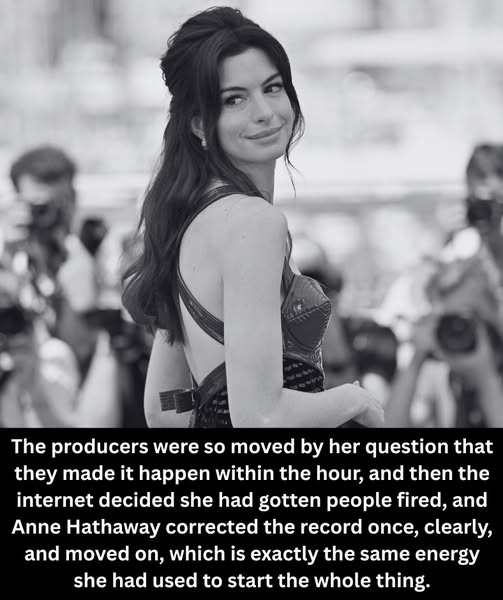
In 2006, The Devil Wears Prada became one of the most quoted comedies of its generation.
Sharp enough to make people laugh. Real enough to make them think. Nearly two decades later, when a sequel was announced with Meryl Streep, Anne Hathaway, Emily Blunt, and Stanley Tucci all returning, the world paid immediate attention.
Filming began. And during one fashion scene, Hathaway noticed something.
Beautiful models were on set. Most of them were, in her own words, “more traditionally model-sized.”
She understood what that phrase had cost women in the fashion industry for decades. She had grown up in Hollywood. She had watched a culture built around one narrow physical ideal and seen the damage it left behind — not just in magazines, but in real people’s lives, real people’s relationships with their own bodies.
So she did something simple.
She walked over to the producers and asked a question.
“Don’t you think the scene would be stronger if we had a more inclusive approach to sizing?”
She didn’t demand. She didn’t lecture. She didn’t frame it as a moral failing or a public statement. She asked, quietly and without agenda, whether a different approach might actually serve the scene better.
The producers, by her account, were immediately and genuinely troubled that they hadn’t thought of it themselves. They had been moving at the pace that film productions move — locked into rhythm, going with the flow, not stopping to examine what the flow was carrying.
But once they saw it, they acted.
Within an hour, models with a wider range of body types had been brought to set. The scene was filmed with everyone present.
A small, human moment. Noticed by one person. Acted on quickly. Folded quietly into the finished film.
That should have been the end of it.
Then Meryl Streep mentioned it in a Harper’s Bazaar cover story.
Streep recalled seeing the models on set and assuming the industry had already moved past this. She noted that Hathaway had gone directly to the producers to make sure the models in the scene wouldn’t be, in Streep’s words, “so skeletal.”
Social media picked up the story. And then it did what social media reliably does.
Posts began circulating claiming that Hathaway had gotten thin models fired. The narrative spread fast, because it fit a story people already carried in their heads — powerful actresses overriding other women’s livelihoods, Hollywood inserting itself destructively into the fashion world, one woman’s moment of virtue costing others their jobs.
None of it was true.
Hathaway went on Good Morning America and addressed it without drama, without anger, and without naming anyone who had spread the rumor.
“I do want to mention there’s a little misinformation getting out there right now that people were fired because of the size inclusivity, and that just didn’t happen. Nobody lost their jobs. In fact, it created more jobs. It was just about making sure that so many different body types saw themselves in a moment in the script.”
One clear statement. Then she moved on.
“It all begins with the question, right?”
Eight words. Summarizing the entire thing.
That is the part of this story that disappears in the noise of the controversy.
Not the rumor. Not the correction. But those eight words and what they actually point to.
A question. Asked simply and without agenda. By someone who noticed something and chose to say so rather than stay quiet in an industry where silence is frequently the safest career move.
Real change doesn’t always arrive as a speech or a campaign or a carefully worded statement released through a publicist.
Sometimes it arrives as a question asked on a busy production day, by someone willing to ask it, to producers who needed only to hear it before making it happen themselves.
And when the world tried to rewrite that quiet kindness into something ugly, the response wasn’t louder noise.
It was the truth. Stated once. Clearly.
That is what quiet courage actually looks like.