
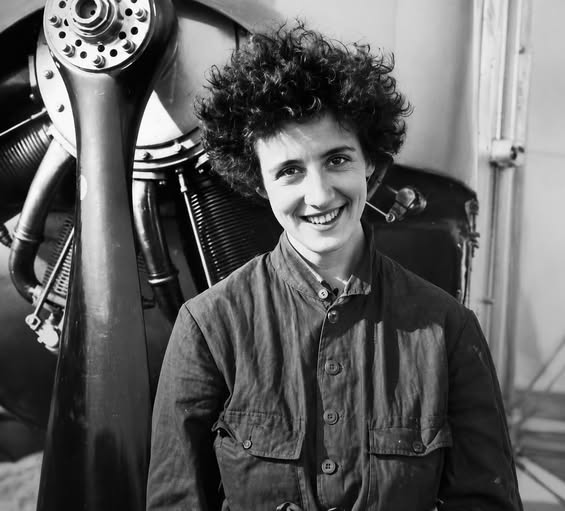
She gambled away everything. Learned to fly to pay her debts. Then with just 40 hours in the air, she attempted what had killed every man who tried—and a mysterious stranger’s prophecy saved her life.
Paris, late 1919. Adrienne Boland had a problem.
The 24-year-old loved two things: wild parties and gambling. That November, she’d lost not just her money but found herself drowning in debt.
A friend offered unexpected advice: “Learn to fly. Pilots are making good money, and aviation is desperate for anyone brave enough to take the risk.”
On November 16, 1919, Adrienne enrolled at the Caudron manufacturing plant in Le Crotoy and began training.
Her instructors quickly realized she had natural talent—the kind that couldn’t be taught.
On January 29, 1920, she earned her pilot’s license, becoming the 13th Frenchwoman to do so. A typo on the certificate added an extra “l” to her surname, spelling it “Bolland” instead of “Boland.”
She kept the mistake. It felt like the beginning of a new life.
René Caudron, the factory owner, saw something else—publicity gold.
When Adrienne demanded her own plane, Caudron pointed to a Caudron G.3, a pre-World War I scout plane held together with wire and struts.
“If you can perform a loop in that,” he told her, “it’s yours.”
She did it effortlessly.
Caudron realized that having an attractive young woman flying his planes would prove how easy they were to operate. On August 25, 1920, Adrienne flew across the English Channel—one of only a few women in history to make the crossing.
The newspapers loved her. And Adrienne discovered something profound: “I became a different person in an airplane. I felt small, humble. Because, the truth is, on the ground I was totally insufferable.”
In 1921, Caudron sent her to Argentina with two crated G.3s to demonstrate his planes to South American buyers.
On the boat crossing the Atlantic, Adrienne conceived an audacious idea: She would fly over the Andes Mountains.
The Andes were a death trap for aviators. Men had been attempting the crossing since 1913. Most failed. Some died.
Chilean officer Dagoberto Godoy had successfully crossed in 1918, but no woman had ever done it. And the route Adrienne planned was even more treacherous—threading through the highest section of the range, where peaks soared above 20,000 feet.
Her fragile G.3 had a maximum ceiling of around 15,000 feet. The only way across was through unpredictable river valleys where violent winds could slam a plane into a mountainside without warning.
Adrienne telegraphed Caudron requesting a more suitable aircraft.
His response was blunt: “Take decision yourself. Could not send another plane.”
She decided to fly the G.3 anyway.
By April 1, 1921, she had just 40 hours of total flight experience. No maps adapted for aerial navigation. No knowledge of the terrain. No radio.
What she did have was absolute conviction that she could do what others said was impossible.
The night before the flight, something strange happened.
A shy Brazilian woman appeared at Adrienne’s hotel room in Buenos Aires, insisting on seeing her.
Annoyed, Adrienne lit a cigarette. “You have as long as it takes me to smoke this. Tell me what you came to say.”
The woman’s message was cryptic and unsettling:
During the flight, she said, Adrienne would see an oyster-shaped lake. When she did, she would face a choice—a valley to the right that looked safe, or a steep mountain face to the left that resembled an overturned chair.
“Turn left toward the mountain. If you turn right, you’re lost.”
Then she left.
Adrienne dismissed it as superstitious nonsense. But she didn’t forget it.
At 6:00 a.m. on April 1, 1921, Adrienne Bolland took off from Mendoza, Argentina.
Santiago, Chile was just 121 miles away—under normal circumstances, an easy flight.
But ahead lay one of the most formidable mountain ranges on Earth.
The Caudron G.3 groaned and shuddered as she gained altitude. She flew at around 14,750 feet, threading through river valleys, banking around peaks that towered above her.
The cold was brutal—temperatures dropped to -26°C (-15°F). The thin air made every breath an effort. Without oxygen equipment, altitude sickness set in.
For hours, she navigated by instinct alone, searching for a path through the mountains.
Then she saw it—an oyster-shaped lake, exactly as the Brazilian woman had described.
To the right was an inviting valley, wide and promising. Every instinct told her to turn right toward safety.
But to the left was a mountain face that looked like an overturned chair.
Against everything she believed about flying, against every rational calculation, Adrienne turned left.
An updraft caught the plane, lifting it over the mountain face. On the other side, she saw the Chilean plains stretching toward Santiago.
“Make whatever you will of it,” she said later. “But you have to admit that it takes some effort not to believe.”
Four hours and seventeen minutes after takeoff, Adrienne landed in Santiago.
Crowds had gathered to celebrate. The French consul wasn’t among them—he’d assumed the whole thing was an April Fool’s Day joke and stayed home.
The celebrants called her “the goddess of the Andes.” Newspapers across South America and Europe declared her a hero.
She had become the first woman to fly over the Andes Mountains through its highest and most dangerous section.
Adrienne dismissed the acclaim: “I said to myself: this is glory? It’s nothing. Glory isn’t worth anything compared to the inner joy of accomplishing something.”
Back in France, her achievement went largely unnoticed.
Two years later, Caudron’s new wife grew jealous and pressured him to fire Adrienne.
She kept flying anyway.
On May 27, 1924, she flew 212 consecutive loops in an hour—a new women’s record. That same year, France finally recognized her Andes crossing, naming her a Chevalier de la Légion d’Honneur.
In 1930, she married fellow aviator Ernest Vinchon. When World War II came, both joined the French Resistance, fighting the Nazi occupation. For her wartime service, she was later promoted to Officier de la Légion d’Honneur.
Adrienne Bolland died in Paris on March 18, 1975, at age 79.
Today, a stop on Paris’s Tramway T3 bears her name. Argentina issued a commemorative stamp in 2021 marking the centenary of her Andes crossing. Streets and schools in France honor her memory.
But her real legacy isn’t found in stamps or street names.
It’s in the impossible choice she made that April morning—to turn left toward the mountain when every instinct screamed to turn right. To trust something she couldn’t explain. To believe she could do what no woman had done before.
She gambled away everything in 1919.
By 1921, she’d won something far greater than money—proof that the only real limits are the ones we accept.
And sometimes, just sometimes, mysterious strangers appear in hotel rooms with prophecies that save your life.
Make whatever you will of it