
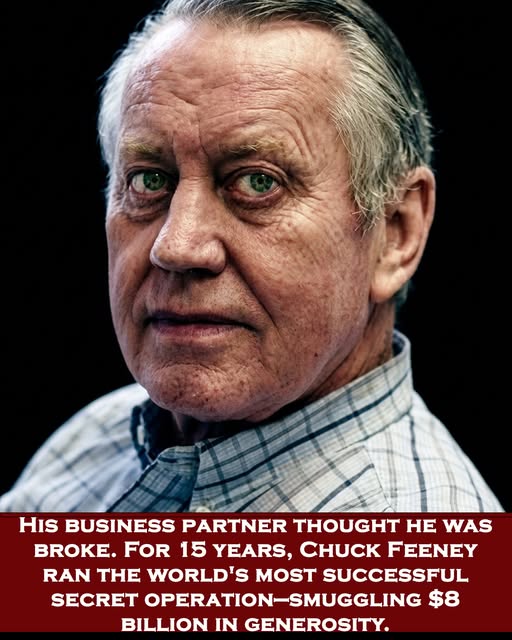
In the 1990s, if you flew first class from Hong Kong to New York, you might have walked past a rumpled man in coach.
Wrinkled shirt. Plastic watch. Papers stuffed in a grocery bag.
You wouldn’t have guessed he was worth billions.
You definitely wouldn’t have guessed he’d already given most of it away.
Chuck Feeney made his fortune selling what rich people wanted most: status without taxes.
In 1960, he and his Cornell buddy Robert Miller opened the first Duty Free Shoppers location in Honolulu.
The concept was simple: sell luxury goods in airports and ports where travelers didn’t have to pay import duties.
Whiskey. Perfume. Designer handbags. All tax-free.
When Japan lifted travel restrictions in 1966, everything changed overnight.
Millions of newly wealthy Japanese tourists wanted Western luxury goods. DFS was perfectly positioned.
Chuck learned Japanese. He hired translators. He made deals with every tour operator who’d listen.
By the 1980s, Duty Free Shoppers dominated global luxury retail.
Chuck Feeney was a billionaire several times over.
And nobody could figure out why he lived like he was broke.
His business partners started to worry.
Chuck wore the same ratty sweater with holes in it. He owned exactly one sports jacket—no tuxedo, ever.
When DFS executives traveled, they stayed in five-star hotels. Chuck stayed in budget motels.
They flew business class. Chuck flew coach—often on the cheapest ticket he could find, which sometimes meant three connections instead of one.
One colleague offered to upgrade him. Chuck refused.
“Why would I pay more for the same destination?”
He didn’t own a house. He rented. No car—he’d take taxis or the bus.
When he absolutely needed wheels, he’d rent the cheapest vehicle available. Usually a dinged-up Volvo.
His watch cost fifteen dollars. Plastic Casio from a drugstore.
Some partners thought he’d gone crazy. Others whispered he must have gambling debts or a secret family draining his accounts.
The truth was so much stranger.
In 1982, Chuck created something called The Atlantic Philanthropies.
It was registered in Bermuda. The paperwork was dense and deliberately obscure.
In 1984, he transferred his entire stake in DFS—worth over $500 million—into the foundation.
He kept less than $5 million for himself.
Then he started giving the money away.
Hospitals. Universities. Human rights organizations. Medical research.
Millions of dollars flowing out every month.
But here’s the twist: nobody knew where it was coming from.
Cornell University suddenly received massive anonymous donations. Administrators had no idea who their mystery benefactor was.
Universities in Ireland got similar windfalls. So did hospitals in South Africa. AIDS clinics. Research centers in Vietnam.
The recipients would ask: “Who’s funding this?”
Atlantic Philanthropies would respond: “We prefer not to say.”
Chuck had become a philanthropic ghost.
Why the secrecy?
Chuck had two reasons, both practical.
First: “Once people know you have money to give away, they never leave you alone.”
He’d seen it happen to other philanthropists. Every charity on earth sending proposals. Every fundraiser calling. Every gala demanding his attendance.
Chuck didn’t want to spend his life saying no.
Second: He believed anonymity kept the focus on the work, not the donor.
“It’s not about me,” he’d say. “It’s about what gets done.”
So Atlantic Philanthropies operated like a intelligence agency.
Grants went out through intermediaries. Contracts had confidentiality clauses. Even some of Chuck’s own children didn’t know the full extent of what he was doing.
His ex-wife found out during their divorce proceedings. She was stunned.
For 15 years, Chuck ran the largest private charitable operation in the world—and almost nobody knew his name.
The secret broke in 1996.
LVMH—the French luxury conglomerate—bought DFS for $1.63 billion cash.
The sale required public disclosure. Chuck’s name appeared in documents.
Reporters started connecting dots.
A New York Times business writer named Judith Miller began investigating.
Wait—this guy who dresses like a grad student owns half of Duty Free Shoppers?
And he gave it all away?
Fifteen years ago?
The article ran in January 1997, buried on page D4: “He Gave Away $600 Million, and No One Knew.”
Except the number was already wrong. Chuck had given away much more than $600 million.
He just hadn’t told anyone.
Once the secret was out, Chuck didn’t change much.
He still flew coach. Still wore the fifteen-dollar watch. Still carried papers in a plastic bag.
But now people understood.
He wasn’t crazy. He wasn’t broke.
He’d made a choice.
He’d decided that watching his money do good was better than watching his money sit in a bank.
Warren Buffett called him “my hero.”
Bill Gates studied his methods.
In 2011, when Buffett and Gates launched the Giving Pledge—asking billionaires to commit to giving away at least half their wealth—Chuck was one of the first to sign.
Except he’d already given away 99% of his fortune. Thirty years earlier.
“Chuck was showing us the way,” Buffett said, “long before we knew we needed a guide.”
Between 1982 and 2020, Chuck gave away $8 billion.
Let that sink in.
Eight. Billion. Dollars.
Almost a billion went to Cornell alone. The university renamed a street “Feeney Way” in his honor. President Frank Rhodes called him Cornell’s “third founder”—as significant as Ezra Cornell himself.
But Chuck’s giving wasn’t scattered. It was strategic.
He focused on four areas: aging, children and youth, public health, and human rights.
He funded campaigns to abolish the death penalty. He backed the grassroots effort to pass the Affordable Care Act.
He paid for AIDS treatment in South Africa when governments wouldn’t.
He built hospitals in Vietnam. He supported peace negotiations in Northern Ireland—his advocacy helped bring about the Good Friday Agreement that ended the Troubles.
He didn’t just write checks. He got involved. Pushed. Strategized.
“Giving isn’t passive,” he said. “You have to make things happen.”
By 2019, Chuck was 88 years old and in declining health.
The foundation had one mission left: spend every remaining dollar.
Not preserve it. Not create an endowment. Spend it all.
“Dead people don’t give money,” Chuck liked to say. “Live people do.”
On September 14, 2020, Chuck logged into a Zoom call from his tiny rented apartment in San Francisco.
His wife sat beside him. Foundation board members filled the screen.
Chuck signed the papers.
Atlantic Philanthropies officially had zero dollars left.
Mission accomplished.
“We learned a lot,” Chuck said. “We’d do some things differently. But I am very satisfied.”
He paused, smiled slightly.
“To those wondering about Giving While Living: Try it. You’ll like it.”
Chuck Feeney died on October 9, 2023, at age 92.
He died the way he’d lived for the past 40 years: with almost no money to his name.
His estate was modest. No mansion to divide among heirs. No vault of assets. No fortune to fight over.
Just the satisfaction of knowing that $8 billion had already done its work.
Built hospitals. Educated students. Protected rights. Saved lives.
Here’s what makes Chuck Feeney’s story different from every other billionaire story:
He didn’t wait until he was dead to give his money away.
He didn’t create a foundation that would spend 5% per year in perpetuity while the principal grew.
He didn’t put his name on buildings or demand gratitude.
He spent it all. Fast. While he could still see what it accomplished.
And he did it so quietly that for 15 years, the world’s business press thought he might be broke.
His business partner thought he was broke.
His own children didn’t know until they were adults.
For 15 years, Chuck Feeney ran the world’s most successful secret operation.
And the only thing he smuggled was generosity.
Eight billion dollars of it.
All gone.
All exactly where he wanted it to be.